Showing posts with label MPCV. Show all posts

Tuesday, January 14, 2014

Utilizing Space Shuttle Main Engines (SSME) for Early SLS Cargo Launches and Commercial Crew Destinations

Some of the SSME (RS-25D) in storage at the Kennedy Space Center (Credit NASA).
by Marcel F. Williams

NASA's future Space Launch System (SLS) won't be fully operational until it can utilize the new expendable RS-25E engines which probably won't be ready until the year 2021. However, NASA has 16 Space Shuttle Main Engines (SSME: RS-25D), previously used by the Space Shuttle stored away for use by the SLS. Since the SLS will utilize four engines per flight, the SSME could launch up to four SLS missions before the arrival of the expendable RS-25E engines. But the safety of astronauts launched on the SLS may depend on utilizing these engines on unmanned test missions.
 
2014


Simulated Video of Delta IV Heavy Launch of the CM of the MPCV
In 2014, NASA will use the ULA's Delta-IV heavy to test launch the Command Module (CM) of the future Multipurpose Crew Vehicle (MPCV),  placing it in low Earth orbit for reentry back on Earth. The  Service Module (SM) of the MPCV, however, will still be under development by the European Space Agency and won't be available to launch with the CM until   2017

2017
MPCV (Credit: NASA)
SLS/MPCV (Credit: NASA)


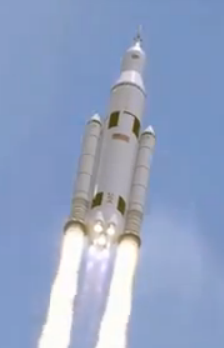
The SLS heavy lift vehicle will make its maiden launch in 2017 along with the complete version of the MPCV . This unmanned flight could be as simple as sending the MPCV to TLI (TransLunar Injection) or on more complex journeys to the Earth-Moon Lagrange points or to some other points of interest within cis-lunar space. 

After 2017, NASA has no SLS missions scheduled until 2021 when the first crewed missions of the SLS/MPCV are scheduled to begin and the new RS-25E engines are scheduled to be utilized. It would also mean that astronauts would be launched on top of the SLS after just one unmanned test flight! But  NASA would still have 12 SSME that could be utilized for cargo missions before 2021 that could further insure the safety of the SLS for manned spaceflight.

 During the Apollo era, there were two unmanned test flights of the Saturn V heavy lift vehicle before NASA finally took a chance and launched three American  astronauts into orbit around the Moon in December of  1968. The first unmanned test flight of the Saturn V in November of 1967-- was a complete success. However, there were some  problems with the second and third stages of the Saturn V during  the second unmanned test  in April of 1968

Of course, serious problems with the Apollo Command Module occurred  during a launch rehearsal test on  January 27th, 1967 which cost the lives of three American astronauts:  Virgil I. "Gus" Grissom (a former Mercury astronaut),  Edward H. White (the first American to walk in space), and  Roger B. Chaffee-- an astronaut who never got a chance to fly into space.

So as far as safety is concerned, I believe it would be prudent for NASA to launch the SLS more than just one time-- unmanned-- before actually placing living human beings on top of the new heavy lift vehicle. 
But that doesn't mean that such early SLS flights can't also be put to good use. Below is a proposal for two additional SLS flights before the first manned flight of the SLS/MPCV in 2021:


2019
CST-100 Commercial Crew Vehicle docked with the Olympus BA-2100 space station (Credit: Boeing)
Interior of the Olympus BA-2100 space station (Credit Bigelow Aerospace)

I propose that in 2019,  NASA should launch the Bigelow Aerospace company's Olympus BA-2100 space station to LEO for-- private commercial utilization. While Bigelow Aerospace would pay for the development of the BA-2100, under this scenario,  NASA would pay for the launch of the habitat in exchange for up to 60 days of annual exclusive use of the facility-- with the exception of Bigelow Aerospace maintenance personal aboard the space station. 

This would give Bigelow Aerospace the advantage of having a huge space station in orbit for exclusive  fee based Commercial Crew and foreign spacecraft  visitations at least 10 months out of the year.   Bigelow could still pay  private launch companys to deploy its smaller microgravity facilities (BA-300) nearby. This would allow small specialized microgravity labs to function without human interference while the human engineers and scientist took shelter at the larger Olympus space station until the experiments are completed and the results can be retrieved from the smaller facilities. Human access to the Olympus space station will, of course, depend on the availability of operational Commercial Crew spacecraft which should be available to NASA well before 2019.

2020
Skylab 2 (Credit: Brand Griffin)
Hypergravity Centrifuge (Credit: NASA)
 I also propose that in 2020, an orbital habitat derived from the SLS hydrogen  fuel tank, similar to the Skylab 2 proposal,  also  be deployed by the SLS to  LEO. Such a habitat could be equipped with a six meter in diameter internal hyper gravity centrifuge-- easily accommodated within the 8.4 meter interior diameter of the space station. This will enable NASA to see if one to two hours of hypergravity per day  can  significantly mitigate some of the deleterious effects of microgravity on the human body. The new NASA space station will also be supplied with enough water shielding to protect astronauts from major solar events while also  reducing their long term exposure to cosmic radiation. Again, NASA will need to utilize Commercial Crew services in order to access the SLS deployed NASA space station at LEO. In the 2020's, a similar SLS derived habitat will be placed at one of the Earth-Moon Lagrange points and could someday be used to house astronauts on interplanetary journeys.

So before the Space Launch System is fully operational in the early 2020s, the old Space Shuttle Main Engines could allow the SLS to deploy two enormous space stations: one privately owned  and one owned by NASA. Both stations could serve as places of refuge if one of the stations had to be abandoned in an emergency. And they could both serve  as  way stations for future reusable Orbital Transfer Vehicles headed towards the Earth-Moon Lagrange points or to Lunar orbit. A new generation of space stations would allow NASA to finally move beyond the ISS while focusing its efforts and finances on beyond LEO missions to the Moon and beyond.

Adding two additional unmanned SLS launches should help to enhance the launch vehicles safety and reliability before manned missions begin in 2021.  And, under this scenario, four SSME would still be available in case the  RS-25E engines are still not ready for manned SLS missions by 2021. 

Marcel F. Williams

 
Links and References:


Wednesday, January 1, 2014

An SLS Launched Cargo and Crew Lunar Transportation System Utilizing an ETLV Architecture

SLS launched ETLV-2 at EML1 liquid hydrogen and oxygen  fuel depot (ETLV derived) while the MPCV waits to dock with the now fully fueled lunar landing vehicle
by Marcel F. Williams

Before the end of the decade, the heavy lift capability that America once had during the Apollo  era-- will return in the form of the SLS.  Some, however, have argued that because of the former Space Shuttle's ability to deploy a 94 tonne aerospace plane plus up to 25 tonnes of useful cargo to LEO that , technically,  the Shuttle was also a  heavy lift vehicle. But even the earliest versions of the Space Launch System will be  far more capable than the Space Shuttle in their ability to lift huge payloads into orbit. Unmanned versions of the  SLS should be capable of deploying at least  70 tonnes of payload to LEO.  And with an SLS derived upperstage, as much as 105 tonnes of cargo could be lifted to orbit. Even when deploying the 22 tonne MPCV (Multipurpose Crew Vehicle), the SLS should still be capable of simultaneously  lifting an additional 45 to 80 tonnes of cargo to orbital space.

SLS crew launch and cargo launch vehicles; with an upper stage, the SLS would be capable of deploying nearly 39 tonnes of payload to Trans-Lunar Injection


Still there are those who argue that the SLS could  be deficient in its ability to deploy large crew landers and heavy cargo to the lunar surface-- relative to the now cancelled Ares V configurations. However, any deficiency in the lifting capability of the SLS could be easily compensated for by  deploying-- fuel depots-- at the Earth-Moon Lagrange Points, or in low Lunar orbit, or both. This might suggest to some NASA critics that the space agency would have to spend substantially more of its limited funds in order to finance still another expensive component for  its beyond LEO architecture-- in addition to funding the development of  lunar crew and cargo vehicles. 
___________________________________________

 Delta-V budgets & Destination Travel Times


LEO to TLI - 3.2 km/s dv

LEO to LLO (~2 days) - 4.5 km/s dv

LEO to LLO (~4 days) - 3.97 km/s dv

LEO to EML1 (~2 days) - 4.41 km/s dv

LEO to EML1 (~4 days) - 3.77 km/s dv

EML1 to or from LLO (~2 days) - 0.75 km/s dv

EML1 to or from  LLO (~3 days) - 0.64 km/s dv

LLO to or from the Lunar surface - 1.87 to 2.1 km/s dv

LEO: Low Earth Orbit; TLI: Trans-Lunar Injection; LLO: Low Lunar Orbit; 
EML1: Earth Moon Lagrange Point 1

(Credit John Connolly: NASA-JSC - 2012)
_________________________________________

However, if the next lunar landing vehicle developed for NASA is a-- single stage reusable spacecraft-- then a Lagrange point  fuel depot and a lunar surface fuel  depot  could both be derived from the reusable lunar lander.  Such a reusable single staged lunar vehicle-- would already be inherently designed to refuel and store cryogenic fuels with zero boil-off. So deriving the fuel depot directly from the tanks utilized for the lunar landing vehicle could significantly reduce development cost. Additionally,  the landing vehicle's reusability should also substantially  reduce its annual recurring cost for transporting humans to the lunar surface. 

In an earlier post, I described a reusable single staged lunar landing vehicle concept that  I called the ETLV-2 (Extraterrestrial Landing Vehicle 2). The vehicle would be designed to take  full advantage of a large  8.4 meter to 10 meter SLS payload fairing.  

The ETLV-2 would utilize four CECE engines but just two common bulkhead tanks; each tank would be capable of storing up to 14 tonnes of liquid oxygen and hydrogen fuel. The tanks would utilize a ULA type of Integrated Vehicle Fluid (IVF) technology plus NASA's breakthrough  cryocooler technology to eliminate fuel boil-off and the waste of ullage gases. Such technologies could substantially reduce tank insulation and the overall weight of the space vehicle. 
Basic components of the ETLV-2 lunar landing vehicle

The four RL-10 derived CECE (Common Extensible Cryogenic Engine) engines should enhance vehicle safety with engine out capability and reusability with up to 50 restarts capability. 

Vehicle development cost are further reduced in this concept by deriving the crew habitat module and airlocks from the light weight cryotanks. The pressurized crew hab should be tall enough to accommodate a crew
of at least seven individuals, pressure suits, and small cargo on three floor levels. Such a large crew capacity would  make the ETLV-2 potentially compatible with Commercial Crew launched vehicles since such privately operated vehicles should be capable of transporting as many as seven individuals  to Earth orbit per flight. The ETLV-2 would, of course,  also be capable accommodating the maximum crew of six aboard the MPCV.    

The twin airlocks of the ETLV-2 would be utilized for giving humans access to the lunar surface through one airlock  while the second airlock will allow small mobile robots and mobile vehicles access to the lunar surface on the opposite side of the vehicle.  As an unmanned vehicle, the ETLV-2 could potentially be utilized for robotic sample retrieval missions to the lunar surface and possibly to the surfaces of the moons of Mars. In both cases, the regolith samples retrieved from deployed mobile robots would be returned to the Earth-Moon Lagrange points where a MPCV would dock with the unmanned ETLV-2 to pick up the samples for their journey to the Earth.  

Fully fueled, the ETLV-2 should still weigh less than 38 tonnes and could, therefore, be deployed to TLI by the SLS upper stage


ETLV-2 lunar landing vehicle: front, corners, & top views

While the ETLV-2 lunar lander would use only two long fuel tanks for its crewed missions to the lunar surface, the EML1 fuel depot concept proposed here would utilize five of the  ETLV-2 tanks within a taller cruciform. The EML1 fuel depot could potentially store more than 60 tonnes of cryogenic fuels.  The L1 fuel depot envisioned here would also be capable of perpetually storing up to 100 tonnes of water and be capable of converting the water into liquid hydrogen and oxygen through solar powered electroysis and cryocooler technology. The space fuel depot would also be capable of self deploying itself practically anywhere within cis-lunar space and even into orbit around Mars and Venus.

A single SLS launch would initially be required to deploy the fuel depot  to EML1 with as much as 20 tonnes of cryogenic fuel. Since the ETLV-2 crew lander  would only require a few extra tonnes of additional fuel when it arrived at L1, 20 tonnes should be enough fuel for perhaps three round trips from L1 to the lunar surface-- if new mostly fueled ETLV-2 vehicle arrives at L1 each time from Earth.   However,  MPCV launches by the SLS to EML1 should be capable of carrying several tonnes of additional cargo. So several tonnes of water cargo could be stored aboard the SLS upper stage along with the MPCV. So any extraction of fuel from the EML1 depot for crewed ETLV-2 lunar missions could be replaced  by water deliveries tagging along with the MPCV flights
 An  ETLV derived cargo lander (C-ETLV-4) would be used to deliver up to ten tonnes of payload to the lunar surface. The C-ETLV-4 would be primarily used for deploying the heavy machinery, ground vehicles, and crew habitats necessary to establish a permanently peopled  water and fuel producing and exporting Lunar outpost-- similar to that envisioned by Dr. Spudis and Lovoie in their most recent papers. 


C-ETLV-4 Cargo Lunar Lander: front, top, and interior position of fuel tanks
Since I envision NASA having at least two operational SLS launch pads by the early 2020s-- a two launch scenario-- would be utilized for early manned missions to the lunar surface. Such a launch infrastructure could also allow at least four heavy lift launches per year for both cargo and crew missions. 

NASA's first manned lunar mission utilizing the SLS  could send the ETLV-2 to TLI (Trans-Lunar Injection) where the remotely controlled unmanned crew lander will separate from the SLS upper stage and utilize some of its fuel to reach EML1. The ETLV-2 will then dock with the previously SLS deployed  EML1 fuel depot in order to add the additional required fuel for its round trip journey to the lunar surface and back to L1.

A second SLS launch, probably a few days later,  would send the MPCV plus a few tonnes of water  to EML1. The MPCV will dock with the fully fueled ETLV-2 and the crew (up to 6 people) will transfer to the lunar lander for their  journey to the Lunar surface and then, eventually, back to L1 after their lunar mission is over. The EML1 fuel depot will dock with the water tank, stored at the top of  the SLS upper stage, and pump the water into the fuel depot water compartment where it will eventually be converted into liquid hydrogen and oxygen.

On their return trip to EML1, the crew will transfer back to the MPCV for their return to Earth.  Under this scenario,
the deployed ETLV-2 would remain at L1  until the EML1 fuel depot is finally being supplied with water from the lunar surface for the manufacture of extraterrestrial fuel. This will allow a small fleet of reusable lunar landers to be deployed at EML1 by the SLS over just a few years for future use for manned lunar missions. Once an ETLV-2 vehicle is reactivated, it will refuel at L1 and then travel-- unmanned back to the lunar surface--  to ensure that the reusable vehicle is fully functional for human use again.  The ETLV-2's CECE engines could be utilized for at least ten round trips before they would be required to be replaced-- or the landing vehicle retired.

I should note that the two launch scenario can also be utilized-- even if their is only one launch pad for the SLS (delaying the next launch from the pad for a few months)-- since the ETLV-2 would be equiped with cryocoolers capable of re-liquifying ullage gasses from is fuel tanks, providing zero boil-off of fuel for several months or even several years. However, limiting the SLS  to just two launches per year would substantially slow down  progress towards establishing  manned outpost on the lunar surface and eventually on the surface of Mars. But there's really no logical reason to limit heavy lift launches to just two a year since NASA was able to launch as many as-- four heavy lift vehicles per year-- during the Apollo era and as many as nine Space Shuttle missions per year during the peak of the Shuttle era


Once the fleet of ETLV-2 landing vehicles are utilizing lunar fuel resources for their operation and lunar water is being exported to the EML1 fuel depot from ETLV derived lunar tankers, NASA should then be able to incorporate the use of Commercial Crew vehicles as a cheaper component for sending astronauts to the Lunar surface. Reusable, ETLV-2 derived reusable Orbital Transfer Vehicles (OTVs) equipped  with delta-v reducing aerobrakers should allow NASA to travel between LEO and EML1 a lot more cheaply. NASA astronauts and possibly even space tourist could then travel to the Moon by first taking  a Commercial Crew vehicle to LEO where they would dock with an ETLV-2 derived OTV that utilizes lunar fuel stored at EML1 and possibly also at LEO. Once at EML1, the ETLV-2 would take the passengers down to the lunar surface.

So under this proposed scenario, the SLS and the MPCV could be used to set up a reusable  transportation infrastructure that could eventually give passengers aboard private Commercial Crew launch vehicles affordable and convenient access to the surface of the Moon-- just a few years after the SLS/MPCV/ETLV program begins.  


Further details about the ETLV components that will give Commercial Crew passengers access to the lunar surface will be discussed  in more detail  in future post.


 Marcel F. Williams
© 2013 MuOmega Enterprises

Wednesday, September 14, 2011

Tuesday, July 12, 2011

Deriving Economically Sustainable Crew Launch Vehicles from the SLS

by Marcel F. Williams

With the end of the Space Shuttle era
, there has been much focus on the emerging commercial crew industry in America with the hope that these vehicles will be ready to transport humans into orbit by the middle of the decade. However, by law, NASA's new SLS (Space Launch System) must also be capable of launching humans into orbit and beyond while also serving as a backup system for delivering crew and cargo to the ISS if such missions cannot be met by the private commercial crew companies.

It has generally been assumed that the crew launch vehicle derived from a shuttle space launch system (SLS) will simply be composed of an inline LOX/LH2 rocket coupled with two 4-segment or 5-segment solid rocket boosters (SRBs). Such a system would be capable of carrying a 20 tonne Orion-MPCV (Multi-Purpose Crew Vehicle) to LEO plus perhaps an additional 40 to 50 tonnes of payload to orbit.

However, without an upper stage (US), such a crew launch vehicle would have very limited beyond LEO capabilities.

But with an upper stage, a crewed SLS should be capable of transporting the 20 tonne Orion plus an additional 10 to 20 tonnes of payload practically anywhere within cis-lunar space (the Lagrange points: L1, L2, L4, and L5 and lunar orbit). And as an unmanned vehicle, the SLS could eventually evolve into a system that could carry as much as 200 tonnes to LEO and 80 tonnes to L1 if it utilized up to four 5-segment SRBs plus and upper stage.

Right: crew launch vehicle with two 4-segment SRBs capable of transporting the Orion-MPCV to LEO ; left: crew launch vehicle with two 4-segment SRBs plus and upper stage (US) capable of transporting the Orion-MPCV anywhere within cis-lunar space

However, as a crew launch system could be much simpler, safer, and cheaper to operate if the SLS was launched without the SRBs. The only fatal crew launch accident ever to occur during the Space Shuttle era was due to a malfunction in the SRBs O-ring that allowed how gases and plumes to critically damage the adjacent cryogenically fueled external tank; the subsequent explosion destroyed the vessel and killed the crew. So in a new launch system, crew safety has to be a priority.


Shuttle derived LOX/LH2 core vehicle capable of launching a 20 tonne Orion-MPCV with a stretched SM with 8 to 9 tonnes of extra hypergolic fuel to LEO

A stretched shuttle derived LOX/LH2 without SRBs could send the Orion capsule to LEO by simply using the hypergolic fueled Service Module (SM) as an upper stage. An additional 8 to 9 tonnes of hypergolic fuel in a stretched SM with could transport 20 tonnes to LEO. Boeing Inc. has already conceived such a SLS derived crew launch vehicle without the SRBs.

Left: Cis-lunar crew launch vehicle, center: HLV cargo vehicle using two 4-segment SRBs, right: HLV cargo vehicle using three LOX/LH2 core vehicles

However, a stretched shuttle derived core vehicle with a large upper stage-- but still without SRBs-- could transport the 20 tonne Orion MPCV anywhere within cis-lunar space. If the upper stage is equipped with multiple RL-10 engines then the crew launch vehicle would have uber-safe engine-out capability in both first and second stages. This would allow NASA conduct simpler and safer manned cis-lunar missions to L1, L2, L4, L5, and lunar orbit almost immediately after the SLS becomes operational in 2016. And NASA is required by law to define near term manned missions for the SLS within cis-lunar space.

Orion-MPCV on cis-lunar mission to lunar orbit

Coupled with SRBs, the SLS would be the only vehicle capable of deploying the largest 65 tonne plus Bigelow space stations (BA-2100) to LEO or sending the smaller 25 tonne water shielded Bigelow space stations (BA 330) to the Lagrange points. While such Lagrange point space stations would still have too little shielding to provide astronauts with adequate protection against galactic radiation and especially potentially brain damaging heavy nuclei beyond a few weeks time, such stations would still contain enough water shielding to protect astronauts from the dangers of a major solar event.

As an orbital crew launch vehicle, the two stage LOX/LH2 vehicle might be capable of transporting the 20 tonne Orion plus 30 to 40 tonnes of payload to LEO. While this might seem like overkill, it should be remembered that transporting humans to an orbital space station requires more than just transporting the human body. Every human requires nearly one tonne of water, oxygen, and food per month in order to survive in space.

Once Americans return to the Moon again (which should still be NASA's priority, IMO), it has been suggested that a reusable LOX/LH2 lunar lander be developed that utilizes fuel mined from the lunar poles. Such a lunar transportation system would be able to transport humans and cargo from the lunar surface to L1 and back. This would greatly simplify and reduce the cost of sending humans to and from the lunar surface. And such a simpler and safer SLS combined with a reusable lunar shuttle might be very attractive to private commercial spaceflight companies seeking to expand the emerging space tourism industry all the way to the lunar surface.

References

1. Heavy Lift Launch Vehicles with Existing Propulsion Systems

2. NASA’s Space Launch System - an All-Liquid Alternative

3. The NASA Authorization Act of 2010

4. Multi-Purpose Crew Vehicle

5. Orion Spacecraft

6. BA 330

7. Mission and Implementation of an Affordable Lunar Return

8. Conquering Cis-Lunar Space with Shuttle and ULA Derived Technologies

9. Boeing's New HLV Concept could be the DC-3 of Manned Rocket Boosters


Blog Archive

CINEMA FANTASTIC

Popular Posts