Showing posts with label Ocean Nuclear power plants. Show all posts

Wednesday, January 10, 2024

Ocean Nuclear Production of Green Methanol in Remote Japanese Territorial Waters

The red circle shows the position of the Japanese island of Minami-Tori-shima.
 by Marcel F. Williams
 
The United States, United Kingdom, and France could all use floating nuclear power plants to produce carbon neutral synthetic fuels, fertilizers, and industrial chemicals in remote  EEZ (Exclusive Economic Zone) territorial waters-- that are devoid of significant cyclone activity. 
 
Japan also has a  EEZ territorial waters surrounding the remote island of Minami-Tori-shima. However, the more than 428 thousand square kilometers of territorial waters surrounding the uninhabited island is still positioned in an area where it periodically experiences cyclonic activity  from July to October. And cyclonic activity might limit a Japanese floating nuclear synplex located near Minami-Tori-shima to just 8 months of  annual production. 
 

Japanese EEZ territorial waters

 
The island of Minami-Tori-shima
 
However,  the Japanese nuclear synplex of ships and barges could be temporarily moved south of the equator  during the cyclone season. This might enable synfuel,  fertilizer and industrial chemical production to continue within the international waters of the high seas. And this could potentially allow a Japanese floating nuclear synplex to operate up to 11 months rather than just 8.
 
Cyclone and tropical storm frequency in areas of the western Pacific

 
Through submarine cables, floating nuclear power plants could supply electricity to floating facilities just five to ten kilometers away. There floating ships or barges could use electricity to produce hydrogen from distilled seawater and extract CO2 directly from the atmosphere. The synthesis of hydrogen and CO2 could produce methanol. 
 
Most methanol today is used for the production of plastics and other polymers. But methanol can also be used to power ships, retrofitted natural gas electric power plants, fuel cell automobiles. Methanol can also be converted into jet fuel, gasoline, and into dimethyl ether (a diesel fuel substitute). 
 
 
 Methanol can also be used in fuel cells to power homes, vehicles, and large power plants. Methanol is also a more convenient way of storing hydrogen. 
 
Alternatively both hydrogen and CO2 could be extracted directly from seawater. 
 
Cheaper sources of CO2 could be imported  from coastal methanol power plants using green methanol. The CO2 from such facilities could be cryogenically captured from flu gases and exported to the nuclear symplex by methanol powered tanker ships. 
 
Floating biowaste incineration plants could also produce CO2 plus additional electricity for hydrogen production. Biochar would also be produced from such floating facilities and could be exported by ships as soil enhancing additive that increased water retention. Recent reports in California indicate the biochar can reduce water demand on crop raising farms by as much as 37%.

Ammonia for fertilizer can also be produced at sea the synthesis of hydrogen with nitrogen. Nitrogen is the most abundant gas in the Earth's atmosphere and can be extracted directly from the atmosphere.  
 
 The EEZ territorial waters surrounding the Japanese island of Minami-Tori-shima can be more than 2200 kilometers away from Tokyo.  Methanol could be transported by tanker ships from the nuclear synplex to  coastal towns and cities all  over Japan and also to coastal towns and cities around the world. Methanol carrying tankers are already in existence. And a growing number of methanol powered sea vessels are already in operation around the world. 
 
Electricity in Japan could be produce from methanol electric power plants. Solar power plants could compliment such facilities by significantly reducing  methanol fuel demand  during daytime hours without the need for expensive battery storage.  
 
Notional floating nuclear power facility
 
To enhance both security and efficiency, floating nuclear power plants could be deployed along a circular arc, supplying electricity through submarine cables  to an outer circle of synfuel, fertilizer, and industrial chemical producing barges and ships five to ten kilometers away. Along the nuplex arc, a one GWe floating power plant could be deployed per every 100 meters along the arc. So potentially up to 1.25 terawatts (1.25 TWe) of power could be deployed along the arc. Japan currently has an installed electrical capacity of less than 350 GWe.
 
 
60 kilometer in diameter nuclear synplex area allowing as much as 1.2 TWe of electric power to be produced
 
 
An inner ringed zone could be used for the passive underwater extraction of  uranium from seawater. This area could also be used to deploy floating nuclear processing plants for converting uranium from seawater into enriched uranium fuel and for storing and reprocessing spent fuel from floating nuclear power plants.
 
Nuclear power plant workers could be housed in cruise ships anchored inside of the innermost ringed zone. Floating synplex workers could be housed in cruise ships anchored outside of the outermost ringed synplex zone.
 
 
Cruise ships could accommodate hundreds of thousands of floating nuclear and synplex workers and their families in remote EEZ territorial waters and on the high seas.
 
 
Security for the circular nuplex and the surrounding synplex could be provided by the Japanese Coast Guard. So pirates and potential terrorist would have to evade the Japanese Coast Guard within the outer synplex zone and then encounter even more Coast Guard forces in the inner nuplex zone. Of course, since the facility is more than 2000 kilometers away from Japan, there would really be no one to terrorize.


Links and References 
 

The Future of Ocean Nuclear Synfuel Production


Saturday, May 25, 2019

Uranium from Seawater as an Unlimited Source of Renewable Energy

Ocean view under golden skies (Credit Simeon Muller)
Approximately 4% of the energy currently consumed by human civilization is provided by commercial nuclear power.  Less than 28 tonnes of slightly enriched uranium is required to fuel a one gigawatt (1000 MWe) nuclear reactor  per annum. But only 0.72% of natural uranium is comprised of the fissile uranium 235 needed to initiate nuclear fission. So fertile uranium 238 has to be enriched with uranium 235, up to 3 to 5%,  in order to be utilized for power production in light water reactors.  Up to 226 tonnes of uranium oxide would have to be mined in order to be processed into  196 tonnes of metallic uranium that would later be enriched into just 28 tonnes of useful nuclear fuel. So approximately 75,000 tonnes of uranium oxide is mined annually to provide just 4% of the world's total energy needs.
The amount of recoverable-- terrestrial uranium-- on the Earth's surface depends on the price. At $40 per kilogram ($US),  646,900 tonnes are deemed to be recoverable. At $260, more than  7,641,600 tonnes is estimated to be recoverable.  So at the current rate of use, terrestrial uranium supplies would only last about a century.

The reprocessing of spent fuel (fissile uranium and plutonium) from commercial nuclear reactors could slash uranium demand in half, providing more than two centuries of uranium supply at current levels of use. However, using terrestrial uranium and spent fuel recycling  to provide all of the world's energy needs with current light water reactor. So the current generation of nuclear reactors could not utilize-- terrestrial uranium-- to completely supplant the environmentally harmful fossil fuel economy that is causing global warming and global sea rise.


Countries with the largest terrestrial uranium reserves

Countries with the largest uranium reserves by metric ton (tonnes)

Australia----------------------1,780,800    
 Kazakhstan--------------------941,600    
 Canada-------------------------703,600    
 Namibia------------------------463,000       
 South Africa-------------------449,300    
 Niger----------------------------411,300    
 Russia--------------------------395,200    
 Brazil---------------------------276,800    
 China---------------------------272,500      
 Greenland---------------------228,000    
 Ukraine------------------------220,700      
 Mongolia-----------------------141,500    
 India----------------------------138,700      
 United States------------------138,200      
 Uzbekistan---------------------130,100    
 Czech Republic----------------119,300    

Source: Wikepedia

However, the next generation of  Fast Neutron Reactors could produce 30 to 60 times as much energy as current commercial nuclear reactors. And at current rates of global energy use, that could allow terrestrial uranium to power human civilization on Earth for more than 600 years. Fast Neutron Reactors could also use thorium in combination with uranium to power human civilization for more than a thousand years.  

But while affordable terrestrial sources of  uranium are less than ten million tonnes, the world's oceans contain more than 4 billion tonnes of uranium-- naturally dissolved within seawater. Utilized in  Fast Neutron Reactors, that would be enough nuclear fuel to power human civilization for more than 300,000 years. And marine uranium would still be able to power the current generation of nuclear reactors, with spent fuel recycling, for about 10,000 years.

However, uranium from seawater is also an intrinsically renewable source of energy. The world's oceans naturally contain uranium dissolved at a concentration of about 3 parts per billion. But the amount of uranium content within marine waters is controlled by a  steady state chemical interaction  between water and rocks on land and in the ocean. So no mater how much uranium is extracted from the ocean, the uranium concentration in seawater remains the same because of its continuous  interaction with the Earth's crust that contain approximately 100 trillion tonnes of uranium. That's a 7.5 billion year energy supply if   Fast Neutron Reactors are utilized or a mere 250 million year supply of fuel to power all of human civilization  using current commercial nuclear power technology and reprocessing.

Of course, in about a billion years, the ever increasing temperature of the sun will cause the oceans to boil. This will make the Earth-- uninhabitable-- long before the sun turns into a red giant.  So, basically,  there's  more than enough renewable marine uranium to power all of human civilization on Earth until the end of life on Earth!

Acrylic fiber test material for uranium extraction from seawater (Credit: Pacific Northwest National Laboratory and LCW Supercritical Technologies)

US marine territorial exclusive economic zones (Credit: NOAA)

Pacific Northwest National Laboratory and LCW Supercritical Technologies have recently had a major breakthrough in their uranium extraction from seawater research. They've managed to extract five grams of yellowcake from seawater by using acrylic fibers. The inexpensive yarn they've developed is both durable and reusable with an innate ability to selectively absorb uranium from seawater. And the material also appears to perform much better in warmer water where the extraction rate could be three to five times higher than in cold water. This could make the extraction of uranium from warm marine waters compatible with Ocean Nuclear Power production in remote tropical waters. Researchers at the Pacific Northwest National Laboratory believe that the acrylic material that they've developed could be ready to be a manufactured on a commercial scale in about 10 years. 


Links and References

Seawater yields first grams of yellowcake

Uranium from the sea: Sequim lab links yarn and seawater to expand energy options

Uranium Seawater Extraction Makes Nuclear Power Completely Renewable

Uranium Markets

Nuclear Energy Factsheet

How Much Fuel Does It Take To Power The World?

Processing of Used Nuclear Fuel

Rapid Advancements for Fast Nuclear Reactors

Deploying Ocean Nuclear Energy Flotillas into International Waters for the Carbon Neutral Production of Synthetic Fuels, Industrial Chemicals, and Fertilizers

Siting Ocean Nuclear Power Plants in Remote US Territorial Waters for the Carbon Neutral Production of Synfuels and Industrial Chemicals

The Case for Remotely Sited Underwater Nuclear Reactors

Will Russia and China Dominate Ocean Nuclear Technology?

The Future of Ocean Nuclear Synfuel Production

Wednesday, February 13, 2019

Deploying Ocean Nuclear Energy Flotillas into International Waters for the Carbon Neutral Production of Synthetic Fuels, Industrial Chemicals, and Fertilizers

Artist’s rendition of the Russian floating nuclear power plant “Akademik Lomonosov” (Credit: SevMashZevod)

by Marcel F. Williams

Floating Nuclear Reactors

Floating nuclear reactors in the form of nuclear submarines,  aircraft carriers, and nuclear icebreakers have been in existence since 1953. And more than 12,000 reactor years of marine operations has been accumulated since the 1950s.  Also, two American and seven former Soviet Union nuclear submarines have sunk into the ocean-- with their nuclear material-- because of accidents or extensive damage.  So nuclear reactors are no strangers to the Earth's marine environment since the 1950s. Currently,  more than 180 small reactors power more than 140 sea vessels in the Earth's oceans.

In 1968, the US military deployed the first floating nuclear power reactor, the Sturgis (MH-1A). Supplying 10 megawatts of electric power to the Panama Canal Zone, the Sturgis operated without incident for over eight years until it reached the end of its service.

Now, Russia has deployed its first floating nuclear power reactor. Recognizing the advantages of floating nuclear power plants, Russia plans to replace nuclear reactors located on land with the new floating reactors.

China also has plans to develop and deploy 20 floating nuclear power plants of its own, the first destined for the South China seas.  

Since water is what keeps nuclear material from melting down in light water nuclear reactors, floating nuclear reactors deployed to the oceans virtually infinite heat sink are viewed as inherently safe.   Environmental organizations such as Greenpeace, however,  suggest that a tsunami could push a coastal floating nuclear reactor on land where the reactors fuel could be damaged and allowed to melt down-- poisoning the local environment with radioactive material. Such a scenario, of course,  couldn't possibly occur for floating  nuclear reactors that are-- remotely sited-- in ocean territories hundreds or even thousands of kilometers away from coastlines.

International Waters

Stationary underwater nuclear reactors would be beneficial to Nations that possess extensive   Exclusive Economic Zones (EEZ) in remote territorial waters, could take advantage of stationary underwater nuclear reactors.  Such remote regions in the world's oceans  could utilize nuclear electricity for the production of carbon neutral synthetic fuels, industrial chemicals, and fertilizers that could be shipped by tankers around the world.

Dark blue areas represent EEZ territories; light blue represents international waters (Credit: Wikipedia)

In international waters, nations that don't possess remote territorial waters could still produce carbon neutral synthetic fuels, industrial chemicals and fertilizers-- on the high seas.    But this would require mobile fleets  of floating nuclear reactors and synfuel producing barges.  Since no nation can legally claim a particular area of-- international waters-- a nuclear synplex flotilla could only occupy an area  within  international waters-- on a temporary basis.

Under this scenario, floating nuclear synplexes would produce hydrocarbon commodities in a particular area of international waters for three to six months before moving a few hundred kilometers away to another region of international waters.  Such fuel producing flotillas would also have the advantage of being able to quickly redeploy to another region of the ocean in order to avoid   hurricanes and typhoons. Tug boats would be used to deploy and to redeploy the barges within international waters.

 Nuclear flotillas could  be accompanied by floating plasma pyrolysis plants and electrolysis plants for converting urban and rural hydrocarbon waste into methanol, gasoline, diesel fuel, dimethyl ether, and jet fuel.

Housing for nuplex and synplex workers could be accommodated aboard cruise ships perhaps modified to use methanol or methanol fuel cells.   

The colored areas  are regions where cyclones and hurricanes are most frequently created in the world's oceans (Credit: National Oceanic and Atmospheric Administration)

Using the new generation of passively safe small nuclear reactors such as the NuScale type of units,  a floating nuclear barge could consist of twelve 60 megawatt reactors producing 720 megawatts of total electricity. Eight floating nuclear barges could, therefore, produce about 5.7 gigawatts of electricity.

Tug boats could transport garbage barges from a coastal town or city to a floating garbage processing barge equipped with cranes  that would separate metals from biowaste and plastics. Afterwards the waste processing barge would use its  cranes to deploy biowaste and plastics to the plasma arc pyrolyis plant where the garbage would be converted into syngas (mainly carbon monoxide and hydrogen). Additional hydrogen would be added to the process by adding hydrogen derived from the electrolysis of distilled water. A catalyst would be used to convert the syngas into methanol.

Production of methanol from hydrocarbon waste

To enhance safety, the  electric powered synfuel barges could be deployed about five kilometers (3 miles) away from the floating nuclear reactors. At $150 per meter, a five kilometer submarine cable connecting the barge to the floating nuclear power plant should cost less than $800,000.

Methanol could be shipped by  tankers to coastal towns and cities to be utilized in natural gas electric power plants cheaply modified to use methanol.  Methanol electric power stations would  actually produce electricity more efficiently than natural gas. It would also be much safer to ship  methanol to coastal towns and cities than liquid natural gas.

Japanese Methanol Tanker (Credit: SHIN KURUSHIMA DOCKYARD CO)

The imported methanol could also be converted into dimethyl ether (a diesel fuel substitute) or be used to make biodiesel. Methanol can also be converted into high octane gasoline that can replace or be easily blended with gasoline derived from petroleum.

Even more methanol can be produced  if the CO2 from the flu gases of  methanol electric power plants is captured and transported by tanker back to the floating nuclear synplex.

Ammonia and urea could also be produced by remote floating nuclear synplexes, allowing fertilizer to be supplied by tankers to the coastlines of islands and countries around the world.

The abundant oxygen produced from the electrolysis of water by the accompanying synplexes could be utilized  for the manufacturing and processing of steel from iron ore.

Coast Guard Cutter (Credit: Wikipedia)

Protection from Pirates and Terrorist 

Floating nuclear power plants and synplexes would still have to be accompanied by at least some naval defense presence in order to protect against being taken over or damaged by pirates or potential terrorist on the high seas. The added expense of naval security  would probably favor large Ocean Nuclear  flotillas capable of generating at least 3000 megawatts  of electricity for the accompanying synplex flotillas. The largest land based nuclear power facilities have electric capacities of nearly 8000 megawatts. The largest land based nuclear power facility in the US (Palo Verde) is capable of generating 3300 megawatts of electricity.

If Coast Guard protection of a nuclear flotilla in international waters cost $100 to $200 million a year, it could cost $10 to $20 billion a year to protect 570 gigawatts of electric power and associated synfuel, fertilizer,  and industrial chemical production in international waters.   However, if such flotillas were congregated in just a few remote US EEZ areas, the cost of Coast Guard protection could be substantially reduced. And it  should be noted that the US military currently spends about--$81 billion a year-- protecting greenhouse gas polluting global oil supplies on the world's oceans. So protecting Ocean Nuclear synfuel production could be a lot cheaper than protecting oil supplies. 

Utilization within and beyond the EEZ by the US and other Nations

Coastal nations that lack remote EEZ areas such as  Singapore, South Korea, Israel, Thailand, Turkey, Ukraine, Syria, Egypt, Eritrea, etc. could utilize floating nuclear synplexes in remote international waters  to export their garbage and sewage for the production of synfuels, fertilizers, and industrial chemicals through floating nuclear synplexes without the political and environmental complications of having nearby nuclear facilities.

The United States could also use floating nuclear synplexes within its remote EEZ areas without the need of frequent redeployment until they've developed underwater nuclear facilities for their remote EEZ areas.  The US Navy would could especially benefit from the production of jet fuel from floating nuclear synplexes in the Wake Island EEZ.  This could allow US nuclear aircraft carriers attempting to counter the growing power of China and Russia in the Pacific to be supplied with jet fuel at the Wake Island EEZ-- in a region near the areas of global tension.

 
Links and References

Nuclear Powered Ships

Catalytic conversion of synthesis gas to methanol and other oxygenated products

 MH-1A

Both reactors on Rosatom’s floating nuclear plant now operational

US spends $81 billion a year to protect global oil supplies, report estimates

NuScale Power

The Future of Ocean Nuclear Synfuel Production

Siting Ocean Nuclear Power Plants in Remote US Territorial Waters for the Carbon Neutral Production of Synfuels and Industrial Chemicals

Will Russia and China Dominate Ocean Nuclear Technology?

The Case for Remotely Sited Underwater Nuclear Reactors

Methanol as a Marine Fuel


Monday, March 26, 2018

The Case for Remotely Sited Underwater Nuclear Reactors

FlexBlue subsea nuclear reactor being deployed by vessel (Credit: DCNS)
by Marcel F. Williams

Within the Exclusive Economic Zones (EEZ) of remote US island territorial waters, centrally  mass produced subsea commercial nuclear reactors could be safely deployed and utilized to provide all of America's energy and industrial chemical needs.   In fact,  remote US territorial waters alone, could provide the American continent  and the rest of  the world with all of the  electricity,  transportation fuel, industrial chemicals, and fertilizers needed to sustain human civilization.

United States Exclusive Economic Zones (Credit: NOAA)

Anchored and moored above the seabed, approximately 100 meters below the water's surface, subsea nuclear power plants would be safe from damage from extreme temperatures,  hurricanes, earthquakes, and tsunamis, plane crashes and ship collisions.  And even if a subsea reactor is seriously damaged, no electricity is need for the reactor to passively shut down since it allows the natural cooling ability of the ocean to keep its fuel from melting.

Notional FlexBlue reactor farm at the bottom of a sea bed (Credit: DCNS) 
Under this scenario,  subsea nuclear reactors, similar to the 250 MWe FlexBlue reactors proposed by France, could be clustered in groups of eight (2000 MWe) and under the control of a floating Control Center barge. Up to eight such nuclear complexes (nuplexes) would be placed along a circle four kilometers in diameter, producing as much as 16 GW of electric power.  Power plant employees living alone would be comfortably housed at one of two cruise ships positioned at the center of the surrounding circle of nuplexes (nearly two kilometers away) when they're not working. 


Floating Control Center connected to subsea nuclear reactors floating above the seabed.


Five to ten kilometers distant from the nuplexes, a variety of floating barges designed to produce carbon neutral synthetic fuels, industrial chemicals, and fertilizers would be deployed to utilize the nuclear electricity provided through submarine cables. Synplex and nuplex workers and their families could be housed in cruise ships positioned at least ten to twenty kilometers away from the nuclear synplex zones.

Ocean Nuclear Zone and surrounding Synplex Zone
While the subsea reactor wouldn't be vulnerable during a hurricane, the Control Center barge floating on the surface above could disconnect from the under water reactors and easily towed to a safe region until the tropical storm has passed. That could also apply to the floating assets within the synplex zones, returning to reconnect with the nuclear grid once the hurricane has passed. Once a hurricane has formed, it can be tracked and scientists can usually predict its path 3 to 4 days in advance.

The security of the nuplex zone would be provided by the US Coast Guard, under this scenario, put payed for by the private nuplex company or companies. Security for the surrounding synplex zone would be provided by private security companies paid for by the synplex companies.

So any attempt at terrorism against a subsea reactor would require terrorist to pass through a privately protected synplex zone five kilometers wide and then pass through an inner Coast Guard protected area that's an additional five kilometers wide-- areas where ships not related to the synplexes or nuplexes would be forbidden to enter.  And if a subsea reactor somehow became extensively damaged, it would still be surrounded by the virtually infinite heat  sink of the ocean which would make the meltdown of its nuclear fuel-- impossible. 
Island EEZ with designated areas for seasteading and nuclear synplex zones

If such nuclear synplexes were confined to a quarter of the EEZ  area at least 100 kilometers  away from a natural island or atoll, less than half of the nuclear synplex zone could produce more than 1.7 Terrawatts of electricity.  So the synplex zones within the EEZ areas of just three different remote US island territories could, in theory,  provide all of America's energy and industrial chemical needs. But such nuclear synplex zones could be deployed in the remote  EZZ areas of: Wake Island, the Midway Islands, the Northern Mariana Islands, the Palmyra Atoll, the Johnston Atoll, Jarvis Island, and the Howland and Baker Islands. The vast and remote Aleutian Island chain would also be an excellent location for nuclear synplex zones.

The opposite quarter of the island's  EEZ would be for a aquaculture and seasteading (inhabited artificial islands). While no one has ever been killed or even harmed from radiation from commercial nuclear power plants within the US, more than 116 million people on the continental US live within 80 kilometers of a commercial nuclear power plant.  So the closest seasteaders under this scenario would be more than 200 kilometers away from ocean synplexes and  nuplexes  that would already be substantially safer than terrestrial commercial nuclear power plants that are already incredibly safe.

The deployment of specialized barges into Synplex Zones powered by Ocean Nuclear power plants could be used to produce:  

1. Methanol

2. Gasoline

3. Diesel Fuel

4. Jet fuel

5. Kerosene

6. Dimethyl ether

7. Liquid hydrogen

8. Liquid oxygen

9. Potable water

10. Sodium Chloride (salt)

11. Ammonia

12. Urea

13. Formaldehyde

14.  Chlorine

15. Uranium


Synplex zones could also be used to locate floating factories that could export their manufactured goods to ports located around the world.

Methanol manufactured from Ocean Nuclear Synplexes could use  methanol powered tanker ships to export methanol to coastal cities and towns around the world for the production of electricity.  Greenhouse gas polluting natural gas power plants can be easily and cheaply converted to burn carbon neutral methanol. Floating methanol energy barges could be used to quickly deployed to provide electricity to coastal towns and cities around the world. Such energy barges and methanol tankers could also be transported into the Great Lakes area of the US to provide carbon neutral electricity to interior states such as Ohio, Indiana, Illinois, Michigan, Wisconsin, and Minnesota plus the Canadian province of Ontario.   

And if the CO2 from the flu gasses from methanol power plants are recovered and exported back to Ocean Nuclear Synplexes for the production of even more methanol, methanol power plants would be carbon negative (extracted carbon dioxide from the atmosphere for each new plant that is either deployed or converted to use methanol).

Since sunlight only provides 8 hours a day of useful energy for solar power plants, methanol electric power plants using synthetic methanol could be used as backup power, replacing greenhouse gas polluting natural gas power plants.

In the near future, a US state like California could export its urban and rural biowaste to a remote nuclear synplex located in the EEZ area of Wake Island. Nuclear electricity could be used to convert the  biowaste  into syngas through plasma arc pyrolysis. The syngas would be enriched with hydrogen produced from the electrolysis of water extracted from seawater in order to triple the production of carbon neutral methanol.  The methanol could then be exported to back to coastal cities and towns in  California to produce back up electricity for its future solar electric power plants. The recaptured CO2 from the flu gasses from the methanol power plants could be exported back the the Wake Island EEZ for the production of more methanol.  So methanol produced from nuclear electricity from the remote Wake Island EEZ could provide at least 70% of California's electric power needs while inland solar energy could provide the rest of California's electricity needs during the daylight hours when the skies are not significantly overcast. Carbon neutral methanol, gasoline, jet fuel, diesel fuel, and dimethyl ether produced from the Wake Island EEZ nuclear synplex zone could also provide California with all of its transportation fuel needs.


Links and References

Flexblue: A Subsea Reactor Project

Siting Ocean Nuclear Power Plants in Remote US Territorial Waters for the Carbon Neutral Production of Synfuels and Industrial Chemicals

Will Russia and China Dominate Ocean Nuclear Technology?

FlexBlue Underwater Commercial Nuclear Reactor

The Future of Ocean Nuclear Synfuel Production

Fueling Our Nuclear Future

Tuesday, December 20, 2016

Siting Ocean Nuclear Power Plants in Remote US Territorial Waters for the Carbon Neutral Production of Synfuels and Industrial Chemicals

US island territorial waters most suitable for floating nuclear synplexes:

Uninhabited islands: Jarvis Island, Palmyra Atoll and Kingman Reef, Johnston Atoll, Howland and Baker Islands, Aleutian Islands (Near Islands, the Rat Islands, Buldir Island and the Island of the Four Mountains)

Islands exclusively occupied by the US military: Wake Island, Midway Atoll

by Marcel F. Williams

The fossil fuel dominated energy economy of modern human civilization has now pushed the carbon dioxide (CO2)  component of our atmosphere above 400 parts per million. This is a 40% increase in carbon dioxide levels in the atmosphere since the start of the industrial revolution.  The Pliocene epoch was last time CO2 levels in the atmosphere were as high , the geologic period that preceded the Pleistocene and the emergence of our genus (Homo). So modern humans are currently living within an atmosphere that is not only alien to our species but also to are genus.    

The enhanced greenhouse effect resulting from the ever increasing amounts of  carbon dioxide being  put into the atmosphere by human activity  is already starting to melt the  the polar icecaps. And melting icecaps are  gradually increasing global sea levels. Rising sea levels caused by increased amounts of atmospheric CO2 is nothing new in the natural history of the Earth.  But the deposition of carbon dioxide into the atmosphere by human activity is something new. And it threatens to  rapidly expose our species and the other plant and animal species currently living on our planet to higher global temperatures and sea levels not seen in millions of years. In the decades and centuries to come, the results of global warming from human activity could drown our coastlines and our coastal cities while causing the mass extinction of many, if not most, of the plant and animal species on our planet.

Politicians have tended to expressed concern about the long term consequences of  carbon dioxide induced climate change from human civilization. But in reality,  there has actually been very little serious pressure placed on  the global  energy companies to shift from a fossil fuel economy to a carbon neutral energy economy. Fear that a shift from fossil fuels could threaten economic prosperity has often been expressed by the global energy companies. And some politicians beholden to the economic might of the energy companies have even denied that CO2 induced global warming is a problem at all.  Of course, since the energy companies have trillions of dollars invested in the fossil fuel economy, they really have no  incentive to move away from a fossil fuel economy.

Top Ten Greenhouse Gas Emitters in 2014 

China - 29.55%

USA - 14.95%

European Union - 9.57%

India - 6.56%

Russia - 4.95%

Japan - 3.58%

Iran - 1.73

South Korea - 1.71%

Canada - 1.58%

Brazil - 1.40%

Fortunately, we Americans and other democratic republics around the world do have an interest and the power  to do what's best for humans and for the Earth's environment. And countries that tend to care about the quality of their environment  also tend to develop economies with the most  prosperity.  And it is in the long term  interest of human society to move towards a carbon neutral economy as rapidly as possible in order to protect the Earth's environment and the quality of human life and economic prosperity.

World Energy Consumption

China - 20.2%

USA - 19.0%

Russia - 5.8%

India - 4.4%

Japan - 4.3%

Germany - 2.7%

Canada - 2.6%

France - 2.1%
  

No Shortage of Uranium

Despite the phobia that surrounds the industry, nuclear energy would seem to be the simplest and the  most rapid way to deal with the threat of human greenhouse gas induced climate change. Nuclear power produces nearly 20% of the electricity in the US and nuclear energy represents approximately 6% of the world's energy consumption.

The current world demand for uranium is over  70,000 tonnes per year. Terrestrial uranium resources exists in ore reserves that are economically viable at $59 per pound in US dollars.  But it is estimated that there are approximately 5.5 million tonnes of proven uranium reserves at a cost below $130 per kilogram. With the resurgence of nuclear power, the exploration for new uranium sources could increase total terrestrial uranium reserves to more than 16 million tonnes. So there should be enough uranium to supply current global nuclear power demand for at least 200 years. But this is clearly not enough provided electric power and synthetic fuels and industrial chemicals for all of civilization.

Nuclear breeding technologies such as fast neutron reactors or ADS accelerator reactors could increase fuel supplies by a factor of 140 since fissile uranium 235 only represents about 0.7% of natural uranium. But terrestrial reserves of fertile thorium are even more plentiful. There is at least 3 times as much terrestrial thorium 232 as there is uranium 238. Thorium would be one of the easiest ways to recycle the plutonium produced from the fission of  uranium 235  within fertile uranium 238. So nuclear technologies that also utilize fertile uranium and thorium supplies in breeding technologies could provide civilization with all of the electric power, fuel, and chemicals that it needs. 

While terrestrial deposits rich in uranium and thorium are relatively  limited, the Earth's oceans contain about 4.6  billion tonnes of uranium. That's also  enough nuclear fuel to provide electric power and synthetic fuels and industrial chemicals  for human civilization for at least a few thousand years without the need for breeding technologies.

However the uranium content of the oceans is naturally replenished by a natural equilibrium between the hydrosphere and the terrestrial environment. And the rocks that chemically interact  with the Earth's hydrosphere contain nearly 100 trillion tonnes of uranium.  So whenever uranium is extracted from seawater, it is replenished by is chemical interaction with the Earth's rocks and soil, leaching their uranium content into the rivers and oceans. Marine uranium, therefore, is a renewable resource that could provide all of humanity's energy needs for the next billion years, about the time when the Earth's oceans will probably disappear because of the continuing natural increase in the sun's luminosity.

Current technology can extract uranium from seawater at a price of $200/lb of U3O8. Nuclear fuel, however, only represents less than 12% of the total cost of electricity from nuclear power plants and the  uranium ore itself, only represents about 46% of the total  cost of the fuel before it is enriched and fabricated for use in a nuclear reactor.   So even at quadruple the current price of uranium, marine uranium would only increase the cost of electricity from nuclear power by a meager 15%.


Environmentally Safest Commercial Energy Technology on Earth

Despite a few serious accidents in Japan, the Ukraine, and in the US, commercial nuclear power is still statistically the safest form of electric energy production. Unfortunately, we live in a global society that still has an inordinate  fear of ionizing radiation. This is despite the fact that  humans and all other plant and animal species on this planet live on a world and within a universe that is naturally radioactive-- and always has been! 

Global Mortality Rate related to commercial energy production (deaths/trillion kWhr)

Coal (global average) 170,000

Oil - 36,000

Biofuel/Biomass - 24,000

Natural gas - 4000

Hydroelectric (global average) - 1400

Solar panels (rooftop) - 440

Wind - 150

Nuclear (global average) - 90


Wind and solar energy have long been touted as-- safe long term solutions-- to climate change. But such renewable systems are extremely land intensive and  only produce energy when the wind is blowing or when the sun is shining. While the storage of wind and solar energy would solve this problem, it would also require a substantial  increase in the number of wind and solar power facilities in order to make up for the majority of time when energy is not being produced and the lowered efficiency of energy storage and power production from stored energy.  Wind and solar power plants  also have significantly shorter lifespans than commercial nuclear power plants that can last at least 60 years or longer.  So replacing old wind and solar power plants with new facilities could double or even quadruple the number of units required to produce the same amount of energy as nuclear power plants could.

Solar power currently produces less than 0.1% of the energy consumed in the US. So even if solar energy production were increased by 100 times, it would still produce less than 10% of America's current energy needs-- and even less for the even larger American populations thirty to forty years from now.

The manufacture of solar panels produces at least 10,000 times as much toxic waste as nuclear power plants. The spent fuel from commercial nuclear power plants is so tiny that all of the spent fuel ever produced by the commercial nuclear industry in the US could be housed in an area the size of a football stadium only a few meters high. Of course, most of the content from spent fuel could be recycled to produce even more carbon neutral electricity.

Environmentally, wind power plants are well known to be deleterious to predatory birds and bats that feed on pest that either harmful to humans or their food supplies.  And while some find them aesthetically beautiful, others find them eyesores the destroy the beauty of the local landscape. 

No American lives have ever been lost as the result of exposure to excessive amounts of radiation from the commercial nuclear industry. and America currently has the most  commercial nuclear reactors currently operating. But as remarkably safe as nuclear power plants are today, they would be even safer if they were deployed on the Earth's oceans.

MIT floating nuclear reactor concept (Credit: MIT)

Lack of coolant (water) caused the partial  meltdowns at the Light Water reactors at  Fukushima in Japan and at Three Mile Island in the US. However, the deployment of light water nuclear reactors out to sea could offer the commercial nuclear industry an inherently safe environment for producing carbon neutral energy.  The ocean's almost infinite heat sink of seawater would  completely eliminate the possibility of nuclear fuel meltdowns for light water reactors deployed out at sea.

Most proponents of floating nuclear reactors would like  to moor such power plants just 10 to 20 kilometers offshore. While this might be convenient for supply electric power to coastal towns, cities, and industries, it might also leave such facilities easily vulnerable to attacks from both the sea and air by hostile entities.   While such attacks on a floating nuclear facility would probably pose little danger to the public and to the environment,  the resulting sociological and political  effects could be  financially devastating for companies that own or who manufacture such facilities.
US Navy floating modular platform concept (Credit: US Navy)

Deploying a floating nuclear reactor within the cavity of a pair of  floating storm shelters, cement barriers designed to enclose and shield the facility from severe weather and from potential aerial and ocean attacks,  could greatly enhance the protection of floating nuclear reactors.  Such floating barriers could easily be derived from the US Navy's modular floating platform concepts.  They could completely envelope a floating reactor by simply using tugs to pull the larger half of a shelter over the smaller half of the shelter. While such barriers wouldn't make it absolutely impossible for floating nuclear power plants to be seriously damaged, they  would  make it very difficult and extremely expensive for potential terrorist to damage a floating nuclear facility.
Floating storm shelters derived from the US Navy floating platform concepts. Under this concept, the floating reactor would mostly be housed within the smaller shelter.  Normally, the cavity of the larger shelter would face the cavity of the smaller shelter less than 100 meters away.  This would allow sea vessels to easily arrive and depart from the floating reactor. During a major storm, tug boats would move the larger shelter over the smaller shelter, completely enclosing the floating reactor within the two storm shelters. This would also be the configuration in case some entity attempts to damage the floating reactor by air or by ship.    


How Many Reactors? 


US Energy Consumption in 2015
(Credit: Lawrence Livermore National Laboratory):

39.0% - Electricity 

28.4% - Transportation

21.8% - Industrial chemical and other  processes (minus the electricity utilized)  

  6.7% - Non-electrical residential heating and cooking

  4.1% - Non-electrical commercial heating, cooking, and other processes

About  409 1.1 GWe (1100 MWe)  terrestrial nuclear reactors would be required to completely replace all of the electricity currently produced in the US by other sources of electricity (coal, natural gas, hydroelectricity, wind, solar, etc.). That would require a five fold increase in current nuclear electric power production.  Some of the electricity could be used to convert urban and rural biomass into methanol for the production of electricity during  peak load hours. Such a substantial increase in  nuclear electric power production  in America could easily be accomplished by simply accommodating up to eight 1.1 GWe nuclear reactors  at every existing site in America.

A five fold increase in terrestrial nuclear power  would still only meet about  39% of America's total energy needs. And, of course, these figures don't even account for future American electricity demand 30 to 40 years from now due to simple population growth. This figure also doesn't  include the probable increase in electricity demand from the growth in the number of  automobiles that either partially or totally use electricity. This figure also doesn't include the increase in domestic electricity demand if all Americans switched from using natural gas to electricity for cooking, space heating, and water heating.

Even with a shift towards electric vehicles, the demand for transportation fuel for planes, ships, and ground vehicles is still going to be enormous. And huge amounts of energy will also be required for the production of industrial chemicals and fertilizers.


Major carbon neutral synthetic fuels and industrial chemicals that could be manufactured at remotely sited floating nuclear synplexes

1. Methanol

2. Gasoline

3. Diesel Fuel

4. Jet fuel

5. Dimethyl ether 

6. Liquid hydrogen

7. Liquid oxygen

8. Fresh water

9. Sodium Chloride

10. Ammonia

11. Urea

12. Formaldehyde

13.  Chlorine

14. Uranium


It would require at least 964 synthetic fuel producing nuclear reactors (1100 MWe each) to replace America's current gasoline needs.  441 reactors would be required  to replace America's diesel fuel demand.  152 reactors would be needed to replace current civilian and military jet fuel demand. These figures, of course, don't account for future demand over the next 30 or 40 years due to population growth. So 1557 1.1 GWe floating nuclear reactors would be needed to provide the carbon fuels for all of America's-- current transportation needs.


Number of 1.1 GWe (1100 MWe) nuclear reactors needed to annually supply all of America's current transportation fuel needs:

964 floating reactors -  carbon neutral gasoline production

441 floating reactors - carbon neutral diesel fuel production

137 floating reactors - carbon neutral  production of civilian jet fuel

15 floating reactors - carbon neutral production of military jet fuel

An additional 1195 floating reactors would be needed to meet America's industrial chemical and fertilizer needs. So just to replace fossil fuels for transportation, industrial chemicals and chemical fertilizers would require 2752 1.1 GWe floating nuclear reactors.

And, again, these figures don't include the inevitable increase in energy demand due to population growth. And there's also the daunting reality that America only consumes about 20% of the world's energy needs. Could America or other nations provide for the rest of the world's clean energy needs?


Exclusive Economic Zones

America is a nation that's still finding it politically difficult to keep a little more than 100  nuclear reactors currently operational within the US.  And with only four new nuclear reactors (~4.4 GWe) currently under construction, its rather difficult to imagine Americans adding more than 3000 terrestrial nuclear reactors to the continental United States--  over the next 30 to 40 years.

It would be equally as politically daunting, in my opinion, to  attempt to deploy thousands of floating nuclear  reactors along the coastlines of the United States over the next 30 to 40 years. So why even go through the process of  attempting to deploy floating nuclear power plants near any populated American coastline at all when its totally unnecessary!  

Public and environmental  fears about deploying floating  nuclear facilities and floating synthetic fuel producing facilities off the populated coast of continental North America could be completely eliminated by simply transporting such facilities-- far out to sea.

America has economic control over vast amounts of ocean territory thousands of kilometers away from populated coastlines. Some of these Exclusive Economic Zones surround uninhabited islands or islands exclusively occupied by small numbers of  US military personal.

Wake Island, for instance, has about 7.1 square kilometers of land area surrounded by a US   Exclusive Economic  Zone (EEZ) of over 407 thousand square kilometers. Administered by the  United States Air Force, the island is only occupied by 94 US personal. The airfield on Wake Island is currently  used as a mid-Pacific refueling stop for US military aircraft.

The US territory of Wake Island.

If just  one quarter of the Wake Island EEZ territory that is at least 50 kilometers away from the island's land and lagoon area were allowed to be utilized for the deployment of floating nuplexes and synplexes, nearly  100,000 square kilometers of territorial waters would be available. This region could be used to produce carbon neutral synthetic fuels and industrial chemicals. Another 100,000 square kilometers of territorial water on the opposite side of the island could be exclusively used for potential Seasteading, aquaculture, and floating farms  while the rest of the territorial water (more than half) would be under conservation including the 50 kilometer stretch of water encircling the island.

Floating nuplexes could  consist of eight to sixteen 1.1 GWe nuclear reactors floating along the arc of a circle four kilometers in diameter.   A cruise ship could be placed at the center of the circle, to kilometers away from each floating reactor,  to house the nuclear workers when they're off duty and may also serve as a floating home for their families.

Each floating nuplex would provide between  8.8 GWe to 17.6 GWe of power (more than four to eight times more power than the typical two unit nuclear plants in the continental USA). 

The fuel and industrial chemical producing  synplexes could be positioned between five to ten kilometers away from the nuclear facilities to ensure that any accidental chemical explosions can't potentially damage any of the nuclear facilities or to their protective storm shelters.

Power to the floating synplexes would come from submarine cables connecting them to the floating nuplexes. So the entire   8.8 GWe to 17.6 GWe nuplex  and surrounding synplexes could be deployed within a circle up to 24 kilometers in diameter. In reality, of course, the floating nuplexes and synplexes would physically only occupy an extremely tiny fraction of this 452 square kilometer area.

Within the proposed 100,000 square kilometer area,  more than 221 nuplexes and their surrounding synplexes could be produce between 1945 GWe to 3890 GWe of electric power.  So this one remotely sited region alone could potentially provide the United States will all of its energy needs.

But if we add a quarter of the EEZ waters surrounding the remote uninhabited islands of the Johnston Atoll, Palmyra Atoll, Jarvis Island, and Baker Island and the US Navy occupied Midway Island Atoll then more than 23 TWe of electric power could be produced, more than enough to provide all of the energy needs for the entire planet!

Beyond the tropical Pacific islands, Alaska might be the only State in the Union that might be willing to accommodate thousands of floating nuclear reactors with its Exclusive Economic Zone. This might be particularly true in the vast  EEZ waters both north and south of the Aleutians. Less than 8500 people live on a few of the Aleutian islands with more than half living on the island of Unalaska. But Alaska has more than 3.7 million square kilometers of EEZ territory. So just a quarter of Alaska's EEZ territory could provide energy for the entire planet.

Of course, the US shipyards could  manufacture and deploy floating nuclear reactors to  some of the vast  remote EEZ areas controlled by other nations. It might be in the interest of the United States to deploy at least some of their Ocean Nuclear assets in the Atlantic within the remote and  EEZ areas of strategic allies such as Europe.  The UK Ascension Island EEZ in the South Atlantic might be a particularly suitable for for the deployment of American and possibly British Ocean Nuclear facilities and synplexes.


Using Renewable Methanol in Natural Gas Power Plants and Methanol Power Barges

Beyond the ocean production of transportation fuels and industrial chemicals, remotely sited synplexes could also  easily supply all of the world's electricity needs by simply producing methanol. Remotely sited nuclear synplexes could produce methanol by importing biowaste and other carbon waste imported from coastal towns and cities. Coastal communities would probably pay to have their garbage towed away, reducing or eliminating the cost of ocean transport. A floating plasma arc pyrolysis plant could convert the imported garbage into syngas which could then be converted into methanol. However, since approximately 66% of the carbon in this process is CO2 waste , substantially more methanol could be produced through the production of hydrogen through the electrolysis of water distilled from seawater. 

The US Navy's new synfuel from seawater technology could also be used to produce carbon neutral synthetic fuels and industrial chemicals. 

Ironically, the infrastructure for utilizing methanol for electric power use on continental America already exist thanks to some of the fossil fuel utility companies.   Only minor modifications are required to covert natural gas turbine electric power plants into turbines capable of using methanol to produce electric power. This was demonstrated decades ago.  So the rapid growth of natural gas power plants could be a back door for the emergence of nuclear power in the form of methanol remotely produced far out to sea at floating synplexes.  And the tankers that could ship methanol to continental America could also be powered by methanol as a growing number of vessels are today.

Existing  cryogenic carbon capture technology, could   liquify up to 99% of the CO2 produced from the  flu gasses of methanol power plants. That CO2 could then be transported by tankers back to the floating nuclear synplexes for the production of more methanol. Such a fuel cycle could make methanol from nuclear energy, carbon negative (permanently extracting CO2 from the atmosphere as the number of methanol power plants grow). So if floating nuclear synplex are used to replace existing fossil fuel power plants and even carbon neutral nuclear and renewable power plants, floating nuclear synplexes for electricity production would actually be carbon negative-- gradually reducing the amount of CO2 in the atmosphere until such facilities finally reach the point where they completely replace other forms of electricity production. So while the growth of terrestrial nuclear reactors would be carbon neutral, the growth of Ocean Nuclear Power plants exporting methanol for electricity production and recycling the CO2  would be carbon negative

106 MWe natural gas powered electric energy barge (Credit: Wartsila Corporation)

Electricity from methanol for coastal towns and cities that don't have existing natural gas power plants could could be quickly deployed through methanol power barges. The US  could   manufactured and deployed such power barges to coastal towns and cities with the US and  around the world. In the US, methanol power barges could also be deployed inland via the Saint Lawrence Seaway to the Great Lakes States or inland states adjacent to the Mississippi and Ohio Rivers with methanol tankers entering the Mississippi River via the Mississippi River Delta.

The waste heat from the methanol power barges could also be used to desalinate seawater, providing both electricity and palitable water to coastal towns and cities. Such electricity and freshwater producing barges might be particularly attractive to states like California which is currently in the middle of a multi-year drought.

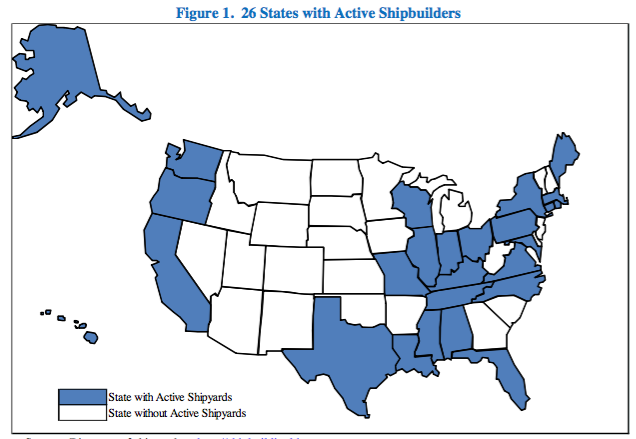
Jobs, the Reindustrialization of America, and Seasteading

States with active Shipyards (Credit: MARAD).


Employment related to shipbuilding and repair (Credit: MARAD)


If natural gas is eventually banned in the US for domestic and commercial use for heating and cooking then there will probably be a dramatic increase the use of electricity. And that would probably require an additional 100 land based nuclear power plants.

Replacing the additional 100 land based nuclear reactors with synfuel from Ocean nuclear reactors would require 400 floating reactors. If all 500 land based nuclear power plants were replace by synfuel from Ocean Nuclear power plants then  at least 2000 reactors would be required. This is  because of the substantial  inefficiency of converting electricity into to carbon fuels, transporting the fuel to coastal towns and cities  and then converting those carbon fuels back into electricity again.

However, the cost of electricity at ocean nuclear sites should  be dramatically lower than that of land based nuclear sites because Ocean Nuclear reactors are likely to be centrally mass produced. And most of the cost of nuclear electricity is due to it high  capital cost.  The recycling of flu gases from power plants using fuels from Ocean Nuclear technology could also significantly increase the fuel production since electricity wouldn't have to be used to for the extraction of CO2. 

The deployment of floating nuclear reactors, floating protective structures, floating synplexes, cruise ships, methanol tankers, methanol power barges and methanol powered tankers for the transport of other synthetic fuels and industrial chemicals will, of course, require a resurgence of the US shipbuilding industry. And that would mean a resurgence of hundreds of thousands of new jobs at shipyards in States along the Atlantic and  Pacific Coast and the Gulf Coast  and even within the Great Lakes region. 

Major shipbuilding activities in an Ocean Nuclear economy

Floating nuclear power plants

Floating nuclear storm shelters 

Methanol fueled tankers:

Methanol tankers

Gasoline tankers

Diesel fuel tankers

Jet fuel tankers 

CO2 tankers

Industrial chemical tankers

Barges: 

Methanol electric power barges

Synfuel production barges

Biowaste transport barges 

Cruise ships designed to house floating nuclear power plant workers and synplex personal

Artificial islands and breakwater structures  for ocean nuplex and synplex workers (Seasteading)


But millions of jobs would be created for US citizens operating far out to seas at  ocean nuclear synplexes. And this might well be the beginning of still another major ocean oriented shipyard industry, the creation of artificial residential islands for all of those millions of Americans working far out at sea! Ocean Nuclear and Ocean Synplex workers may end up being the first large group of American Seasteaders.

There should still be a place for terrestrial nuclear reactors in the US, in my opinion. But the future of terrestrial nuclear power is in the mass production of small nuclear reactors that are placed underground for enhanced safety. But most of the energy for electricity, synfuels, and industrial chemicals in the 21st century will probably be produced by floating synplexes powered by remotely sited floating nuclear power plants.
 

Links and References

 
Uranium (Wikipeidia)

Advances in extracting uranium from seawater announced in special issue

Uranium Seawater Extraction Makes Nuclear Power Completely Renewable

Fueling our Nuclear Future

The Economics of Nuclear Power


How deadly is your kilowatt?

Solar industry grapples with hazardous wastes

Jinko Solar Apologizes for Pollution


Will Russia and China Dominate Ocean Nuclear Technology?

The Future of Ocean Nuclear Synfuel Production

The Floating Stable Platform: Office of Naval Research


Methanol to Power Demonstration Project

Simple Cycle Methanol Power Plant

Methanol Economy

 The Production and Utilization of Renewable Methanol in a Nuclear Economy


The feasibility and current estimated capital costs of producing jet fuel at sea using carbon diox-ide and hydrogen


Market and Economic Assessment of Using Methanol for Power Generation in the CaribbeanRegion 


Exclusive Economic Zones 

What is the EEZ

U.S. Maritime Limits & Boundaries


Plasma arc gasification

Power Barges around the world 

Waller Marine Power Barges

Blog Archive

CINEMA FANTASTIC

Popular Posts