skip to main | skip to sidebar

NEW PAPYRUS

The online magazine of science, technology, socioeconomics, politics, and the future

Showing posts with label propellant depots. Show all posts

Tuesday, May 10, 2022

The Logistical Viability of an SLS EUS Derived Reusable Lunar Crew Lander


Notional reusable EUS derived REUS-LV/Crew vehicle descending to the lunar surface using side thrusters for the final descent and soft landing
 
by Marcel F. Williams

The current development of the Exploration Upper Stage (EUS) for NASA's Space Launch System offers Boeing Aerospace an opportunity to produce reusable variants of the spacecraft that could greatly enhance the capability of Boeing's super heavy lift vehicle system. 


 Reusable Lunar Crew Lander

By simply adding a pressurized crew module at the top of the spacecraft and landing gear at the bottom of the vehicle could allow the EUS to land humans on the surface of the Moon. I will refer to this notional crew landing EUS variant as the REUS-LV/Crew. 

Replacing gaseous helium with gaseous oxygen and hydrogen for pressurizing liquid oxygen and liquid hydrogen tanks should  allow the REUS-LV to be reused at least 50 times. The gaseous hydrogen and oxygen could also power thrusters for attitude control.   However, with  RL 10 engines capable of only 50 starts, reusability for such a vehicle might be limited to only six round trips between  LEO and the lunar surface.   


Artist depiction of an expendable  EUS for the Space Launch System (Credit NASA)

NASA is intent on establishing its deep space Gateway at an NRHO (Near Rectilinear Halo Orbit), a seven day polar orbit around the Moon. The  human occupied Gateway habitat  would allow 12 hour trips to the lunar surface every seven days.  A weeks stay on the lunar surface would also allow a return to NRHO in just 12 hours time. 

Assuming a dry mass of 23 tonnes for a crewed version of the REUS-LV, the space vehicle should be cable of round trips to the lunar surface utilizing less than 70 tonnes of propellant. So substantial amounts of additional payload could be deployed with crewed missions to the Moon if 113 tonnes of the vehicle's total fuel capacity is utilized.   

Private commercial launch vehicles could transport passengers to the  REUS-LV/Crew spacecraft orbiting independently  at LEO or docked at a LEO orbiting space station. 
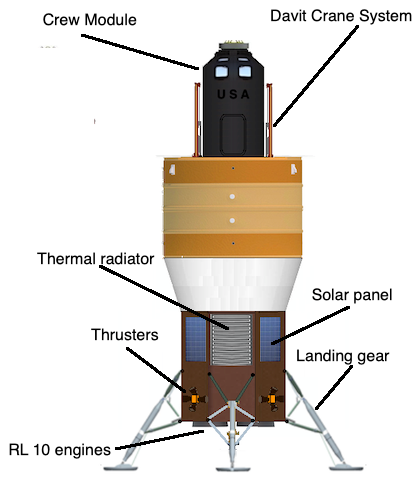
 

Notional reusable REUS-LV/Crew landing vehicle for lunar operations

Once the REUS-LV/Crew vehicle is on the Moon, a davit crane system could be used to lower astronauts, vehicles, and other equipment to the lunar surface and to retrieve astronauts and lunar material later for transport back to the NRHO Gateway. Solar panels positioned on four of the walls surrounding the LOX tank would provide electricity for the crew module plus electric power to keep the hydrogen and oxygen liquefied using the thermal radiators to assist its cryocooler refrigeration systems. 


Orbital Propellant Depots

Two REUS-LV/Crew vehicles could be deployed to LEO with a single SLS launch. But propellant depots would be required to fuel the vehicles at LEO and at NRHO in order to conduct crewed missions to and from the lunar surface and to return the spacecraft back to LEO. So the deployment of two propellant manufacturing water depots at LEO and at NRHO would be necessary for crewed lunar missions. 

Two REUS derived vehicles (REUS-OTV/Depot) could be utilized as propellant producing water depots capable of storing up to 150 tonnes of water for the production of  113 tonnes of LOX/LH2 propellant. 9 tonnes of water contains approximately 8 tonnes of oxygen and one tone of hydrogen. But only 7 tonnes of propellant could be manufactured from 9 tonnes of water since rocket fuel would require a ratio of 6 tonnes of oxygen per ton of hydrogen.   So each depot would be capable of storing approximately 16 tonnes of LH2 plus 97 tonnes of LOX) while wasting 32 tonnes of liquid oxygen. 

However if only 113 tonnes of water is converted into 97 tonnes of liquid oxygen and 13 tonnes of hydrogen then 100% of the water could be utilized as fuel if an  REUS-LV vehicle initially arrives at LEO from Earth with at least 3 tonnes of liquid hydrogen propellant. Two REUS-LV/Crew vehicles would only weigh 46 tonnes. And with an additional six tonnes of liquid hydrogen propellant, would still only be 52 tonnes of payload mass for a basic SLS vehicle capable of deploying at least 70 tonnes to LEO. Fully fueled with LH2, the first REUS-LV/Crew vehicles launched to LEO could require no liquid hydrogen from the LEO depot at all, only its liquid hydrogen.

Water could be continuously supplied to propellant producing depots at LEO by various private American launch systems (Space X, the ULA, and Blue Origin) who have vehicles  that are either currently operational or are very close to being operational: 

Falcon Heavy (Space X) - 63 tonnes to LEO

New Glenn (Blue Origin) - 45 tonnes to LEO

Vulcan-Centaur (ULA) - 27 tonnes to LEO


During the first SLS launch of two propellant depots to LEO, private launch companies could supply one depot with enough water to produce propellant that can be transferred to the second depot to deploy itself plus its solar array to NRHO. 


EUS derived propellant producing water depot approaching orbiting solar power plant @ NRHO where it will use photovoltaic power to electrolyze water into LOX and LH2.
 
Private launch vehicles could also be used to deploy water directly to NRHO once the propellant producing depot arrives. But it would be much cheaper and efficient for private launch companies to simply focus on supplying water to LEO.  Large reusable REUS-OTV (Orbital Transfer Vehicles) could transfer water from LEO to depots located at NRHO much more efficiently.  A single SLS launch would be required to deploy two such EUS derived vehicles into orbit probably with their LH2 tanks already filled with liquid hydrogen.


REUS-OTV plus optional  interstage connection ring for joining two OTV vehicles together. Such vehicles could be used to transport 60 to 120 tonnes of water and other  payloads between LEO and NRHO and to various lunar orbits and Earth-Moon Lagrange points.


Crewed Missions to the Moon and Reusability
 
For crewed missions to the lunar surface, An REUS-LV/Crew vehicle  would be fueled with propellant at LEO and then travel  four days  to the orbital outpost at NRHO. After arriving at NRHO, the REUS-LV/Crew vehicle would then be fueled with additional propellant at   for its round trip journey to the lunar surface and then back to NRHO. Once the crew returns to NRHO, only the minimum amount of propellant would be required to return the REUS-LV/Crew spacecraft back to LEO. 
 
 
Reusable REUS-LV/Crew vehicle docked at a notional single launch SLS derived MegaStation at NRHO. The notional EUS derived vehicle would be cable of round trips between NRHO and the lunar surface on substantially less than a full tank of LOX/LH2 propellant.   REUS-OTV vehicles could be used to deploy the habitat modules and the pressurized spent SLS core stage from LEO to NRHO.
 
 
RL-10 engines can be manufactured with a capability of 50 restarts. So a single REUS-LV/Crew vehicle should be capable of at least 6 round trips to the lunar surface starting and returning to LEO. The REUS-LV/Crew vehicle would be capable of  12 round trips if the spacecraft  is only utilized for trips between NRHO and the lunar surface. 

Two reusable REUS-LV/Crew vehicles could be deployed to LEO with a single SLS launch. And each vehicle deployed would be capable of at least 12 round trips between LEO and NRHO. So a single SLS launch could allow 12 round trips to the lunar surface-- if water can be supplied to LEO and then to NRHO. This would require two more SLS launches to deploy two solar powered propellant depots and two REUS derived orbital transfer vehicles (REUS-OTV) to transport water from LEO to NRHO. So three SLS launches would be required for 12 round trips to the lunar surface (four potential round trips to the lunar surface per SLS launch). 


Lunar Depots

REUS derived propellant producing water depots with landing gear could also be  deployed to the lunar surface with photovoltaic solar power units. If water ice resources are exploited at the lunar poles then propellant could be produced on the Moon. The REUS-LV/Crew vehicle could be fueled with propellant at LEO and travel directly to the lunar surface. And the same REUS-LV/ Crew could later be fueled with lunar propellant for its return trip directly to LEO. 

Reusable REUS-LV/Crew vehicle docked at a notional single launch SLS derived MegaStation at NRHO. The notional EUS derived vehicle would be cable of round trips between NRHO and the lunar surface on substantially less than a full tank of LOX/LH2 propellant.   REUS-OTV vehicles could be used to deploy the habitat modules and the pressurized spent SLS core stage from LEO to NRHO.

 Alternatively, propellant from Earth could be substantially reduced for lunar missions if tankers supplied water from the moon to NRHO depots. REUS-LV/Crew vehicles could then return to LEO using LOX/LH2 propellant produced on the Moon. 


Reusable Lunar Hopper  


The delta-v and travel times for possible crewed suborbital hops on the lunar surface. Fueled with liquid hydrogen and oxygen at a lunar base, a notional REUS-LV/Crew vehicle would be capable of traveling to any region on the surface of the Moon in less than an hour and return back to the lunar outpost on less than  a single tank of fuel.


Supplied with propellant on the lunar surface, the REUS-LV/Crew could also be used as a lunar hopper that could travel to any region on the surface of the Moon in less than an hour. The vehicle would also carry enough fuel to return to the lunar outpost where it was fueled in less than an hour.  With four trajectory burns for each round trip, each REUS-LV/Crew vehicle could travel to 12 regions on the lunar surface. So a single SLS launch could potentially explore 24 regions on the lunar surface if REUS-LV/Crew vehicles are refueled with lunar propellant. 


Repurposing Decommissioned Landing Vehicles 

REUS derived vehicles could still be put to good use after they are decommissioned from their original task.  REUS-LV/Crew vehicles that are no longer safely capable of crewed flights could  be repurposed for storing substantial quantities of water mined from the lunar ice and for storing sewage accumulated from the inhabitants of lunar outpost. With both a hydrogen and oxygen tank, substantial quantities of  water and sewage could be stored in the two different tanks of one vehicle.   The decommissioned vehicles could also be used to store excess oxygen from the production of propellant. LOX and LH2 could be stored in decommissioned spacecraft to produce electric power during the lunar night using fuel cells. Such fuel cells would not only produce electricity from the hydrogen and oxygen-- but also water. 

Decommissioned vehicles could also be used as temporary outpost in lunar regions of particular interest. They could be transported to their lunar locations by electric powered lunar cranes. And regolith bags could be deployed around the vehicle's habitat modules for additional protection against cosmic radiation and micrometeorites. 

Decommissioned REUS-OTV vehicles in orbit could be used in a similar fashion at NRHO for  storing water, or excess oxygen from the production of propellant. 


Deep Space Robotic Missions to Phobos and Deimos

At NRHO, the  REUS-LV/Crew vehicle could also be used for-- unmanned-- round trip  robotic missions to the moons of Mars. The delta-v requirements for such round trip missions between NRHO and the martian moons  would actually be less than round trip missions between NRHO and the lunar surface.  So a robotic REUS-LV would be fully capable of traveling to the surface of Deimos or Phobos and returning to NRHO with substantial quantities of rocks and regolith from those two tiny martian moons.  Roving vehicles could also be left behind that could be used to extensively explore each of the martian moons. The REUS-LV davit system could easily lower and retrieve such vehicles after landing on those tiny worlds.


 Links and References

Rocket to the Moon: What Is the Exploration Upper Stage?

Exploration Upper Stage

EUS on the Moon

 RL 10 Engine

 CECE: A Deep Throttling Demonstrator Cryogenic Engine
for NASA's Lunar Lander

Cis-Lunar Gateways and the Advantages of Near Rectilinear Orbits

Realistic Near-Term Propellant Depots: Implementation of a
Critical Spacefaring Capabilit

Large-Scale Demonstration of Liquid Hydrogen Storage With Zero Boiloff for In-Space Applications

Delta-v Calculator

Delta-v Budget

Deploying a Ginormous SLS Derived Dry/Wet Workshop Habitat with a Single SLS Launch

Travel on Airless Worlds

Reusable Hoppers and Orbiters for Rapid Lunar Transportation and Exploration


Posted by Marcel F. Williams at 12:15 PM No comments:
Labels: Boeing, EUS, Moon, NASA, propellant depots, REUS-LV/Crew

Tuesday, April 30, 2019

The Fastest, Safest, and Most Economically Sustainable Way to Return to the Lunar Surface


by Marcel F. Williams

 “I’m taking nothing off the table, and we’re not compromising safety. Anything we don’t need to do we can delay. There’s future launches, there’s future things we can test, but right now, how do we get boots on the moon in 2024?”  (NASA Administrator Jim Bridenstine)

It is now a directive of the Executive Branch of the United States for American astronauts to return to the surface of the Moon by 2024. But the type of transportation infrastructure developed for a US return to the lunar surface could largely determine whether, or not,  America will strategically and economically dominate the Moon, cis-lunar space, and the rest of the solar system.

It is estimated that between 100 million to one billion metric tons (tonnes) of water ice may exist at the Moon's north and south poles. Exploiting polar ice deposits on the lunar surface for the production of rocket fuel is one of the principal arguments for returning to the Moon. Lunar hydrogen and oxygen propellant would make it much easier to send humans to Mars. And lunar propellant and propellant dept technology  could also give astronauts easy access to the surfaces of Mercury and Jupiter's Galilean moon, Callisto, two additional worlds that could be potentially colonized by humans someday. 

Liquid oxygen comprises nearly 86% of the mass of LOX/LH2 propellant and nearly 89% of the mass of water. So even if there were no ice deposits on the Moon, the extraction of oxygen directly from the lunar regolith would provide humans with an almost endless supply of oxygen for utilization as propellant.

So any reusable spacecraft developed to return humans to the surface of  the Moon should also be inherently designed  to utilize potential lunar propellant resources-- once such lunar resources become available. But until lunar ice and regolith resources can be exploited hydrogen and oxygen, or water,  will have to be launched into cis-lunar space from the Earth's surface.

The primary purpose for a Lunar Gateway at NRHO (Near Rectilinear Halo Orbit) is to make it simple and easy to routinely visit the lunar surface from that delta-v bridging location. Yet NASA is currently advocating  a highly complex and inherently more dangerous transportation infrastructure to operate out of the NRHO Gateway. NASA's current gateway transportation architecture requires two or three different spacecraft in order to transport astronauts on a simple round trip between NRHO and the lunar surface. And the elements are not even completely reusable.

Notional  Lockheed Martin reusable lunar landing spacecraft on the lunar surface (Credit: Lockheed Martin)

Lockheed Martin, on the other hand, has proposed a simple--  single stage-- spacecraft that can operate out of NRHO. And its completely reusable. The Lockheed Martin's reusable spacecraft concept is derived from the ULA's future Centaur V and ACES rocket technologies. These cryogenic oxygen and hydrogen fueled upper stages will be used in the ULA' new Vulcan rocket system-- which is supposed to go into operation in 2021.


Lockheed Martin's Notional  Reusable Crewed  Lunar Landing Vehicle

Propellant: 40 tonnes of LOX/LH2

Inert Weight: 22 tonnes

Engines: Four RL-10 derived engines

Maximum delta-v capability: 5.0 km/s

Maximum number of crew: Four


Two of the 22 tonne Lockheed Martin lunar landing vehicles, which I will refer to as the R-LL (Reusable Lunar Lander), could easily be deployed to LEO by a single Block I SLS launch within the 8.4 meter (7.5 meter internal) payload fairing equipped with an extra barrel section.  The notional lunar spacecraft, however, would have to be fueled by propellant depots. But propellant depots would be essential if NASA is really serious about exploiting lunar resources to produce hydrogen and oxygen. So there's no logical reason not to develop cryogenic depots now!

The optimal propellant depot design would be a-- water depot-- that simply uses solar electricity to convert liquid water into hydrogen and oxygen though electrolysis and then into liquid hydrogen and oxygen through cryo-refrigeration. However, much simpler depots could be directly derived from the propellant tanks of  existing  upper stages and could utilize NASA's new helium or nitrogen cryorefrigeration technology.

Propellant could be easily transferred to a spacecraft by docking the spacecraft to the propellant depot, automatically connecting the spacecraft fuel hoses, and then firing thrusters to create simulated gravity through acceleration. Useful acceleration for propellant transfer  can be as little as 0.00004 g.

Both water and propellant could be easily deployed to LEO and NRHO by commercial launch vehicles. The Falcon Heavy should be able to deploy more than 15 tonnes of propellant to NRHO and the future Vulcan Heavy rocket systems should be capable of routinely deploying more than six tonnes of propellant to NRHO per launch.  Monthly propellant launches by each system could deploy enough liquid hydrogen and oxygen to NRHO for at least six R-LL round trips to the lunar surface  per year. NASA only sent astronauts to the moon six times from  1969 to 1972 during the entire Apollo program. 

Lightweight, disposable, propellant tank derived from Centaur 3 LOX tank capable of storing 26 tonnes of liquid oxygen (Credit: ULA)
If the R-LL uses ULA's future IVF technology, then only hydrogen and oxygen would have to be transported to NRHO. However, if the R-LL uses existing Centaur rocket technology then gaseous helium will also have to be deployed to NRHO. While the helium itself would represent less than 2% of the total propellant mass, the tanks needed to deliver the helium to NRHO would be heavy and would require the helium to be  launched to NRHO by a  Falcon Heavy or Vulcan Heavy rocket. But using IVF technology would, obviously, make the R-LL simpler to fuel.

Much larger depots, directly  derived from the ULA's Centaur V or ACES upper stage rockets, could be deployed to LEO with the ability to self deploy themselves to NRHO. Such vehicles could store up to 68 tonnes of LOX/LH2 propellant.  So Falcon Heavy and Vulcan Heavy launches to NRHO could transfer their propellant directly to the large depots for long term storage. Reusable ACES tankers could also transport propellant originally deposited by commercial launchers to LEO to NRHO. This could allow technology such as Boeing's Phantom Express to continuously deploy propellant to LEO that could later be exported to NRHO.

Total mass of a water or propellant  that can be deployed to LEO via daily launch of a single Phantom Express space plane:

Daily - 1.36  to 2.27 tonnes

Monthly - 40.8  to 68.1 tonnes

Yearly - 496.4  to 828.6 tonnes 

Yearly amount of water or propellant that could then be transported by reusable ACES spacecraft to NRHO by a single Phantom Express space plane:  200 to 330 tonnes     

Once lunar water and propellant are being manufactured on the lunar surface then the R-LL could also be used as a reusable lunar tanker. Simply replacing the crew transport module with a water tank,  a single R-LL tanker could transport more than 40 tonnes of water to NRHO from the lunar surface. And after 12 round trips, a single  R-LL tanker could deploy more than 480 tonnes of water to NRHO before its RL-10 derived engines would have to be replaced.

Of course, propellant depots deployed to both LEO and NRHO would also make it easy for reusable spacecraft to travel between LEO and NRHO. So an Orion/ACES spacecraft could eliminate the need of using a super heavy lift vehicle to transport astronauts to NRHO.

Under NASA's current scenario, billions of dollars would be spent developing three lunar elements with one or two of the expensive elements having-- no long term future-- as far as the pioneering of the Moon and the rest of the solar system is concerned. The complexity of a three stage vehicle also enhances the risk to astronauts. And it delays the-- inevitable development-- of propellant depots, a technology that is essential for the exploitation of lunar propellant resources.    

So, under the scenario presented here, the propellant depot and reusable spacecraft architecture designed to return astronauts to the Moon would give NASA and America's launch companies almost complete strategic and economic dominance over cis-lunar space by 2025. And NASA could have astronauts on the surface of the Moon at the south lunar pole before then end of 2024.


SLS and Commercial Launch Scenario for Returning Astronauts to the Lunar Surface by 2024

2020 

SLS Block I:   Uncrewed test launch of Orion/SM/ICPS to DRO (Distant Retrograde Orbit)


2021

SLS Block I:   Crewed launch of Orion/SM/ICPS on a trans lunar injection lunar flyby.

Commercial Launch:  Propulsion and Power Bus deployed to LEO for self deployment to NRHO


2022

Commercial Launch: Remaining Gateway elements deployed and assembled LEO

Commercial Launch: Commercial Crew launch to inspect the Gateway before it is deployed to NRHO later in the year


SLS Block I + ICPS upper stage: Two fully fueled ICPS or Centaur V upper stages, or a combination of both  are deployed to LEO for a docking rendezvous with the Gateway at LEO. The two boosters transport the Gateway to NRHO (More Gateway component mass can be transported to NRHO if water for  radiation shielding is transported to the Gateway later by commercial launchers)

Commercial Launch: Two FlexCraft vehicles launched to NRHO Gateway

Commercial Launch: Beginning of commercial launches of water and other supplies to NRHO Gateway 


2023

(Last use of RS-25 engines from the Space Shuttle legacy) 

SLS Block I: Crewed launch of Orion/SM/ICPS or Orion/SM/Centaur V to NRHO Gateway

Commercial Launch: Vulcan/Centaur launch of ACES propellant depot to LEO

Commercial Launch: First commercial launches of  liquid oxygen tankers to LEO

Commercial Launch: First commercial launches of liquid hydrogen tankers to LEO


2024

(New RS-25 engines now being produced and utilized)

SLS Block I: Two R-LL reusable spacecraft launched to LEO utilizing commercial propellant depots at LEO to redeploy to NRHO. Both vehicles are initially used to deploy robotic vehicles to the lunar surface for sample returns. One R-LL goes to the north lunar pole. The second R-LL goes to the south lunar pole.

SLS Block I: Crewed launch of Orion/SM/ICPS or Orion/SM/Centaur V or Orion/SM/EUS to NRHO Gateway

Three members of the Orion crew boards one of the R-LL spacecraft for the first human mission to the south lunar pole. Three other crew members remain at the NRHO Gateway to serve as an emergency rescue team in case the first vehicle experiences a serious malfunction while on the lunar surface.

Commercial Launch: Vulcan/Centaur Launch of ACES depot to LEO to self deploy to NRHO

Commercial Launch: Beginning of commercial deployment of liquid oxygen tankers to NRHO

Commercial Launch: Beginning of commercial deployment of liquid hydrogen tankers  to NRHO

Commercial Launch: Vulcan/Centaur launch of reusable Orion/ACES to LEO  for crew transport between LEO and NRHO using propellant depots


Launch Vehicles that could be used to help return humans to the surface of the Moon

SLS Block IB: 110 tonnes to LEO (operational 2024)
 
SLS Block I + ICPS upper stage: 95 tonnes to LEO (operational in 2020)

SLS Block I : 70 tonnes to LEO  (operational in 2020)

Falcon Heavy: 63.8 tonnes to LEO (currently operational)

Vulcan Centaur Heavy: 34.9 tonnes to LEO (operational 2023)

Delta IV Heavy: 28.4 tonnes to LEO (currently operational) 

Vulcan Centaur: 27.5 tonnes to LEO (operational 2021)


Upper Stages that could be deployed to LEO by an SLS Block I Launch

ICPS: Total mass: 30.7 tonnes; empty mass: 3.49; propellant mass: 27.2 tonnes (currently operational)

Centaur V: Total mass: ~ 46 tonnes; empty mass: ~5 tonnes; propellant mass: 41 tonnes (operational 2021)

ACES:  Total mass: ~ 73.5 tonnes; empty mass: ~ 5.5 tonnes; propellant mass: 68 tonnes (operational 2023)

EUS: Total mass: 140 tonnes; empty mass: 15 tonnes;  propellant mass: 125 tonnes (operational 2024)


With NASA's new super heavy lift capability, America will be able to deploy large and heavy structures (up to 110 tonnes in mass) to LEO with a single launch.  This should enable NASA and private space companies to deploy huge reusable spacecraft with crewed interplanetary capability to LEO.  Single launches of the  SLS will also be able to deploy enormous microgravity and artificial gravity space habitats to LEO with pressurized volumes greatly exceeding that of the International Space Station.

With its propellant depot architecture, reusable ACES spacecraft working alone or in pairs could transport at least 40 to 80 tonnes of payload from LEO to practically anywhere within  cis-lunar space. An reusable EUS that could utilize propellant depots would have substantially more capability.

Cargo landing vehicles directly  derived from the notional R-LL vehicle should be able to land more than 40 tonnes of payload on the surface of the Moon.

Finally, by using commercial spacecraft to reach LEO,  a propellant depot architecture could  allow astronauts and tourist to easily travel between NRHO and LEO. This would make it unnecessary to launch astronauts to NRHO aboard a super heavy lift vehicle that is only infrequently used to launch passengers.  At the Gateway, single stage reusable vehicles could be used to travel between the lunar surface and NRHO.   And suddenly private commercial space tourism could expand beyond LEO-- all the way to the practically any place on the surface of the Moon.  And a new economic age of space travel will have begun!


Links and References

Bridenstine says “nothing off the table” as NASA develops new lunar plan 

How Much Water Is on the Moon?

Cis-Lunar Gateways and the Advantages of Near Rectilinear Orbits

Work begins on rocket engines for SLS flights a decade from now
Realistic Near-Term Propellant Depots: Implementation of aCritical Spacefaring Capability 

Status of Power and Propulsion Element (PPE) for Gateway

Utilizing the Centaur V and ACES 68 for Deep Space SLS Missions


ACES Stage Concept: Higher Performance, NewCapabilities, at a Lower Recurring Cost

ULA’s Vulcan Rocket To be Rolled out in Stages

ULA's Tory Bruno (Twitter)

A Commercially Based Lunar Architecture


Evolving to a Depot-Based Space Transportation Architecture
A Study of CPS Stages for Missions beyond LEO

LARGE SCALE CRYOGENIC STORAGEWITH ACTIVE REFRIGERATION


Transient Modeling of Large Scale Integrated Refrigerationand Storage Systems


Posted by Marcel F. Williams at 1:49 PM No comments:
Labels: lunar surface, Moon, NASA, propellant depots, reusable lunar lander, Space travel

Tuesday, April 11, 2017

Reusable Heavy Cargo and Crew Landing Vehicles for the Moon and Mars

Notional ETLV-4 rendezvous with propellant producing water depot @ EML1 with orbiting solar power plant (where propellant depots dock when converting water into LOX/LH2) in the background.
by Marcel F. Williams

In 2018, NASA will launch the first unmanned test flight of its wide body super heavy lift vehicle, the Space Launch System (SLS). That first launch will also test the first uncrewed version of the Orion spacecraft. Coincidentally, 2018 will also be the same year that private companies, thanks to  the  financial help of NASA, will return American astronauts into orbit aboard private spacecraft. Crewed Orion/SLS missions are not scheduled to occur until at least the year 2021.

Congress has directed NASA to reveal the design of a  microgravity Deep Space Habitat (DSH)  by 2018. Unfortunately, the American space agency continues to ignore the use of a DSH as a gateway for crewed missions to the lunar surface while simply ignoring the significant  physiological problems associated with potential multiyear interplanetary missions within a microgravity environment.


Orion MPCV docked @ SLS propellant tank derived Deep Space Habitat (Credit NASA)

 The primary purposes for a  Deep Space Habitat (DSH) should be to:

1. Serve as a gateway to the lunar surface. Astronauts traveling from the Earth or from the lunar surface could dock their spacecraft at an EML1 habitat, taking temporary advantage of the more spacious accommodations before transferring to vehicle fueled destined for the lunar surface.  

2. Serve as a storm shelter during the occurrence of major solar events. This will probably require at least 30 cm of water shielding for the areas within the habitat that the astronauts will be occupying. Major solar events can last for several minutes to several hours.

3. Serve as a maintenance and repair station for reusable lunar shuttles (ETLV) and orbital transfer vehicles. Flex Craft docked at the DSH could also be utilized  for extravehicular repairs to  nearby water/propellant depots and associated solar arrays at EML1.

4. Test the effectiveness of various levels of water shielding required to mitigate cosmic radiation and potentially brain damaging heavy nuclei. In theory, 20 cm of water would be enough shielding to to stop the penetration of the heavy nuclei component of cosmic rays while 30 cm of water would reduce overall  annual cosmic radiation exposure to less than 25 Rem per year during solar minimum conditions. Solar storm events would also be significantly mitigating with 30 cm of water protection. Minimizing the mass of radiation shielding required for safe interplanetary travel would be essential for reducing the amount of propellant required for such missions.

5. Test the integrity and reliability of the pressurized habitat structures that might also be used for habitats on the surface of the Moon and Mars and for rotating  artificial gravity habitats for space stations placed in cis-lunar orbits, Mars orbit, and for crewed interplanetary journeys. 

Of course, a  DSH would be a-- destination to nowhere-- without developing vehicles capable of transporting humans and heavy cargo to the surfaces of the Moon and Mars. And, in my opinion, most Americans and members of Congress will continue to believe that  America's glory years in space are in the past until American astronauts are once again  walking on the surfaces of other worlds-- this time to stay.

NASA's beyond LEO ambitions are severely  hampered by the fact that it continues to operate a relatively expensive (~$3 billion/yr) LEO program (ISS) without a significant increase in the NASA budget for its beyond LEO program. While it has been presumed that much more funding will be provided for NASA's beyond LEO missions once the ISS program comes to an end, there are still efforts to extend the ISS program beyond 2024, again, without increasing the NASA budget in order to pay for its continuation.

Bigelow Aerospace plans to deploy its first private commercial space habitats to LEO  in 2020 aboard the ULA's Atlas V rocket. If this private space company is successful then there's really no reason for NASA to continue the ISS program beyond 2020 since private companies will be able to do  research and development at LEO.   This, of course, would allow NASA to use ISS related funds to develop the cargo and crew landing vehicles, habitats, and related infrastructure for crewed missions to the Moon and Mars.

 Allowing foreign astronauts to participate in NASA's beyond LEO program could provide additional funding for NASA. By 2018, Russia plans to charge NASA,  $81 million per astronaut for transport  to an from the ISS. NASA could charge  foreign space agencies $150 million for each astronaut participating in one of its  beyond LEO missions. The Orion MPCV is capable of accommodating as many as six astronauts. If two of those astronauts were from foreign space agencies paying NASA to join the mission then  NASA could save $300 million per crewed SLS launch.

The Center for Strategic and International Studies (CSIS) has estimated that the cost of developing a crewed two stage lunar lander  at approximately $12 billion. Former NASA director,  Charlie Bolden,  estimated the cost of developing a lunar landing vehicle at approximately $8 to $10 billion.

Neil Armstrong and Buzz Aldrin landed on the surface of the Moon just seven years after NASA invited  eleven private firms  to submit proposals for the Lunar Excursion Module (LEM) in July of 1962. So if we assume that it will take seven years to develop an extraterrestrial landing vehicle or vehicles ( using a COTS type of funding for more than one vehicle), then annual development cost over the course of seven years might range from approximately $1.1 billion  to $1.7 billion. We can also assume that an additional  $1.1 billion a year to $1.7 billion a year over the course of an additional seven years would then be needed to fund the development of a future Mars landing vehicle.  Such annual funding for  extraterrestrial landing vehicles would still leave ample funds for financing the development of lunar and martian habitats and the associated infrastructure.

Boeing Aerospace 2.4 meter Super Light Weight cryotank (Credit Boeing Aerospace)
However, the development time, cost, and recurring cost  for an extraterrestrial landing vehicle (ETLV) could be substantially reduced if: 

1.  A single stage vehicle, or vehicles,  were developed instead of a-- two stage vehicle

2. An ETLV was developed that was largely derived from technology that either already exist or is currently in development

3. An ETLV was developed that utilized LOX/LH2 common bulkhead propellant tanks instead of two different tanks for liquid oxygen and liquid hydrogen

4. An ETLV was developed that were capable of transporting cargo and crews to the surfaces of both the Moon and Mars and back to the orbits of the Moon and Mars

5.  An ETLV was  developed that had pressurized habitat and airlock areas derived from re-purposed ETLV propellant tanks. 

6. An ETLV was  developed that was  capable of being reused for at least for ten round trips to and from their destinations (the surfaces of the Moon or Mars)

7.  An ETLV was  developed that was capable of also being utilized for unmanned robotic and cargo missions

8.  An ETLV was  developed that was capable of also being utilized as a crewed orbital transfer vehicles between LEO, Low Lunar Orbit, and the Earth-Moon Lagrange points

Front view of notional singe stage reusable ETLV-4 derived from 2.4 meter in diameter cryotanks
Side view of notional singe stage reusable ETLV-4 derived from 2.4 meter in diameter cryotanks

ETLV-4 

Up to 40 tonnes of LOX/LH2 propellant in four 2.4 meter in diameter propellant tanks 

Four RL-10 derived CECE engines 

2.4 meter in diameter propellant tank derived central crew habitat area with lower heavy ion shielded storm shelter   

Twin 2.4 meter in diameter propellant tank derived airlocks 

Inert mass without heavy ion water shielded area: ~12 tonnes 

Inert mass with heavy ion water shielded area (22 cm of water): ~17 tonnes 

Gross mass: 57 tonnes 

specific impulse: 445 seconds

   
Due to reduced vehicle mass, reductions in vehicle components, and reduced vehicle complexity, Lockheed-Martin  concluded that the development  cost and recurring cost for a lunar lander could be substantially reduced if a reusable single stage vehicle were developed instead of a two staged spacecraft.   NASA reached a similar conclusion back in the late 1980s when JPL proposed its own single stage LOX/LH2 lunar landing vehicle.  

Boeing developed and tested a 2.4 meter cyrotank as a prelude to its development of a 5.5 meter in diameter, Super Light Weight Tank, that might possibly be used for the 5.5 meter LOX tank for the SLS upper stage (EUS). The 2.4 meter tank was successfully filled with liquid hydrogen chilled at  –423 °F  and cycled through-- twenty-- pressurization and  vent cycles.  If Boeing's 2.4 meter tank were utilized in a common bulkhead configuration for storing LOX/LH2 propellant in an Altair-like vehicle then such tanks could be utilized for a reusable single staged spacecraft. 

Four RL-10 derived CECE (Common Extensible Cryogenic Engine) engines, currently in development by Aerojet Rocketdyne,  could enhance vehicle safety with engine out capability and would be capable of up to 50 restarts. This should enable the vehicle to be used for at least 10 round trips from the surfaces of the Moon or Mars and to various orbital regions near each celestial body.  The CECE engines are also supposed to be designed to have a throttle capability ranging from 104% of thrust down to just 5.6%, which should allow an extraterrestrial landing vehicle to land on worlds as large as the Moon and  Mars or as small as the moons of Mars. However, thrusters near the bottom of an ETLV could also be used to land on the surfaces of the small low gravity martian moons.

Utilizing Integrated Vehicle Fluid (IVF) technology currently being developed by the ULA, helium and hydrazine would no longer be required for an extraterrestrial spacecraft with some ullage gases even being utilized for  attitude control. With the addition of  NASA emerging cryocooler technology, solar powered cryocoolers could reliquify some ullage gases, eliminating the  boil-off of hydrogen and oxygen.

Pressurized crew areas and airlocks derived from re-purposed ETLV propellant tanks, could further reduce development and recurring cost.  The twin cryotank derived airlocks allows more room within the cabin while allowing astronauts to leave the vehicle without having to decompress and then re-pressurize the crew cabin.  With the airlocks positioned just a few meters above the landing pods, pressure suited astronauts could depart the vehicle just few meters above a planetary surface, reducing the difficulty and risks associated with exiting and entering the spacecraft.   The low position of the airlocks should also make it convenient for mobile robotic vehicles to be deployed to the surface of a the Moon or Mars or the moons of Mars for robotic exploration and potential sample  returns to orbit.

NASA's ADEPT deceleration shield concept (Credit NASA)
Developing a  landing vehicle that could be used for crewed missions to both the lunar and martian surfaces would, of course, substantially reduce development cost.  A spacecraft capable of transporting astronauts from surface of Mars to Low Mars Orbit (~4.4 m/s delta-v)  would also be easily capable of transporting astronauts from the surface of the Moon to Low Lunar Orbit or to any of the Earth-Moon Lagrange points (less than 2.6 m/s delta-v).

Landing such an extraterrestrial landing vehicle on the surface of Mars, however, would require the development of a deceleration shield. NASA is currently doing research on two types of deceleration shields: HIAD and ADEPT. The rigid ADEPT deceleration shield could allow spacecraft to deploy up to  40 tonnes of payload  practically anywhere on the surface of Mars. After the ADEPT deceleration shield was discarded, a delta-v of less than 0.6 meters per second would only be required to land the vehicle on the martian surface

 
Notional ADEPT deployment of 40 tonnes of cargo to the martian surface (Credit NASA)

An extraterrestrial landing vehicle capable of transporting astronauts from the surface of Mars to low Mars orbit would also be capable of transporting astronauts from LEO to Low Lunar Orbit or to any of the Earth-Moon Lagrange points. Utilizing the ETLV in such a manner, however,  could make the Orion MPCV obsolete,  allowing astronauts to be transported into orbit by Commercial Crew vehicles and then transferred to a propellant depot fueled  ETLV  for easy access to the Earth-Moon Lagrange points and Low Lunar Orbit and to the lunar surface.
Notional CLV-7B cargo lander derived from 2.4 meter diameter cryotanks

A cargo lander (CLV) derived from the crew version of the ETLV could easily be derived using all seven 2.4 meter in diameter pressurized tanks to carry propellant. With a  diameter of at least 7.2 meters, such a cargo transport could deploy large and heavy structures as large as 8.6 meters in diameter to the surfaces of the Moon and Mars. Pressurized habitats derived from an SLS propellant tank technology with diameters up to 8.4 meters  could easily be deployed to the surfaces of the Moon and Mars by such an ETLV derived CLV. 
ATLETE robots could be used  for offloading heavy cargo to the surfaces of the Moon and Mars aboard a notional CLV-7B (Credit: NASA)


CLV-7B

Up to 35 tonnes of LOX/LH2 propellant in seven 2.4 meter in diameter propellant tanks 

Four RL-10 derived CECE engines 

Specific impulse: 445 second

Inert mass without payload: ~8 tonnes 

Gross mass without payload: ~43 tonnes 

Capable of accommodating cargo with diameters as large as 8.6 meters 

Notional SLS propellant tank derived  regolith shielded habitat for the Moon and Mars with an 8.4 meter in diameter pressurized habitat area that could be deployed to the lunar or martian surface using the CLV-7B and ATHLETE technologies. 

Once the cargo lander is  on the surface of the Moon and after its payload is deployed,  water bags could be securely attached to the top of the  CLV-7B. This could allow the CLV to be reused as a water transport tanker capable of transporting  at least 35 tonnes of water from the surface of the Moon to EML1. Using its CECE engines for ten round trips could enable the CLV to  deliver more than 300 tonnes of water to   propellant producing water depots located at EML1.

With the capability of landing crews and payloads on the Moon and Mars, the ETLV-4 crew lander and the CLV-7B cargo lander should also be capable of  someday landing crews and cargo on the surfaces of the planet Mercury and on Jupiter's moon, Callisto, two other viable worlds for potential commercialization and human settlement. Within Jupiter space, automated unmanned ETLV-4 spacecraft operated from an outpost on Callisto could transport mobile robotic vehicles to the Jovian moons within Jupiter's deadly radiation belt (Ganymede, Europa, and Io) for continuous robotic exploration and sample returns from these interesting but heavily radiation inundated  worlds.


Links and References

Composite Cryotank Technologies; Demonstration


CECE (Common Extensible Cryogenic Engine)


An Integrated Vehicle Propulsion and Power System for Long Duration Cryogenic Spaceflight (ULA)


 The SLS and the Case for a Reusable Lunar Lander

Finally, some details about how NASA actually plans to get to Mars


Private Space Habitat to Launch in 2020 Under Commercial Spaceflight Deal


Russia is squeezing NASA for more than $3.3 billion — and there's little anyone can do about it


Apollo Lunar Module


Substantially Enhancing the Capability of the SLS Architecture by Utilizing EUS Derived Propellant Depots and Reusable Orbital Transfer Vehicles


ADEPT Technology for Crewed and Uncrewed Missions to the Planets


Landing on Mars with ADEPT Technology


Inflatable Biospheres for the New Frontier 


Living and Reproducing on Low Gravity Worlds

Posted by Marcel F. Williams at 1:03 AM No comments:
Labels: 2.4 meter super light weight tank, ACES, ADAPT, Boeing, deceleration shield, ETLV-4, Extraterrestrial Landing Vehicle, HIAD, IVF, lunar lander, Mars lander, propellant depots, ULA

Tuesday, April 4, 2017

The ULA's Cis-Lunar Economy


Cis-Lunar Panel


Posted by Marcel F. Williams at 2:39 PM No comments:
Labels: ACES, Cis-lunar space, EML1, L1, lunar water, Moon, propellant depots, The United Launch Alliance, ULA, Vulcan Rocket

Sunday, April 17, 2016

Lunar Geologist, Dr. Paul Spudis, on Exploiting Lunar Water Resources


Links and References

Lunar Source Book

Dr. Paul Spudis Lunar Resource Site


Posted by Marcel F. Williams at 2:59 PM No comments:
Labels: Dr. Paul Spudis, lunar poles, lunar water, Moon, NASA, propellant depots
Older Posts Home
Subscribe to: Posts (Atom)

Blog Archive

  • ▼  2026 (32)
    • ▼  October (2)
      • Heart Aerospace Flies the World's Largest Electric...
      • How the US Can Dominate the Evolution of AI
    • ►  September (4)
    • ►  August (2)
    • ►  July (2)
    • ►  June (4)
    • ►  May (1)
    • ►  April (7)
    • ►  March (4)
    • ►  February (4)
    • ►  January (2)
  • ►  2025 (35)
    • ►  December (4)
    • ►  November (2)
    • ►  October (8)
    • ►  September (2)
    • ►  August (2)
    • ►  July (2)
    • ►  June (1)
    • ►  May (1)
    • ►  April (2)
    • ►  March (4)
    • ►  February (1)
    • ►  January (6)
  • ►  2024 (23)
    • ►  December (1)
    • ►  November (4)
    • ►  October (1)
    • ►  September (1)
    • ►  August (2)
    • ►  July (1)
    • ►  June (2)
    • ►  May (2)
    • ►  April (2)
    • ►  March (1)
    • ►  February (3)
    • ►  January (3)
  • ►  2023 (43)
    • ►  December (3)
    • ►  November (6)
    • ►  October (3)
    • ►  September (3)
    • ►  August (4)
    • ►  July (1)
    • ►  June (5)
    • ►  May (3)
    • ►  April (3)
    • ►  March (4)
    • ►  February (4)
    • ►  January (4)
  • ►  2022 (57)
    • ►  December (1)
    • ►  November (3)
    • ►  October (3)
    • ►  September (4)
    • ►  August (3)
    • ►  July (8)
    • ►  June (6)
    • ►  May (8)
    • ►  April (4)
    • ►  March (2)
    • ►  February (5)
    • ►  January (10)
  • ►  2021 (34)
    • ►  December (4)
    • ►  November (2)
    • ►  October (2)
    • ►  September (2)
    • ►  August (2)
    • ►  July (4)
    • ►  June (4)
    • ►  May (3)
    • ►  April (2)
    • ►  March (3)
    • ►  February (2)
    • ►  January (4)
  • ►  2020 (51)
    • ►  December (6)
    • ►  November (8)
    • ►  October (3)
    • ►  September (3)
    • ►  August (5)
    • ►  July (3)
    • ►  June (3)
    • ►  May (7)
    • ►  April (4)
    • ►  March (3)
    • ►  February (3)
    • ►  January (3)
  • ►  2019 (25)
    • ►  December (2)
    • ►  November (2)
    • ►  September (3)
    • ►  August (1)
    • ►  July (3)
    • ►  June (3)
    • ►  May (2)
    • ►  April (3)
    • ►  March (1)
    • ►  February (3)
    • ►  January (2)
  • ►  2018 (23)
    • ►  December (1)
    • ►  November (1)
    • ►  October (2)
    • ►  September (1)
    • ►  August (3)
    • ►  July (4)
    • ►  June (2)
    • ►  May (4)
    • ►  April (1)
    • ►  March (2)
    • ►  February (1)
    • ►  January (1)
  • ►  2017 (25)
    • ►  December (4)
    • ►  November (2)
    • ►  October (1)
    • ►  September (2)
    • ►  August (4)
    • ►  July (1)
    • ►  May (3)
    • ►  April (3)
    • ►  March (1)
    • ►  February (1)
    • ►  January (3)
  • ►  2016 (34)
    • ►  December (1)
    • ►  November (1)
    • ►  October (2)
    • ►  September (2)
    • ►  August (2)
    • ►  July (2)
    • ►  June (2)
    • ►  May (5)
    • ►  April (3)
    • ►  March (5)
    • ►  February (4)
    • ►  January (5)
  • ►  2015 (26)
    • ►  December (3)
    • ►  November (3)
    • ►  October (1)
    • ►  September (1)
    • ►  August (1)
    • ►  July (2)
    • ►  June (2)
    • ►  May (2)
    • ►  April (5)
    • ►  March (2)
    • ►  February (2)
    • ►  January (2)
  • ►  2014 (32)
    • ►  December (4)
    • ►  November (2)
    • ►  October (1)
    • ►  September (2)
    • ►  August (2)
    • ►  July (4)
    • ►  June (3)
    • ►  May (2)
    • ►  April (4)
    • ►  March (1)
    • ►  February (2)
    • ►  January (5)
  • ►  2013 (42)
    • ►  December (5)
    • ►  November (5)
    • ►  October (1)
    • ►  September (4)
    • ►  August (3)
    • ►  July (2)
    • ►  June (2)
    • ►  May (5)
    • ►  April (4)
    • ►  March (3)
    • ►  February (3)
    • ►  January (5)
  • ►  2012 (45)
    • ►  December (6)
    • ►  November (4)
    • ►  October (2)
    • ►  September (4)
    • ►  August (4)
    • ►  July (3)
    • ►  June (4)
    • ►  May (3)
    • ►  April (4)
    • ►  March (2)
    • ►  February (4)
    • ►  January (5)
  • ►  2011 (62)
    • ►  December (1)
    • ►  November (4)
    • ►  October (5)
    • ►  September (4)
    • ►  August (2)
    • ►  July (5)
    • ►  June (6)
    • ►  May (9)
    • ►  April (3)
    • ►  March (12)
    • ►  February (4)
    • ►  January (7)
  • ►  2010 (91)
    • ►  December (7)
    • ►  November (14)
    • ►  October (9)
    • ►  September (9)
    • ►  August (10)
    • ►  July (5)
    • ►  June (6)
    • ►  May (9)
    • ►  April (7)
    • ►  March (5)
    • ►  February (5)
    • ►  January (5)
  • ►  2009 (74)
    • ►  December (5)
    • ►  November (9)
    • ►  October (6)
    • ►  September (4)
    • ►  August (9)
    • ►  July (13)
    • ►  June (5)
    • ►  May (2)
    • ►  April (6)
    • ►  March (4)
    • ►  February (6)
    • ►  January (5)
  • ►  2008 (24)
    • ►  December (5)
    • ►  November (4)
    • ►  October (3)
    • ►  September (3)
    • ►  August (4)
    • ►  February (2)
    • ►  January (3)

CINEMA FANTASTIC

  • Cinema Fantastic
    CARRIE
    4 weeks ago

Popular Posts

  • Energy Independence through Nuclear Re-industrialization
    by Marcel F. Williams During the Great Depression, the Roosevelt administration decided to create jobs in the US by expanding electric power...
  • Mining the Moons of Mars
    by Marcel F. Williams Moving towards a non carbon dioxide polluting energy economy does face a few problems as far as natural resources ar...
  • Utilizing the SLS to Build a Cis-Lunar Highway
    The Earth seen rising above the Lunar horizon aboard Apollo 17, the last human mission to the Moon (Credit: NASA) by Marcel F. Willia...
  • Was the Swamp Ape Bipedal?
    by Marcel F. Williams  Tuscany is renowned for its beautiful cities of Florence and Siena, and is  historically famous as the birthplace ...
  • Conquering Cis-Lunar Space with Shuttle and ULA Derived Technologies
    by Marcel F. Williams Congress has now made it clear that they want the immediate development of a heavy lift vehicle and a crew explorato...
  • Inflatable Biospheres for the New Frontier
    X-Ray of a notional regolith shielded 16 meter in diameter biosphere (Credit: NASA) by Marcel F. Williams  A t least 0.1 g is required...
  • The Plug-in Hybrid Revolution
    by Marcel F. Williams General Motors yesterday introduced the production model for their new plug-in hybrid vehicle (PHEV) which they believ...
  • The Salton Sea's Potential Trillion Dollar Lithium Boom
  • Ares vs the Sidemount and the Augustine Commission
    by Marcel F. Williams During Space Shuttle manager John Shannon's presentation of the Side-mount Shuttle (SD-HLV) concept to the Augu...
  • Why a CANZUK Alliance Has Now Become Crucial

New Papyrus Articles

  • Nuclear Energy
  • Space Frontier
  • Transportation
  • Paleobiology
  • NewPapyrus@DailyKos

***CHICAGO CUBS***

CINEMAFANTASTIC

  • Cinema Fantastic
    CARRIE

Science News

  • BBC Science/Nature
  • BBC Technology
  • Science Daily
  • Space News
  • Space Daily
  • Space Travel
  • Moon Daily
  • Mars Daily
  • Robo Daily
  • Energy Daily
  • World Nuclear News
  • Nuclear Power Daily
  • Terra Daily

NEW PAPYRUS

NEW PAPYRUS
“It is important for the human race to spread out into space for the survival of the species,” Stephen Hawking

New Frontier

New Frontier

Astronomy & Space Blogs

  • Universe Today
    ESA's Hera Mission Targets Binary Asteroid Pair in November
    1 hour ago
  • Astroblog
    Thursday 15 October to Thursday October 22
    4 hours ago
  • Spaceflight Now
    Live coverage: NASA, SpaceX to launch new solar arrays, 6,300 pounds of cargo to the space station
    15 hours ago
  • NASA SpaceFlight
    CRS-35 launches to ISS with final iROSA arrays, experiments, and other items
    19 hours ago
  • An Ex Rocket Man's Take On It
    Supersonic Inlets for Ramjets
    21 hours ago
  • ESA Top News
    Welcome home, Sophie Adenot
    1 day ago
  • SpacePolicyOnline.com
    What’s Happening in Space Policy October 11-17, 2026
    1 day ago
  • Planetary Society Blog
    Born from fire
    4 days ago
  • Centauri Dreams
    Musings on White Dwarfs and Planetary Survival
    6 days ago
  • The Space Review
    From debris mitigation to orbital sustainability: The next stage of space governance
    1 week ago
  • THE HUMAN SPACEFLIGHT BLOG: From the Space Shuttle to Beyond
    A New Group of Spacefarers Has Arrived at the ISS...
    1 week ago
  • The National Space Society of Phoenix
    Upcoming Events
    2 weeks ago
  • Selenian Boondocks
    Star Trek 2 should have led to a court-martial
    1 month ago
  • Polymath
    Could Blue Origin develop a lander for Artemis III?
    10 months ago
  • DSFP's Spaceflight History
    ROMBUS: Reusable Orbital Module - Booster & Utility Shuttle (1963)
    1 year ago
  • SpaceFlight Insider
    NG-20 Cygnus spacecraft service module on its way to Florida
    2 years ago
  • Parabolic Arc
    ispace to Make Second Lunar Attempt in Winter 2024
    2 years ago
  • Science @ NASA
    Chandra Rewinds Story of Great Eruption of the 1840s
    3 years ago
  • Hop's Blog
    Wish list for space video games.
    7 years ago
  • Spudis Lunar Resources
    An Architecture for Direct Lunar Return Using SLS and Orion
    8 years ago
  • SpaceNews
Show 10 Show All

Energy and Environment Blogs

  • Neutron Bytes | A time traveler from the age of steam
    Where the New York Times Missed a Few Facts About Nuclear Reactors on the Moon
    3 days ago
  • Atomic Insights
    Atomic Show #354 – Doreen Harris, President and CEO NYSERDA (New York State Energy Research and Development Authority)
    3 weeks ago
  • Nuclear Street - Nuclear Power Portal
    Modern Regulation for a New Nuclear Era
    5 weeks ago
  • DeSmogBlog
    Gulf Royal Family Banks Over €70 Million in EU Farming Funds
    5 months ago

TRANSPORTATION BLOGS

  • CleanTechnica
    Europe Should Learn From South Korea’s Hydrogen Station Failure
    55 minutes ago
  • Electric & Hybrid Vehicle Technology International
    THE BATTERY SHOW NA: Comau and Intecells present cold plasma battery cell surface treatment
    1 hour ago
  • Marine Log
    Matson christens Makua, first of three new LNG-fueled Aloha class containerships
    2 hours ago
  • Aerotime
    German Eurofighters escort Corendon jet as Nuremberg Airport shuts down
    5 hours ago
  • Splash247
    Emarat Maritime piles six more tankers onto China orderbook
    5 hours ago
  • Clean Fleet Report
    Thinking about a New Car? Here’s How to Pick the Right Model for You
    2 days ago
  • Sustainable Skies
    XPrize Wildfire Winners
    2 weeks ago
  • Ship Technology
    Why cyber-secure systems are becoming critical to naval procurement
    3 weeks ago
  • Green Car Congress
    Audi and Navistar showcase C-V2X technology to enhance school stops safety
    3 years ago
Show 5 Show All

CINEMAFANTASTIC

  • Cinema Fantastic
    CARRIE
    4 weeks ago

PaleoBiology Blogs

  • Anthropology.net
    A 700,000-Year-Old Elephant Tooth From Gesher Benot Ya’aqov
    4 days ago
  • Nutcracker Man
    Paleoantropología: novedades 3er trimestre 2026
    1 week ago
"The knowledge that we have now is but a fraction of the knowledge we must get, whether for peaceful use or for national defense. We must depend on intensive research to acquire the further knowledge we need ... These are truths that every scientist knows. They are truths that the American people need to understand."
(Harry S. Truman 1948).

Sci-Tech Blogs

  • Phys.org - latest science and technology news stories
    A closer look at hard-to-see cells could answer new questions about nerve damage and recovery
    13 minutes ago
  • Scientific American
    What happens to the body during menopause? New research hints at a biological ‘cliff’
    2 hours ago
  • Ars Technica
    High-speed video reveals how honey bee stingers pump venom
    3 hours ago
  • NextBigFuture.com
    Criminal IP to Showcase Threat Intelligence and AITEM at Security Days Fall 2026 Tokyo
    3 hours ago
  • Eos
    Reading Rainfall in a Snail’s Shell
    4 hours ago
  • Tech Xplore
    Fortnite maker Epic Games makes 'huge pivot' with AI, CEO says
    6 hours ago
  • SciTech
    📚 The Inoculation Project 4/12/2026: Texas Owls, California Books
    6 months ago
Show 5 Show All
"The greatest long-term threat to U.S. national security is not terrorists wielding a nuclear or biological weapon, but the erosion of America's place as a world leader in science and technology."

Gordon England:
1st Deputy Secretary of Homeland Security
and former Secretary of the Navy

Message Boards

  • NASA Spaceflight Forum
  • New Mars Forum
  • Space Redit.com
  • Space Settlers Forum
  • Space Policy
  • Space News

Science Search Engines and Encyclopedias

  • PubMed
  • Wikipedia
  • Animal Diversity Web
  • Encyclopedia of Life
  • Digital Morphology
  • Dictionary
  • Urban Dictionary
  • Google Maps
  • Weights & Measures Converter
  • Google Translator
  • World Clock
  • World Clock- Time Zones
  • US & World Population Clocks
  • Distance to Horizon Calculator
  • Patents.com

Daily Kos

  • FerrisValyn@DailyKos
  • Nella Selim@Daily Kos
  • Bryfry@Daily Kos
  • Newpapyrus@DailyKos
  • Vladislaw@Daily Kos
  • David Walters@Daily Kos
  • Darksyde@DailyKos

Science Links

  • Areva
  • Biochar Journal
  • California High Speed Rail
  • Carbon Sciences
  • Economic Policy Institute
  • Encyclopedia Astronautica
  • espacetickets.com
  • Global Research Technologies
  • Go Zero G
  • Hominin.net
  • HY9
  • International Dimethyl Ether Association
  • Journal of Energy Security
  • Methanol Institute
  • NASA
  • Nuclear Energy Institute
  • Nuclear Oil
  • Planets in the Nightime Sky
  • Resources for Students of Anthropology
  • Science Centric
  • Scientific American
  • Space.com
  • Spaceflight Insider
  • Spaceflight Now
  • Spudis Lunar Resources
  • Stop Ill Wind
  • Tau Zero Foundation
  • The Case for Nuclear Energy
  • The Nuclear Blog
  • US Department of Energy
  • Vertical Farming
  • World Nuclear Association

Published Books & Research Papers

  • Marine Adaptations in Human Kidneys In: Was Man More Aquatic in the Past? Fifty Years After Alister Hardy - Waterside Hypotheses of Human Evolution (2011)
  • Cranio-dental evidence of a hominin-like hyper- masticatory apparatus in Oreopithecus bambolii. Was the swamp ape a human ancestor? (2008)
  • Morphological evidence of marine adaptations in human kidneys (2006)
  • Primate encephalization and intelligence (2002)
  • The adaptive significance of endothermy and salt excretion amongst the earliest archosaurs (1997)

About Me

My photo
Marcel F. Williams
View my complete profile