 |
| CST-100 docking with ISS (Credit: Boeing Aerospace) |
Thursday, July 31, 2014
Astronaut Chris Ferguson on Boeing's CST-100 Commercial Spacecraft

Thursday, July 10, 2014
Landing Large Cargos and Crews on the Surface of Mars
 |
| Tethered beneath a hydrogen inflated ballute, a crewed Ares 2 (Ares ETLV-2) reusable landing shuttle slowly descends towards the martian surface. |
by Marcel Williams
Launching human crews from the surface of the Earth to low Earth orbit (LEO) requires a delta-v of more than 9.3 kilometers per second (km/s). But on the Moon and Mars, the delta-v requirements are significantly lower. Launching humans from the surface of the Moon to lunar orbit can require as little delta-v as 1.87 km/s. And launching human crews from the surface of Mars to low Mars orbit requires a delta-v of only 4.4 km/s.
Landing humans on the surface of the Earth and on the Moon is relatively easy. Only minuscule amounts of delta-v are required to for crews to leave Earth orbit and glide or parachute through the Earth's thick atmosphere to the terrestrial surface. The delta-v required to land a crew on the surface of the Moon from lunar orbit is equivalent to the delta-v required to leave the lunar surface to low lunar orbit.
Unfortunately, landing crews and large payloads on the surface of Mars is much more problematical. The largest spacecraft that NASA has managed to safely deploy to the Martian surface are all below 600 kilograms in mass. The weight of a lunar derived crewed vehicle to the Martian surface is likely to weigh as much as 10 tonnes, not including the substantial amounts of fuel needed to return to orbit around the Red Planet. And NASA eventually wants the ability to deploy as much as 100 tonnes of payload onto the martian surface by a single spacecraft.

 |
| Notional ballutes designed to aerobrake into a planetary orbit or to land on the surface of Mars (Credit: NASA) |
The problem with landing large masses on the surface of Mars is that even though the martian atmosphere is approximately 1% as dense as the Earth's atmosphere, it's still thick enough to produce substantial amounts of frictional heating as a vehicle plunges at hypersonic speeds through its atmosphere but still not enough friction to sufficiently lower the terminal velocity as it approaches the planet's surface. Small vehicles (less than 600 kg) attempting to land on Mars have, therefore, been designed to have a high drag coefficients. Designing a spacecraft with a high drag coefficient for vehicles weighing several tonnes or more, however, is much more difficult.
This has pushed NASA towards the idea of utilizing large inflatable ballutes to assist heavy payloads and spacecraft entering the martian atmosphere. The large drag coefficient of a toroidal ballute could allow a spacecraft to decelerate at very low densities high in the martian atmosphere with relatively low rates of frictional heating. The low frictional heat experienced by the ballute could allow for light-weight construction techniques that could enhance the ability to deploy more mass to the martian surface. Ballutes inflated with gases that are lighter than the carbon dioxide could also increases static lift. Recent studies suggest that a toroidal ballute with a tube radius of 80 meters could be used to deliver masses the martian surface of approximately 100 tonnes.
 |
| Top: ETLV-2 vehicle designed for landing on the surfaces of the Moon and the moons of Mars; Bottom: An ETLV-2 derived Ares 2 vehicle designed to dock with a disposable heat shield and compacted ballute in order to land on the surface of Mars. |
 |
| Left: Ares 2 docked with a compacted (pre-deployed) ballute, configured to inject the spacecraft towards an aerobraking encounter with the martian atmosphere. Right: After the rocket burn towards Mars, the Ares 2 would reconfigure itself in order to protect the spacecraft and to inflate the ballute in order to aerobrake and to descend through the martian atmosphere. |
 |
| A liquid hydrogen and oxygen producing water and fuel depot derived from a reusable orbital transfer vehicle. The Ares 2 landing vehicle would fuel up up at the orbital depot before docking with the compacted ballute/heat shield unit. Water would be transferred to the fuel depot from water factories on the martian moons, Deimos and Phobos. |
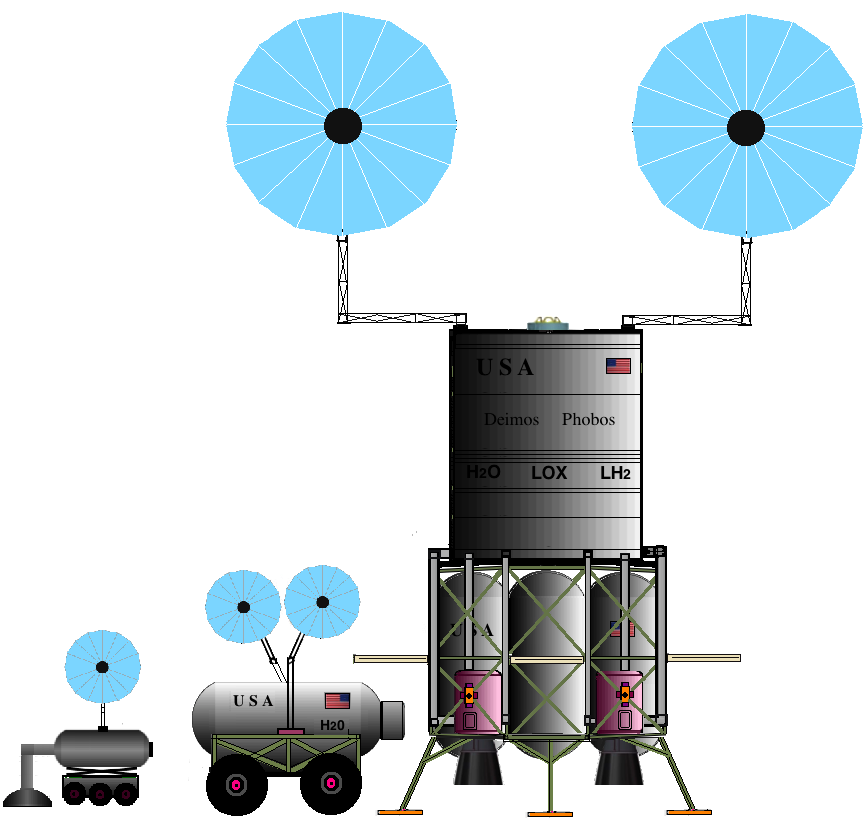 |
| Water factory would utilize mobile microwave water bugs to extract water from the regolith of the martian moons, Deimos and Phobos; WFD-LV would convert water into fuel to launch water to fuel manufacturing depot in high Mars orbit. |
A ballute capable of deploying nearly 40 tonnes to the martian surface
could also easily deploy habitats and cargo larger than those
contemplated for the Altair vehicle to the lunar surface. Cargo missions to the martian surface could utilize ballutes to deploy
mobile robots for excavating and sintering the surface of Mars to
create landing and launch pads for crewed shuttle vehicles and for
regolith shielded outpost similar to those that could be utilized on the
lunar surface.
 |
| Hydrogen inflated ballute would enable the crewed Ares 2 vehicle to aerobrake and land on the martian surface. |
Water factories than mine water from the martian regolith would also need to be deployed. Mobile microwave robots could be used to melt the ice contained in the martian regolith. Water, of course, is essential for drinking, washing, and growing food but is also essential for the production of oxygen for air. Hydrogen and oxygen can also be used to produce hydrogen and oxygen to fuel the reusable shuttle craft.
 |
| Ares 2 hovers near the sintered landing area of a martian outpost. |
Under the scenario presented here, fuel depots and rotational human
outpost would already be placed in high Mars orbit a few years before the first crewed missions to the martian surface along with water and fuel
producing facilities on the surface of the martian moons, Deimos and
Phobos. Human interplanetary missions to Mars orbit would utilize an
orbital transfer vehicle operating between the Earth-Moon Lagrange
points and high Mars orbit.
Such an interplanetary orbital transfer vehicle would utilize fuel manufactured from water exported from the lunar poles when going to high Mars orbit and fuel manufactured from water from the martian moons when returning to cis-lunar space. Such crewed missions would already transport reusable Ares ETLV-2 vehicles to Mars orbit for docking with orbiting space habitats or transferring crews to the surface of the moons of Mars. A single SLS launch could deploy one or two compacted ballutes plus heat shields to high Mars orbit for one or two human missions to the martian surface.
 |
| Rotating regolith shielded (enriched with iron ore) SLS fuel tank derived artificial gravity habitat in high Mars orbit capable of housing as many as 16 astronauts. |
Such an interplanetary orbital transfer vehicle would utilize fuel manufactured from water exported from the lunar poles when going to high Mars orbit and fuel manufactured from water from the martian moons when returning to cis-lunar space. Such crewed missions would already transport reusable Ares ETLV-2 vehicles to Mars orbit for docking with orbiting space habitats or transferring crews to the surface of the moons of Mars. A single SLS launch could deploy one or two compacted ballutes plus heat shields to high Mars orbit for one or two human missions to the martian surface.
 |
| Three solar powered regolith shielded habitat modules joined together by two inflated corridors. Additional power for the outpost would be provided by a couple of small nuclear reactors buried beneath the regolith, a few hundred meters away. |
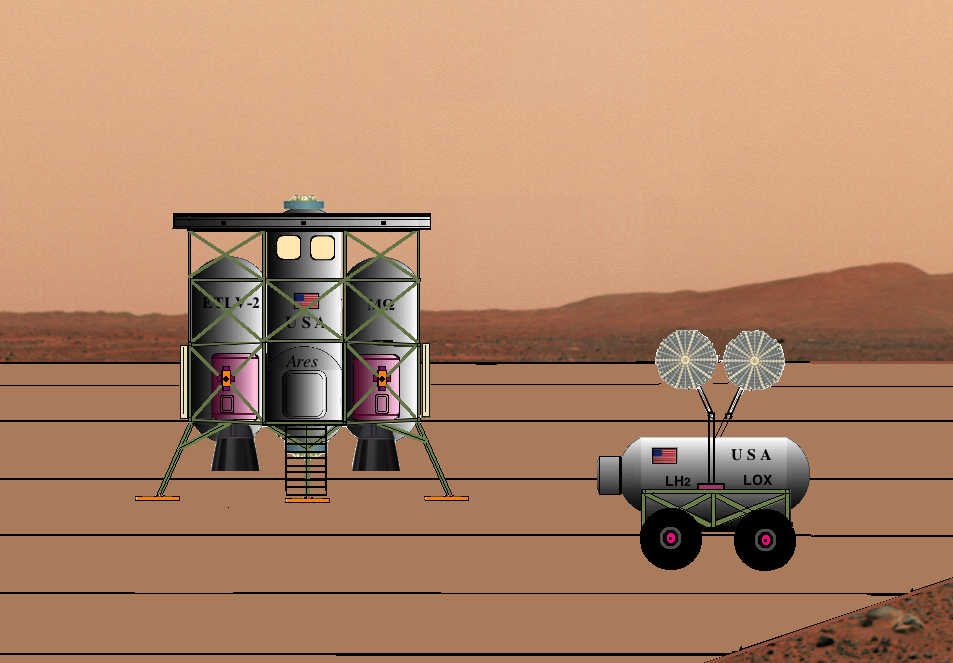 |
| Ares 2 (Ares ETLV-2) about to be fueled for take-off by a mobile LH2/LOX cryotanker. |
Links and References
The Mars Landing Approach: Getting Large Payloads to the Surface of the Red Planet
DUAL-USE BALLUTE-BASED ROBUST AEROCAPTURE, EDL, AND SURFACE EXPLORATION ARCHITECTURE FOR MARS.
Summary of Ultralightweight Ballute Technology Advances
A Survey of Ballute Technology for Aerocapture
TRAJECTORY AND AEROTHERMODYNAMIC ANALYSIS OF TOWED-BALLUTE AEROCAPTURE USING DIRECT SIMULATION MONTE CARLO
An Evaluation of Ballute Entry Systems for Lunar Return Missions
THEORETICAL OBSERVATIONS OF THE ICE FILLED CRATERS ON MARTIAN MOON DEIMOS
SLS Fuel Tank Derived Artificial Gravity Habitats, Interplanetary Vehicles, & Fuel Depots
Pioneering and Commercial Advantages of Permanent Outpost on the Moon and Mars
Utilizing the SLS to Build a Cis-Lunar Highway
Thursday, July 3, 2014

Tuesday, July 1, 2014

Tuesday, June 24, 2014
Pioneering and Commercial Advantages of Permanent Outpost on the Moon and Mars
 |
| Twin Regolith shielded habitats on a sintered lunar surface area. Each habitat module is connected to each other by an inflatable pressurized walkway. |
Planets and Moons within the solar system that are potentially suitable for human colonization:
Moon
surface area relative to the Earth: 7.4%
surface gravity relative to the Earth: 0.17g
diameter relative to the Earth: 27.3%
Mars
surface area relative to the Earth: 28.4%
surface gravity relative to the Earth: 0.38g
diameter relative to the Earth: 53.1%
Mercury
surface area relative to the Earth: 14.7%
surface gravity relative to the Earth: 0.38g
diameter relative to the Earth: 38.3%
Callisto
surface area relative to the Earth: 14.3%
surface gravity relative to the Earth: 0.13g
diameter relative to the Earth: 37.8%
Note: Land area comprises 29% of the Earth's surface with 71% covered by water
 |
| Regolith shielded habitat designed for the Moon and Mars. Mobile water tanker provides water to the habitat for drinking, washing, growing food, and for the production of air. |
 |
| Internal view of a regolith shielded habitat with regolith placed within the two meter cavity within the automatically deployed walls surrounding the 8.4 meter in diameter pressurized habitat. |
Permanent outpost on the surface of the Moon could immediately exploit lunar regolith to protect humans from significant exposure to harmful levels of radiation. Just two meters of lunar regolith dumped within the walls of a lunar regolith habitat could reduce annual cosmic radiation exposure below the maximum legal limit for radiation workers on Earth (5 Rem per year) during the solar minimum while also protecting astronauts from radiation exposure from major solar events. Protection from micrometeorites and extreme temperature fluctuations would be an added benefit of insulating a lunar habitat with regolith.
A single lunar habitat derived from the technology used to make the light weight 8.4 meter in diameter hydrogen fuel tanks for the SLS could provide two levels of floor space approximately 111 square meters in area. That would be more floor space than the average home in Germany, Japan, Sweden, Italy, Spain, Russia, and in the UK. The deployment of such habitats for the private commercial community could also be used as lunar hotels for space tourist or to house workers for private companies involved in the export of lunar water or regolith for government and private entities.
Creating solid pavement for the deployment of habitats and other lunar outpost components upon dust free surfaces could be created by using mobile robots to pave and sinter lunar regolith. This could eliminate tracking in deleterious lunar dust into pressurized habitats when astronauts are working in the paved lunar outpost area.
 |
| Mobile water tanker for storing and transporting water and a mobile water extracting robot that uses microwaves to extract water from regolith from the shadowed areas of the lunar poles. |
Human biowaste could be converted into methanol through pyrolysis. Methanol and oxygen can be used with fuel cells to produce electricity for back up energy during periods of lunar darkness. The water produced from the combustion of methanol and oxygen can be recycled. The CO2 produced from the manufacture of methanol and from the combustion of methanol in fuel cells can be used to enhance the growth of indoor lunar crops. Small portable methanol fuel cells could also be used to provide power for pressure suits during lunar excursions.
Nitrogenous biowaste, such as urine, could be used as fertilizer for lunar crops.
However, there is some evidence that substantial quantities of carbon and nitrogenous material may also be a significant component of the permanently shadowed areas at the lunar poles. Astronauts stationed at lunar outpost at the lunar poles could used to explore and to quantify the amount of volatiles located within the shadowed regions.
 |
| Buried nuclear power plant on the lunar surface (Credit: NASA) |
Outposts originally designed for the lunar surface could also be utilized on the surfaces of Mars, Mercury, and Callisto and even on the meager surfaces of large asteroids and on the moons of Mars.
 |
| Three regolith shielded habitat modules on a sintered Martian surface area. Each habitat module is connected to each other by two inflatable pressurized walkways. |
Permanent outpost on the Moon and Mars and on other worlds, would allow the continuous exploration of those surfaces by both humans and robots. Unmanned solar or nuclear powered rovers on the lunar surface, operated by humans on Earth, could visit and collect samples from practically every area on the surface of the Moon. The collected rocks and soil could then be returned to the lunar outpost for immediate study or for eventual export back to Earth.
On Mars, both robotic rovers and hydrogen blimps could be utilized to continuously explore the Martian surface. Such robots could be operated in real time by the astronauts on the Martian surface or in orbit around Mars at a space station. Again, the collected samples by the remote controlled robots could be returned to the Martian outpost for immediate study or for eventual export back to Earth.
A permanent US government presences on the surface of the Moon and Mars will also enhance the ability of private American companies to protect their assets from potentially hostile foreign entities that will probably also be on these new worlds by mid century.
Marcel F. Williams
© New Papyrus
Links and References
D. Bryant Cramer. "Physiological Considerations of Artificial Gravity." Applications of Tethers in Space, volume 1, pages 3·95-3·107. Edited by Alfred C. Cron. NASA Scientific and Technical Information Branch, 1985. Conference Publication 2364: proceedings of a workshop held in Williamsburg, Virginia, June 15-17, 1983.
Lunar Station Protection: Lunar Regolith Shielding
Wet vs Dry Moon
Utilizing the SLS to Build a Cis-Lunar Highway
Cosmic Radiation and the New Frontier
NASA Steps Closer to Nuclear Power for Moon Base
How big is a house? Average house size by country
Mission and Implementation of an Affordable Lunar Return (Spudis & Lavoie)
Using the resources of the Moon to create a permanent, cislunar space faring system (Spudis & Lavoie)
Friday, June 20, 2014

Tuesday, June 10, 2014

Subscribe to:
Posts (Atom)
CINEMA FANTASTIC


Popular Posts
-
 by Marcel F. Williams During the Great Depression, the Roosevelt administration decided to create jobs in the US by expanding electric power...
 -
 by Marcel F. Williams Moving towards a non carbon dioxide polluting energy economy does face a few problems as far as natural resources ar...
 -
 by Marcel F. Williams Tuscany is renowned for its beautiful cities of Florence and Siena, and is historically famous as the birthplace ...
 -
 by Marcel F. Williams Congress has now made it clear that they want the immediate development of a heavy lift vehicle and a crew explorato...
 -
 by Marcel F. Williams General Motors yesterday introduced the production model for their new plug-in hybrid vehicle (PHEV) which they believ...
 -
 The Earth seen rising above the Lunar horizon aboard Apollo 17, the last human mission to the Moon (Credit: NASA) by Marcel F. Willia...
 -
 X-Ray of a notional regolith shielded 16 meter in diameter biosphere (Credit: NASA) by Marcel F. Williams A t least 0.1 g is required...
 -
 by Marcel F. Williams During Space Shuttle manager John Shannon's presentation of the Side-mount Shuttle (SD-HLV) concept to the Augu...


