Showing posts with label propellant depot. Show all posts

Monday, July 4, 2022

The Functional and Economic Value of Repurposing Spent SLS Core Stages


Notional SLS derived Dry/Wet orbital habitat at LEO with more than 4000 cubic meters of pressurized volume. A notional  crewed reusable REUS-LV approaches the habitat after a voyage from a similar habitat at NRHO.

by Marcel F. Williams
 
Deploying large habitats, depots, and reusable interplanetary vehicles to LEO is probably the most logistical and economically efficient way to utilize the new Space Launch System (SLS). But the basic SLS Block I configuration capable of deploying up to 70 tonnes to LEO also comes with an added benefit. The spent core stage of the  SLS  could also arrive and remain in low Earth orbit fully intact. 

With a pressurized volume exceeding 916 cubic meters, $165 billion (in current dollars) the International Space Station is considered to be the most expensive structure ever built by humanity. But the pressurized volume of a spent  SLS core stage would exceed 3000 cubic meters (more than three times the pressurized volume of the ISS). 

If SLS core stages were allowed to remain in orbit, it could be retrofitted by astronauts from a nearby space station or space vehicle to accommodate enormous amounts of water, or cryogenic propellants, or the pressurized atmospheres of habitats. This, of course, would add significantly more economic value to each SLS launch.   

X-Ray of the SLS core stage hydrogen and oxygen tank (Credit NASA)


Microgravity Habitats

Polls suggest that 42% of Americans would like to travel into space. But  there are only about 52,000 people, worldwide, who could actually afford the $25 to $50 million cost of space travel. Still that suggest that perhaps 22,000 people who would like to travel into space-- actually have the funds to to do so. Annually, if just 10% of that group paid to visit an orbiting space hotel it would  require more than 400  commercial launches every year. This, of course, doesn't include the number of unmanned launches needed to provide such orbital facilities with the food and water and other supplies.  But even if a mere 1% of the super wealthy who desired to travel into space purchased rides to a space habitat every year,  that would require 44 to 55 private commercial launches annually.

Of course, additional revenues could be accrued by providing accommodations for astronauts from NASA, the Department of Defense and astronauts from foreign space agencies.  


Cramped conditions inside the interior of an ISS crew module (Credit NASA)

Relatively spacious interior of  6.6 meter in diameter Skylab space station (Credit NASA)


If the owner of a space hotel charged  $500,000 a day for each day their facility accommodated a  visiting astronauts or space tourist resided in their facility (including arrival and departure days) then they would make $5 million for a ten day stay. For a six member flight crew that would be $30 million dollars in revenue in just ten days.  If such a facility was continuously occupied by six individuals on average then  the orbiting hotel would make $1.095 billion (nearly $1.1 billion a year).

An SLS core stage retrofitted with docking adapters and airlocks could be latter attached to habitat modules deployed by the SLS or other launch vehicles. This could allow pressurized habitats deployed by private companies or national space agencies to attach their modules to a purchased retrofitted SLS spent core stage, guaranteeing them and additional 3000 cubic meters of pressurized space-- no matter how large of small their habitat modules are.

A  spent SLS core stage retrofitted with docking airlocks sold for $5 billion could be paid off in less than five years if the facility was continuously occupied by at least 6 astronauts or tourist. A 20 to 30 year lifetime might produce $21 to $32 billion of revenue for the SLS core stage enhanced habitat.


Notional SLS derived Dry/Wet orbital habitat at NRHO with more than 4000 cubic meters of pressurized volume. A notional crewed reusable REUS-LV is docked at the habitat before transferring a six person crew to the surface of the Moon.

Water & Sewage Depots

Water, of course,  is an extremely valuable commodity in extraterrestrial environments. Water can be used to wash, to drink, and to prepare food for its human occupants. Electrolysis can be used to convert water into  oxygen to create breathable atmospheres.   And the oxygen and hydrogen produced through the electrolysis of water can also be liquefied and utilized for rocket propellant. 

Since a spent SLS core stage would have two empty tanks, one tank, in theory,  could be used to store enormous quantities of water. This water  could later be transported to nearby orbiting habitats or to propellant producing orbiting depots. 

Human occupied orbiting habitats will also produce substantial quantities of waste water in the form of sewage. So the second SLS core stage tank could be used to store this sewage-- almost indefinitely. Ultimately this sewage could be used as another source of water.  Methane could also be produced from the sewage to fuel liquid methane fueled interplanetary spacecraft. 

Nearly a tonne a day of waste water could be produced for six occupants aboard a space habitat saving more than 300 tonnes of water a year, avoiding perhaps $1.5 billion a year in cost if such water had to be brought from the surface of the Earth.  Assuming a 20 to 30 year lifetime for the depot, that could be $30 to $45 billion in water transport savings from Earth.                                                                                                                                                                                                                                                                                               

Liquid Oxygen and Liquid Methane Depots

Nine tonnes of water for a propellant producing depot would produce one tonne hydrogen propellant plus six tonnes of oxidizer-- leaving two tonnes of oxygen as a waste product. However, a spent SLS core stage could be used to store the excess oxygen.  The spent SLS core stage could be retrofitted with solar panels to keep the oxygen refrigerated. Interplanetary  vehicles launched from Earth could arrive in orbit with only fueled with hydrogen or methane, utilizing the excess oxygen stored by the SLS core stage for propellant oxidizer.

The second tank in the SLS spent cores stage could be used to store liquid methane produced from the sewage stored in water and sewage depots.

So every 90 tonnes of water sent into space for propellant production (~$450 million),  20 tonnes ($100 million) would be wasted-- if the excess oxygen produced through electrolysis  is not stored away to be later utilized. So 900 tonnes of water sent into orbit a year for propellant production could save $1 billion a year in propellant for extraterrestrial missions.


 Rotating Crop and Orchard Plantations 

With an interior diameter of approximately 8.4 meters, the two empty tanks of a spent SLS core stage tanks could accommodate two large areas for growing crops or trees. The cylinders would have interior surfaces of 285 meters squared for the empty oxygen tank and 886 meters squared for the empty hydrogen tank. The domed end caps could be used for vineyards (growing grapes). Even with soil (presumably originating from the lunar surface) a meter deep, the two tanks should be able to grow enough food to feed at least 12 people a year. 

Dwarfed trees between 2.5 to 3 meters tall could be used to grow apples, oranges, lemons, peaches, pears, plums, cherries, olives, etc. Banana plants could also be grown. 

Crops such as wheat, corn, rice, potatoes, yams, sugar beets,  tomatoes, lettuce, pineapples, etc. could also be grown.

The bio-waste from the agricultural foliage could also be of value. Pyrolyzed into syngas,  hydrogen or methane could be produced for rocket fuel and the waste CO could be converted into CO2 for growing trees and crops. 

A thruster module could be attached to the top of the spent core stage in order to make the structure spin along its axis, producing artificial gravity within the interior of the tanks. Remote controlled robots could be used to manage the orchards and crops. Humans in pressure suits could periodically visit the space farms under microgravity conditions to retrieve fruits and vegetables or to bring in more water and equipement by simply using the thrusters to hault the structure's rotation. Entry docking ports into the two tank areas could be retrofitted into each tank area the same way it would be done for the habitat core stages that were retrofitted to be habitats.   

Solar panels and cooling fins  could be attached to the thruster unit for providing thermal control and  electricity and interior lighting for a space farm.

If eight tonnes of food could were grown a year to feed up to 12 people, $40 million a year could be saved in food exports from Earth. This is perhaps $800 to $1.2 billion --in food import savings over the course of a lifetime for the spent SLS core stage tanks.


Notional EUS derived REUS-OTV with connecting ring for operations with a second REUS-OTV vehicle


Exploiting Residual Fuel

Several tonnes of propellant would be required to de-orbit the SLS core stage. But the residual fuel used to de-orbit the core stage sending it into the Earth's atmosphere could be extracted by orbiting propellant depots to be stored and saved to fuel vehicles destined for beyond LEO missions. This could amount to $5 million per tonne of fuel saved.


Beyond LEO Deployment 

While the SLS could deploy spent core stages to LEO, a notional REUS (Reusable Exploration Upper Stage) used in pairs could be used to redeploy the core stage practically anywhere within cis-lunar space (NRHO, DRO, L3, L4, and L5) and even into orbit around Mars and Venus.


Links and References

Deploying a Ginormous SLS Derived Dry/Wet Workshop Habitat with a Single SLS Launch

Space Launch System

Commercial Launch Demand to Private Microgravity Habitats at Low Earth Orbit

The Logistical Viability of an SLS EUS Derived Reusable Lunar Crew Lander

All about dwarf fruit trees

Cis-Lunar Gateways and the Advantages of Near Rectilinear Orbits


Thursday, July 6, 2017

(Part III) A Practical Timeline for Establishing a Permanent Human Presence on the Moon and Mars using SLS and Commercial Launch Capability

A rotating artificial gravity space station in Mars orbit beyond the orbital arc of Deimos. One ETLV-4 crew lander is docked at the station's central docking port while a crewed ETLV-4 approaches the station after visiting the surface of Phobos.


by Marcel F. Williams

Part III: Artificial Gravity and the Moons of Mars 


While traveling from Earth to the Moon or the Earth-Moon Lagrange points only takes a few days, human voyages between Mars and cis-lunar space will require a several months of travel time. So astronauts will have to be adequately  protected from the  deleterious effects of cosmic radiation (especially its heavy nuclei components), solar storms, and the microgravity environment. 

The notional crewed spacecraft proposed under this scenario all have habitat areas that provide at least 20 grams per centimeter squared of radiation shielding, enough to protect astronauts from the penetration of heavy ions and from harmful levels of radiation resulting from major solar events. Such levels of shielding in interplanetary vehicles should limit astronaut radiation exposure to less than 30 Rem per year during the worse cosmic ray conditions (the solar minimum).  Permanently occupied space stations beyond the Earth's magnetosphere and  that rotate to produce a simulated gravity will have their internal shielding (iron plates)  gradually increased until levels of internal radiation exposure for its human inhabitants  is below 5 Rem per year (the legal limit of radiation exposure allowed for radiation workers on Earth). 

In order to mitigate or eliminate the deleterious effects of microgravity, under this architecture, artificial gravity environments (0.5g) will be provided for astronauts for multimonth interplanetary journeys. Simple rotating spacecraft (AGH-I) composed of three pressurized SLS propellant tank derived habitats joined together by cables and twin expandable and retractable booms will be used for interplanetary voyages between EML1 and high Mars orbit. Similar artificial gravity producing habitats will also be used for permanent space stations (AGH-SS) deployed in orbits within cis-lunar space and in orbit around Mars. 


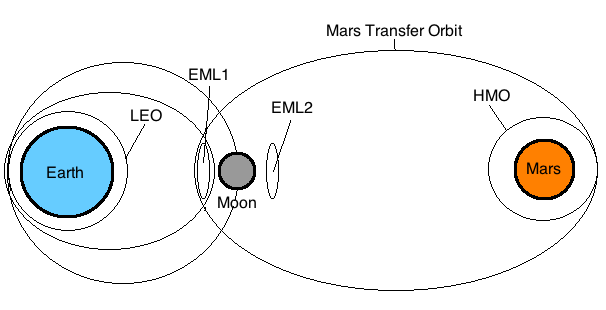
Flight paths between LEO and  EML1 and EML1 and high Mars orbit
NASA is currently contemplating a solar/xenon based interplanetary architecture. The scenario presented here, however,  advocates a propellant depot based interplanetary architecture similar to that advocated by the ULA (United Launch Alliance). The advantages are:

1. LOX/LH2 propellant allows astronauts to reach Mars faster than interplanetary vessels propelled by xenon gas, reducing radiation exposure and the psychological stress of longer travel times.

2. The continuous drive of xenon engines would make it difficult to accommodate artificial gravity habitats, forcing astronauts to endure the deleterious of effects and the physical and psychological stresses associated with a microgravity environment. So multi-month journeys within a microgravity environment could significantly increase that chances of fatal mishaps during an interplanetary mission.
3. Chemical rockets would have the advantage of being able to dump their water shielding just before their final trajectory burns,  substantially reducing vehicle mass as the spacecraft enters high Mars orbit or cis-lunar space. 

4. A xenon based interplanetary spacecraft would be dependent on an expensive fuel that has to be launched out of the Earth's enormous gravity well. A LOX/LH2 producing water depot, on the other hand, could eventually use extraterrestrial sources of water and oxygen from the Moon, Mars, the moons of Mars, etc.  

5. In order to reduce the mass required to be launched from the Earth's gravity well, a xenon based interplanetary architecture would still require substantial amounts of extraterrestrial water for drinking, food preparation, washing, radiation protection, the production of air,  and for the production of LOX/LH2 or LOX/methane propellant for vehicles landing and taking off from the surfaces of Mars or the moons of Mars. So it would be much simpler and cheaper for extraterrestrial resources to be used for the entire architecture instead of just part of it.


Bigelow BA-330 habitat which is inherently provided with enough shielding to protect astronauts from heavy nuclei penetration.


SLS and Commercial Launch Sequences to Establish a Permanent Human Presence in High Mars Orbit

2027

SLS Launches: 

SLS Launch 14: Two CLV-7B (Cargo Landing Vehicle) deployed to lunar outpost after refueling at EML1:

First CLV-7B   will be carrying  a second mobile hydrogen tanker (MHT) derived from the 2.4 meter cryotank technology plus  four  more Water Bug microwave water extraction robots.

Second CLV-7B  will deploy at least 160 KWe of  nuclear power to the lunar surface with at least a 10 year lifetime for the fueled reactors. 

SLS Launch 15: SLS deploys first artificial gravity habitat to LEO (AGH-I). An OTV-125 (an IVF modified EUS) transports the AGH-I to EML1

SLS Launch 16: SLS deploys WPD-OTV-400  EML1. The propellant producing water depot will be capable of storing up to 400 tonnes of LOX/LH2 propellant and up to 1000 tonnes of water.  

SLS Launch 17: SLS deploys OTV-400 to EML1. The SLS propellant tank derived vehicle will be used to transport crews between high Mars orbit and cis-lunar space.  


Commercial Launches:

1. First commercial deployment of reusable ACES-68 (ULA) and Shepard (Blue Origin) derived lunar landing tankers for transporting  lunar water from the lunar surface to EML1 (at least 1000 tonnes to EML1 per year)

2. Commercial launches of twin satellite communications and navigation system to Sun-Mars L4 and L5  plus a trio of satellites into Aresynchronous orbit in order to establish uninterrupted communications between Earth and Mars and between Mars orbit and the martian surface.

Notes:

 1. 2027 will be the beginning of four SLS launches per year by NASA

2. The AGH-I will be provided with water 30 centimeters of internal water shielding from water depots located at EML1. In 2027, the crewed structure will test its ability to provide 0.5 g of simulated gravity and its ability to routinely expand and contract its cables and booms and to increase and decrease its rate of rotation. 

3. The OTV-400 orbital transfer vehicle will be tested by sending it unmanned to Sun-Earth L2 and then back to cis-lunar space. 


SLS propellant tank derived Deep Space Hab (DSH). Requires additional water shielding to protect astronauts from heavy nuclei penetration (Credit NASA)

2028

SLS Launches: 

SLS Launch 18: Two DSH (Deep Space Habitats) deployed to LEO; one remains permanently at LEO while the other will  be transported by an  OTV-125 to EML1 and then to high Mars orbit

SLS Launch 19: Second WPD-OTV-400 to EML1

SLS Launch 20: SLS deploys third WPD-OTV-400 to EML1

SLS Launch 21: SLS deploys fourth WPD-OTV-400 to EML1

Notes:

1. Odyssey 1 (OTV-400 +AGH-1+ETLV-4) will travel to to  SEL2 (Sun Earth Largrange Point 2) in order to test the Odyssey vehicles interplanetary capability. It will take about 30 days to reach ESL2 and 30 days to return to cis-lunar space. 30 days will be spent at SEL2. 

2. LEO DSH (LEO Space Hab) will join the BA-330 as an additional way station for beyond LEO missions for NASA  


SLS propellant tank derived artificial gravity habitat (AGH). Requires 30 cm of water shielding for crewed interplanetary journeys and 50 cm of iron shielding as a permanent space station deployed beyond the Earth's magnetosphere. 

2029

 SLS Launches:

SLS Launch 22: Second AGH-I deployed to EML1

SLS Launch 23: Second OTV-400 deployed to EML1

SLS Launch 24:  Two ETLV-4 + OTV-125 are launched to LEO for redeployment to EML1

SLS Launch 25: Two CLV-7B vehicles deployed to LEO for redeployment at EML1:

Cargo Langer One: mobile magnetic iron extraction robots + 3D iron  panel manufacturing machines for internally radiation shielding AGH-SS space stations.

Cargo Lander Two: regolith bag manufacturing plant to enhance the protection of landing pod areas and for shielding the domed sections of future biosphere habitats

Commercial Launches:

1. Commercial launch of  BA-330 to LEO and transported to EML1 by ACES-68 OTV. The BA-330 will  be transported to high   Mars orbit by an OTV-125; departs in February of 2029 to arrive in high Mars orbit in July of 2029.
Notes:

1. Odyssey 2: Second crewed  mission of the Odyssey spacecraft will be a 235 day  round trip to SEL1 (Sun-Earth Lagrange point 1)

2. With four  WPD-OTV-400 depots at EML1, one will depart for  Mars  in January of 2029 to arrive at high Mars orbit in July of 2029. A second WPD-OTV-400 depot will depart EML1 in February of 2029 to also arrive in high Mars orbit in July of 2029. Both propellant depots will carry at least 550 tonnes of water to high Mars orbit. 

3. OTV-125 transports DSH  to high Mars orbit; departing EML1 in January of 2029 to arrive at high Mars orbit in July of 2029.

LOX/LH2 fueled OTV-400 and EUS derived OTV-125. Both reusable vehicles will use the ULA's Integrated Vehicle Fluid technology for eliminate the need for helium and hydrazine while utilizing ullage gases for attitude control. 

2030

 SLS Launches:

SLS Launch 26: Third OTV-400 deployed to EML1

SLS Launch 27AGH-SS deployed to EML4 for DOD

SLS Launch 28: NASA deploys a second AGH-SS  to EML1. The partially iron shielded artificial gravity space station will  be transported to high Mars orbit by an OTV-400.

SLS Launch 29: Two Ares R-ETLV-4  deployed to EML1+ OTV-125


Commercial Launches:

1. First commercial crew  shuttles to the lunar surface: reusable  Xeus (ULA), reusable Lunar Shepard (Blue Origin)?
 
Notes:

1. Odyssey 3:  Crewed Odyssey mission ( OTV-400/AGH-I/ETLV-4)  to high Mars orbit with a flyby past Venus.  Departs from EML1 in February of 2030, flying past Venus in  July of 2030 and arriving at Mars in January 2031. The AGH-I will replenish its water shield by rendezvousing with one of  the WPD-OTV-400 water depots.   The Odyssey 3 will use one of the WPD-400 depots to refuel with LOX/LH2 propellant in order to depart  Mars orbit in April 2031,  returning to cis-lunar space in December of 2031

During the crew's three months stay in Mars orbit, the crew will use the two ETLV-4 vehicles in Mars orbit to visit the surfaces of Deimos and Phobos. The crew will also visit the  BA-330 storm shelter and the DHS previously deployed to  high Mars orbit 

2. Second ETLV-4 is not transported with the Odyssey vehicle but self deploys itself to high Mars orbit for utilization in the crewed mission, following the same flight pattern as the Odyssey 3. 

Reusable ETLV-4 will allow astronauts to visit the moons of Mars. The ETLV-4 will also be used to transport the the ADEPT attached Ares-ETLV-4 to low Mars orbit for missions to the surface of Mars.


2031

 SLS Launches: 

 SLS Launch 30: Two ETLV-4 + OTV-125 are launched to LEO for redeployment to EML1


SLS Launch 31: OTV-125+ LRH (Lunar Regolith Habitat) to Moon for DOD
 
SLS Launch 32: SLS deploys OTV-125+LRH (agronomy hab) to lunar outpost

SLS Launch 33: Two CLV-7B cargo landers deployed to LEO to be transported to EML1.

CLV-7B One will transport four mobile crew vehicles to the lunar outpost; two for NASA and two for the DOD.

CLV-7B Two will transport two mobile optical telescopes to the lunar surface: one for NASA and one for the DOD


Commercial Launches:

1. Start of commercial launch of ADEPT deceleration shields to LEO by Vulcan launch vehicles. The ADEPT shields will be transported to high Mars orbit by reusable  OTV-125 vehicles and possibly by ACES-68 vehicles.  

 Notes:


1. An OTV-400 will transport the partially shielded AGH-SS to high Mars orbit, departing in February of 2031 and arriving in high Mars orbit in September of 2031.  

2. Second crewed Odyssey mission (Odyssey 4) will be transported to high Mars orbit by another OTV-400. The Odyssey 4 will depart EML1 in March of 2031, arriving in high Mars orbit in August of 2031. Beginning of permanent human occupation of Mars AGH-SS space station

3. Lunar manufactured iron radiation shielding plates for the AGH-SS will be transported to high Mars orbit over the years by several OTV-125 vehicles, decreasing cosmic radiation exposure to less than 30 Rem per year to less than 5 Rem per year during solar minimum conditions. 

4. The two Ares R-ETLV-4 vehicles will rear dock with two ADEPT deceleration shields. An ETLV-4 will dock and transport an Ares R-ETLV-4  from high Mars orbit to low Mars orbit. The unmanned Ares-ETLV-4 will land on Mars, testing the ADEPT shield. Teleoperated robots will be deployed to collect regolith samples and samples of the martian atmosphere. The Ares R-ETLV-4 will return to low Mars orbit where it will be transported by an ETLV-4 back to high Mars orbit. Both Ares-R-ETLV-4 vehicles will be used multiple times,  mating with other expendable ADEPT shields for unmanned sample retrieval missions to the martian surface.  This will also test the reliability of the ADEPT shields for future crewed missions to the martian surface.

5. First DOD outpost on the lunar surface (just a few kilometers away from NASA’s lunar outpost). Mobile crew transport vehicles will be used to transport astronauts between   NASA and DOD facilities.  


Odyssey interplanetary space craft. After trajectory burns to insert the Odyssey into a Mars Transfer Orbit, the AGH-I will separate from the OTV-400 and the ETLV-4 in order to rotate and expand its cables and booms to provide 0.5g of simulated gravity in the twin counter-balancing habitat modules. The AGH will dump its water shield and reattach itself to the OTV-400 and the ETLV-4 for the final trajectory burns into orbit around Mars. 


A Permanent Human Presence in High Mars Orbit

So under this propellant depot architecture, the first crewed mission (Odyssey 3) to high Mars orbit will depart from EML1 in February of 2030 and arriving at Mars in January 2031, flying past the planet Venus during the nearly year long journey. Once the crew arrives, a DSH (Deep Space Habitat) and storm shelter (BA-330) will already be deployed in high Mars orbit in order to enhance their safety. After their orbital transfer vehicles (OTV-400) has been refueled by one of the twin propellant depots (WPD-OTV-400), the Odyssey 3 will depart from Mars in April 2031 and returning to cis-lunar space in December of 2031.

WPD-OTV-400 propellant producing water depot in high Mars orbit refueling an OTV-400 that will transport the Odyssey back to cis-lunar space.


The second crewed mission to high Mars orbit (Odyssey 4) will depart from EML1  in March of 2031, arriving in high Mars orbit in August of 2031. This mission will include the first use of ADEPT deceleration shields to land   R-ETLV-4 vehicles on the martian surface for the robotic retrieval of lunar regolith samples. 
Ares-ETLV-4 simply adds additional thrusters to the top of the ETLV-4 to provide sufficient attitude control while entering the martian atmosphere behind and ADEPT deceleration shield. 


Unmanned Ares-ETLV-4 attached to an ADEPT deceleration shield. Teleoperated robots will be deployed to retrieve regolith and atmospheric samples to be returned to low Mars orbit and back to the AGH-I.


Landing Humans on Mars will be the last part (Part IV) of this article.  
 

Friday, February 3, 2017

Leasing the Moon

The near side of the Moon

by Marcel F. Williams

At the bottom of the world lies an icy continent larger than Europe-- but with only 5000-- temporary-- residents. While the continent of Antarctica can be explored, this polar condominium cannot be  colonized or commercially exploited. It is argued that this is the only way to protect Antarctica's pristine environment.

Of course, the same environmental philosophy could also be argued for Earth's other continents: North America, South America, Africa, Australia, and Eurasia.
 

And some have advocated that the Moon should also be under the same environmental protection as Antarctica. This, of course,  would prevent the colonization of the Moon and the commercial exploitation of lunar resources.

On the Earth's surface, only about 3% of the land area is urbanized with cities, towns, and suburban areas.  But the human utilization of the Earth's surface grows to 43% if we include the amount of land used for agriculture.

I happen to be  a strong advocate for preserving the Earth's environment and the environment and natural beauty of the other major worlds in our solar system. Trying to convert Mars into an Earth-like world would be an abomination, in my opinion.  But I don't believe that people should object to a reasonable level of commercial exploitation and colonization of other worlds -- if it proves to be possible to do so under a lower gravity environments.

And this should also apply to Antarctica, in my opinion.


The 1% Rule

What if the nations of the world passed an international law that allowed up to 1%  of the terrestrial environment in Antarctica to be commercially exploited and even colonized (up to 140,000 square kilometers of territory) by the other nations of the world while also preventing at least  99% of the rest of the continent from being settled or commercially exploited? That would mean that up to 140,000 square kilometers of land could be colonized or commercially exploited on the Antarctican continent.

Under this scenario, individual nations would be   allowed to lease territory in Antarctica for $1 million  per year for one square kilometer of land (100 hectares).  While probably only the wealthiest nations would be able to afford to lease and exploit territory in Antarctica,   the  revenue-- from the leases-- would be equally divided amongst every nation on Earth. Because of the need to administer the leases, the UN (the United Nations) as an entity would also a receive a share of the revenue equal to that of the individual nations.  So, in theory,  as much as $140 billion in annual revenue could be annual generated from the leasing of 1% of the territory on Antarctica.

I'd also charge-- a  renewal fee-- of $1 million per square kilometer of leased territory  every 20 years.

Nations leasing territory in Antarctica would have the right to sublease some or all of its territory to private entities. If governments subleased territory for  perhaps $100,000 a year per hectare, each square kilometer of territory could potentially be worth up to $10 million per year.

Antarctica (Credit: Wikipedia)
To prevent enormous blocks of land from being leased in a single region by a single government, I'd limit the amount of continuous land that can be leased in Antarctica by a single nation to just 25 square kilometers within a radius of five kilometers. I'd also forbid a nation from leasing  land in Antarctica that is less than 100 kilometers away from other lands that they are leasing in Antarctica. I'd also forbid other nations from leasing land that is within 5 kilometers of land being leased by another nation. This would allow potentially valuable regions in Antarctica to be colonized or exploited by multiple nations within a particular region. 

Antarctica

Surface area: 14 million square kilometers

Maximum leasable land area (1%): 140,000 square kilometers ($140 billion per year)

Maximum continuous area allowed to be leased by a single nation: 25 square kilometers within a 5 kilometer radius

Minimum gap between leased areas among different nations: 5 kilometers

Minimum gap between  areas leased by the same nation: 100 kilometers


The Lunar Territories

I would also advocate a similar international law for  the exploitation and colonization of the lunar surface and the preservation of at least 99% of the lunar environment on the lunar surface. A maximum of 1% of the lunar surface could be leased to national governments who would be allowed sublease parts of their leased territories to private individuals and commercial companies.  

I do believe, however,  that there are some areas on the lunar surface that need to be more carefully managed and even banned from potential commercialization and colonization.  I think it should be internationally agreed that territory  on the far side of the Moon below 70˚ north or south (well beyond the polar regions) should be banned from commercial exploitation and colonization.

Positions of the Earth-Moon Lagrange Points (Credit: Maccone)
Because the far side of the Moon is blocked from electromagnetic noise emanating from the surface of the Earth, this region of the lunar surface has always been viewed as the perfect location for future radio telescopes and phased array detectors. However, the prospect of outpost and colonies located at the EML4 and EML5 Earth-Moon Lagrange points would shrink the radio shielded areas on the backside of the Moon to a territorial radius of 910 kilometers extending from the lunar equator at a 180˚ longitude. Again, forbidding nearly all of the territory on the far side of the Moon from being leased would prevent it from being explored or used as an astronomical observatory. But it would prohibit the permanent deployment of spacecraft and potential habitats at EML2.

Protected Antipode circle on the farside of the Moon (Credit: Maccone)

 I'd also prevent the ice at the lunar poles from being-- over exploited--  by limiting the maximum leased area within the polar regions to 1%. Since it is estimated the north and south poles of the Moon may contain as much as 6.6 billion tonnes of water ice. Assuming that areas in the polar regions that don't contain significant amounts of ice are avoided, perhaps up to 10% (660 million tonnes) of the ice in the polar regions could eventually be exploited under these rules.   Over a 200 year period of maximum legal exploitation, up to 3.3 million tonnes of water ice could be mined each year.  About 1000 tonnes of water per year would be required for NASA's human cis-lunar and Mars operations during the next 25 years. A lunar population of more than 450,000 people could probably be supported over a 200 year span, a lot more if a significant portion of the water is recycled and oxygen from the lunar regolith is exploited for air.

Probable ice deposits in the lunar south pole (Credit: NASA)

While such a large and growing lunar population might put intense political pressure on allowing even more polar ice to be exploited, it might be more sustainable for future Lunarians to start importing hydrogen from other regions of the solar system: the NEO asteroids, Mars, Mercury, Callisto, Jupiter's atmosphere, the asteroid belt, the Greek and Trojan asteroids of Jupiter's orbital arc. Water and energy could be produced  By using the Moon's almost limitless oxygen resources, hydrogen can be converted into  water and energy.   The import of substantial amounts extraterrestrial hydrogen into cis-lunar space could also give the Moon the economic advantage of exporting its  oxygen resources to LEO and the Earth-Moon Lagrange points for propellant and to produce water and energy.

Moon

Surface area: 38 million square kilometers

Maximum leasable land area (1%): 380,000 square kilometers ($380 billion per year)

Maximum leasable area in polar regions (1%)

Regions not available for leasing: Regions on the far side of the Moon below 75 degrees latitude (north and south) including the Protected Antipode Circle,  a circular piece of land 1820 kilometers in diameter on the far side of the Moon shielded from potential radio signals from orbital habitats and colonies located at EML4 and EML5. 

Maximum continuous area allowed to be leased by a single nation: 25 square kilometers within a 5 kilometer radius

Maximum continuous area allowed to be leased in the polar regions by an individual nation: 16 square kilometers within a 3 kilometer radius 

Minimum gap between leased areas among different nations: 5 kilometers

Minimum gap between  areas leased by the same nation: 100 kilometers

Minimum gap between  areas leased by the same nation in the polar regions: 50 kilometers


Under these rules,  the 51km in diameter Shoemaker crater alone would have enough area to legally exploitable area to accommodate ice mining by  more than a dozen countries. Even with the 100 km gap between leased regions, the US could still lease several ice rich areas in the lunar south pole.


The Martian Territories

With a surface area of nearly 145 million square kilometers, nearly 1.45 million square kilometers of land could be exploited or colonized by the nations of the Earth with a potential revenues of nearly $1.45 trillion a year if all the territories legally allowed to be occupied were leased. But because Mars is much larger world, I'd allow up to 100 square kilometers of continuous land to be leased by an individual nation within a radius of 10 kilometers.


Map of the martian surface (Credit: NASA)


Mars 

Surface area: 145 million square kilometers

Maximum leasable land area (1%): 1.45 million  square kilometers ($1.45 trillion per year)

Maximum continuous area allowed to be leased by a single nation: 100 square kilometers within a 10 kilometer radius

Minimum gap between leased areas among different nations: 5 kilometers

Minimum gap between  areas leased by the same nation: 100 kilometers

I think its obvious, under these rules, that far less than 1% of the land area on these extraterrestrial worlds would ever have to be leased in order to sustain human civilization in the solar system over the next 1000 years.


Links and References

Antarctica - Wikipedia

“Protected antipode circle on the Farside of the Moon,” Acta Astronautica 63 (2008), pp. 110-118. 
 

 PROTECTED ANTIPODE CIRCLE ON LUNAR FARSIDE


Monday, July 11, 2016

Substantially Enhancing the Capability of the SLS Architecture by Utilizing EUS Derived Propellant Depots and Reusable Orbital Transfer Vehicles

Left: Orion space capsule with hypergolic fueled Service Module; right:  notional Orion spacecraft with a reusable EUS derived orbital transfer vehicle.  
It now appears that Congress will direct NASA to return Americans to the surface of the Moon in order to prepare for future crewed journeys to the surface of  Mars. But the Moon could prove to be much more than just a beyond LEO testing ground for astronauts and components.

At minimum, an interplanetary round trip to the Red Planet would require several hundred tons of  water for drinking, washing, food preparation, radiation shielding, the production of air, and for the production of liquid oxygen (LOX) and liquid (LH2)  for rocket propellant.

Supplying the water needed for an interplanetary spacecraft parked at LEO  would require a delta-v ranging from  9.3 km/s to 10 km/s from the Earth's surface. Minimum energy launch windows during the 2030s would require an additional delta-v ranging from 3.59 km/s to 4.81 km/s for Trans Mars Injections (TMI)  that could send humans to Mars in less than a year.

But at different locations within cis-lunar space, substantially lower levels of delta-v could be taken advantage of in order to launch cargo and crew into a Trans Mars Injection. And these interplanetary launch points within cis-lunar space are most easily accessible from the lunar surface rather than from within the Earth's deep gravity well. So utilizing lunar ice resources could greatly reduce the cost and the complexity of sending humans to Mars.


Delta-v to important destinations within cis-lunar space

Earth surface to LEO - 9.3 km/s to 10 km/s

LEO to EML1 - 3.77 km/s (~3 days)

LEO to EML1 - 4.5 km/s (~2 days)

LEO to EML2 - 3.43 km/s (~8 days)

LEO to EML2 - 3.95 km/s (~4 days)

Lunar surface to EML1 - 2.52 km/s (~3 days)

Lunar surface to EML2 - 2.53 km/s (~3 days)


Delta-v from cis-lunar space to Trans Mars Injection

LEO to TMI (2030s) - 3.59 km/s to 4.81 km/s

EML1 to TMI (2030s) - 1.04 km/s to 1.3 km/s

Because of its shorter travel times from Earth orbit,  EML1 would appear to be the optimal region for locating Deep Space Habitats (DSH), reusable lunar shuttles,  propellant manufacturing water depots that receive water from the lunar surface and for launching cargoes and crew on interplanetary journeys to the orbits of Mars and Venus.

A delta-v of   3.77 can transport crews to EML1 in approximately 4 days. It would require 3.95 km/s to travel to EML2 in 4 days but 8 days of travel and radiation exposure would be required to take advantage of a lower delta-v to EML2 at 3.43 km/s. A delta-v of 2.52 km/s would be required for a 3 day journey between EML1 to the lunar surface. 2.53 km/s would be required for a similar journey between EML-2 and the lunar surface. The significant presence of habitats and depots and reusable vehicles at EML-2 could also interfere with future radio astronomy on the back side of the Moon.

Taking full advantage of polar ice resources on the Moon would require a space architecture that utilizes orbiting depots to supply water and propellant to reusable interplanetary spacecraft and landing vehicles. Some space advocates have argued that propellant depots make heavy lift vehicle's an unnecessary expense. However, heavy lift vehicles would make it possible to easily deploy propellant manufacturing water depots to  EML1  for crewed interplanetary journeys to the orbits of Mars and Venus.

Similar depots located at LEO could also enable large payloads  originally deployed  to LEO by heavy lift vehicles to be later  deployed by reusable orbital transfer vehicles practically anywhere within cis-lunar space.


Expendable EUS for SLS launch vehicle (Credit: NASA)


In 2018, NASA will launch the first SLS heavy lift vehicle with an unmanned Orion space capsule and a hypergolic fueled Service Module and an interim upper stage. But NASA currently envisions crewed SLS launches in the 2020s to include an Orion space capsule with a hypergolic fueled Service Module and a large LOX/LH2 fueled Exploratory Upper Stage (EUS). 

But two of the principal companies (Boeing and Lockheed Martin) currently developing the SLS/Orion architecture are also--  privately developing-- an alternate space architecture through their joint company, the  ULA (the United Launch Alliance). In this alternate architecture, the ULA  will utilize their emerging  IVF (Integrated Vehicle Fluids ) technology to deploy a reusable ACES upper stage that could eventually utilize LOX/LH2  propellant depots for travel within cis-lunar space during the 2020s. IVF technology allows a spacecraft to utilize hydrogen and oxygen ullage gases for attitude control, power production, and for autogenously pressurizing propellant tanks, eliminating  the need for hydrazine and liquid helium. 

NASA could greatly enhance the capability, efficiency, and the safety of the SLS/Orion architecture by taking full  advantage of the ULA’s  emerging IVF  technology. While there's no reason to stop Boeing from developing the EUS as an expendable upper stage for the SLS, it would still be technologically advantageous for NASA to commission the ULA to use its IVF technology to convert some EUS vehicles into  reusable orbital transfer vehicles and others into propellant depots.

EUS derived propellant manufacturing water depot and reusable Orion orbital transfer vehicle.

 An SLS/Orion architecture utilizing EUS derived Orbital Transfer Vehicles (OTV-125) and EUS derived propellant producing water depots (WPD-OTV-125) would no longer require the expense and the enhanced risk of launching astronauts on top of a super heavy lift vehicle. So for beyond LEO missions in the 2020s, under this scenario, astronauts would simply be transported to LEO by Commercial Crew vehicles that would have already been in operational service since 2018.

Once in orbit, the commercial crew capsule would dock directly with the Orion-OTV-125 reusable spacecraft, transferring its crew aboard the Orion for its beyond LEO mission. Alternatively, a crew capsule could dock at the port of  a space station where the Orion-OTV-125 would also be docked at a different port. Both scenarios would mean that the ATV based hypergolic Service Module being manufactured by the Europeans would not be required for crewed beyond LEO missions, and would only be used once during the 2018 test mission. So only  the domestically manufactured Orion capsule being developed by Lockheed Martin would be preserved in this architecture.

A single SLS Block I cargo launch could be used to deploy two WPD-OTV-125 depots to LEO plus a two 1 MWe solar arrays. With at least 35 tonnes of propellant, one of the water/propellant depots could self deploy itself to EML1 along with its 1.4 to 2.8  MWe solar array. Another basic SLS Block I cargo launch could be used to deploy two reusable Orion-OTV-125 vehicles to LEO. But once this reusable depot based extraterrestrial architecture is deployed by the SLS,  private commercial launch vehicles will only be required to conduct crewed beyond LEO missions. This will allow the SLS to be used exclusively as a cargo launcher for the deployment of large and heavy spacecraft and habitats and other large and heavy structures.

Notional lunar water ice extraction, storage, and LOX/LH2 manufacturing facility.

Water for the propellant manufacturing orbital depots could be regularly supplied to LEO and to EML1 from commercial launch vehicles (Atlas V, Delta IV heavy, Falcon 9, and the future Falcon Heavy, Vulcan, and Vulcan Heavy vehicles).  However, once water is being manufactured on the lunar surface, water transported to EML1 would be supplied  exclusively from the lunar surface.


Since the  Orion-OTV-125 would derived from the EUS, it would be capable of accommodating up to 125 tonnes of propellant. But less than 35 tonnes of propellant would be required for an Orion-OTV-125 to transport its crew to EML1. And an equal amount of fuel would be needed to return astronauts to LEO. No aerobraking would be required.

A reusable Extraterrestrial Landing Vehicle (ETLV) would transport astronauts from EML1 to the surface of the Moon and back  to EML1 with a single fueling of LOX/LH2. A single SLS Block I cargo launch could deploy three ten tonne ETVL-2 vehicles to LEO, each with enough propellant to travel to EML1. The ETLV-2 could also serve as an back up OTV in case one or both of the Orion-OTV-125 vehicles becomes inoperable.

Until new RS-25 engines are in production, perhaps by 2021 to 2023, NASA will only be able to launch four SLS vehicles. And one of those launches will be an unmanned test launch in 2018. So after 2018, only three SLS launches will be possible before the RS-25 engines go into production.

Notional EUS derived propellant manufacturing water depot @ EML1 after refueling a reusable Extraterrestrial Landing Vehicle.

But  just three basic  SLS Block I cargo launches would be required to deploy a reusable EUS derived cis-lunar transport architecture (WPD-OTV-125, Orion-OTV-125, and the ETLV-2) capable of transporting humans to EML1 and to the lunar surface and back.

However, the deployment of the lunar landing vehicles could be delayed until the new RS-25 engines are in production. This would allow NASA to use their last four Space Shuttle Main Engines to be used to launch a DHS (Deep Space Hab) to EML1. An SLS propellant tank derived habitat with over 510 cubic meters of pressurized habitable volume would have a dry weight of 22.4 tonnes. So in theory,  a single SLS Block I cargo launch could be used to deploy two or three pressurized habitats to LEO. A partially fueled Orion-OTV-125 could then be used to transport one of the pressurized habitats to EML1.
SLS propellant tank derived habitat (Credit: NASA).

This would leave one or two pressurized habitats at LEO with a combined pressurized habitable volume exceeding that of the ISS! All of that would be achieved with  a single SLS launch and a reusable propellant producing water depot architecture routinely and sustainably  supplied with water from commercial launch vehicles.


Links and References

Moon first, then Mars? Congress moves to shift space priorities

The return to the moon, Lori Garver, and the price of ambition

Lori Garver Questioned Astronauts about NASA's Next Destination?

Seeing the end of Obama’s space doctrine, a bipartisan Congress moves in

What about Mr. Oberth

Human Lunar exploration architectures

Earth Departure Options for Human Missions to Mars

A Study of CPS Stages for Missions beyond LEO

Deep Space Habitats

First Human Voyages to the Martian Moons Using SLS and IVF Derived Technologies

Congress Requires NASA to Develop a Deep Space Habitat

UltraFlex Solar Array Systems


Monday, September 7, 2015

Reusable Hoppers and Orbiters for Rapid Lunar Transportation and Exploration


by Marcel F. Williams

For NASA and its future SLS program,  developing  a reusable single staged extraterrestrial  landing vehicle (ETLV) could allow America to send astronauts  to the surface of the Moon, Mars, and even to the surfaces of the moons of Mars. Such an ETLV could be used to conveniently transport astronauts from EML1 (Earth-Moon Lagrange point 1) to the surface of the Moon and back to EML1 on a single fueling of LOX/LH2 propellant. NASA astronauts could reach EML1 and return to the Earth via an SLS launched Orion spacecraft.

Eventually, by deploying ETLV derived orbital propellant depots at points of departure and destination, such a reusable spacecraft could also be used as an orbital transfer vehicle, transporting astronauts between LEO and the Earth-Moon Lagrange points. This would allow Commercial Crew vehicles to shuttle NASA astronauts to LEO to dock with an ETLV destined for EML1 or to return astronauts from an ETLV returning from EML1. 


ETLV-2 (Extraterrestrial Landing Vehicle)

Inert weight with cargo and  crew (8 passengers): 10 tonnes

Maximum amount of propellant:  24 tonnes of  LOX/LH2

Maximum fueled weight: 34 tonnes

Specific Impulse of LOX/LH2 engines: ~ 450 seconds 
Top: ETLV-2 reusable lunar crew lander and lunar hopper; Bottom: CTLV-5B reusable LOX/LH2 cryotanker.

CTLV-5B (Cryotanker Landing Vehicle)

Inert weight: 8 tonnes

Maximum amount of propellant: 30 tonnes

Maximum fueled weight: 40 tonnes

Specific Impulse of LOX/LH2 engines: ~ 450 seconds


By utilizing  ADEPT  deceleration shields, such an ETLV could also be used to transport humans from low Mars orbit to the surface of Mars and back into  Mars orbit  on a single fueling.  With an ADEPT decelerator, the delta-v requirement to land on the lunar surface from orbit is only 0.51 km/s. The delta-v to travel from the surface of Mars back to Mars orbit is 4.4 km/s. Propellant depot located in Low Mars Orbit would allow the vehicle to refuel in order to travel to orbital habitats or interplanetary vehicles located in High Mars Orbits. Traveling between High Mars Orbit and the Earth-Moon Lagrange points has the lowest delta-v requirements between Mars orbit and cis-lunar space.

A reusable  ETLV located at propellant producing  lunar outpost that utilizes a reusable CTLV (Cryotanker Landing Vehicle) could also allow humans to continuously explore practically every region on the lunar surface without the need of any additional SLS launches from Earth-- dramatically reducing the cost of the human exploration of the Moon

Once a permanent outpost is established on the surface of the   Moon, the entire lunar surface, including its craters, could be continuously explored by robotic lunar rovers tele-operated from Earth. Such solar and nuclear powered mobile robots could also retrieve regolith samples  for return to the outpost for study and, eventually, transported back to Earth. Such mobile robots could also be used to  locate interesting sites for future human exploration.

Because annual levels of cosmic  radiation on the lunar surface can range from 11 Rem during solar maximum conditions to as high as 38 Rem during solar minimum conditions, astronauts living on the Moon for several months or several years will have to minimize their radiation exposure by mostly living inside regolith shielded habitats to reduce annual radiation exposure to less than 5 Rem (the maximum level of radiation exposure for radiation workers on Earth) during solar maximum and minimum conditions. This can easily be done by landing  habitats on the lunar surface that can automatically deploy regolith walls that can be easily filled with approximately 2 meters of lunar regolith.

If astronauts spend about 10% of their time outside of their shielded habitats  (2.4 hours per day or 16.8 hours per week), their additional exposure after a year would only range from 1.1 Rem to 3.8 Rem. A 25 year old female could live and work on the Moon for a decade and still not exceed her maximum lifetime limit of 100 Rem. Astronauts minimizing their radiation exposure by  exploring the lunar surface for just  four to eight hours per week could, therefore,  explore various regions on the Moon on a weekly basis-- if they could have easy access to such regions.

Since ground vehicles transporting crews across the lunar surface are not likely to exceed 20 km per hour in average speed, the maximum area that could be explored by pressure suited astronauts is not likely to exceed a distance of more than 80 kilometers away from a shielded lunar  outpost.

However, rocket powered sub-orbital Lunar Hoppers hurtling along parabolic arcs have long been advocated as a way for humans to explore more distant regions on the Moon-- far beyond a permanent lunar outpost. But such missions would require the reusable vehicle to have-- enough propellant-- to:

1. take off from the outpost on a suborbital trajectory,

2. land at the site intended to be explored,

3. take off again on a suborbital trajectory,

and,

4. land back at the lunar outpost.


The delta-v and travel times for possible crewed suborbital hops on the lunar surface.
David Hop, on his popular space blog, has done some interesting calculations, suggesting  that lunar hoppers could transport humans anywhere on the lunar surface in less than an hour with a maximum delta-v of only 1.68 km/s. So  transportation between lunar outpost and lunar cities could be conveniently fast and easy-- as long as every lunar outpost or  lunar city can refuel the Hopper for its next suborbital destination.  

An ETLV fueled with a maximum of 24 tonnes of LOX/LH2 propellant (originally designed for round trips between EML1 and the lunar surface) could transport astronauts within a 1300 kilometer radius from a lunar outpost and back.  Beyond 1300 kilometers (45 degrees), however, such an ETLV  would not have enough propellant for its return trip to the lunar outpost.

Since the distance from the poles to the lunar equator would be 2700 kilometers away and to  the opposite pole, more than 5400 kilometers away,  a single polar outpost would pretty much  confine  human exploration via Hoppers mostly to it's polar region.

One way to overcome such geographical limitations would be to launch crewed ETLVs to EML1.  There it would add additional rocket fuel  from a  propellant depot (WPD-OTV-5A) located at EML1 for a round trip mission from the Lagrange point to the lunar site chosen to be explored. After the completion of the exploratory mission, the ETLV would return to EML1 to add propellant for its return trip to its original lunar outpost.


Lunar Exploration via lunar outpost and EML1 propellant depot

1. Crewed ETLV-2 launched from lunar outpost to EML1 (less than 12 hours at high delta-v or two days at a lower delta-v))

2. ETLV-2 rendezvous with WPD-OTV-5A adding enough propellant for a round trip from the lunar surface and back to EML1

3. ETLV-2 travels to lunar orbit and lands at lunar site (~2 days of travel) for a few hours or a few days of exploration

4. ETLV-2 launches itself back to EML1 (~2 days of travel) and rendezvous with WPD-OTV-5A to refuel for trip back to lunar outpost

5. ETLV-2 departs from EML1 to return to lunar outpost (less than 12 hours or up to two days)

This scenario requires only one vehicle (ETLV-2). In theory, it would  allow sorties to be conducted practically anyplace on the lunar surface on a weekly basis.  This method, however,  would require at least five to eight days of travel time-- excluding the time spent exploring the region on the lunar surface. So each lunar sortie would expose astronauts to five to eight continuous  days cosmic radiation outside of a regolith shielded outpost-- for perhaps just a few hours or a few of days of exploration at a particular lunar site.

Alternatively, pre-deploying a mobile propellant depot (MCT) at the site intended to be explored could minimize astronauts radiation exposure during a lunar sortie.


 ETLV-2 lands near a pre-deployed mobile cryotanker (MCT) after it's suborbital flight to a predetermined lunar exploratory site. The MCT will provide the ETLV-2 with additional LOX/LH2 for its return flight to a polar outpost.

 Lunar exploration utilizing mobile cryotankers

1. A solar and fuel cell powered mobile cryotanker (MCT) with up to 12 tonnes of propellant is sent to a lunar exploratory site (distance traveled: 300 km/day) in less than a month

2.  Crewed ETLV-2 launched from lunar outpost to lunar exploratory site (less than an hour)  with a few tonnes of extra fuel for the return trip to the outpost. 

3. MCT adds enough additional  fuel to the ETLV-2 for it to return to the lunar outpost

4. With added fuel, the ETLV-2 launches itself back to lunar outpost in less than an hour of travel time

5. The mobile MCT returns to the lunar outpost after a few weeks of travel time.

This scenario dramatically reduces  astronaut's travel time  to less than two hours of continuous radiation exposure. Preparing for such lunar sorties, however, would require a mobile cryotanker to be deployed to the exploratory site a few weeks before the crewed mission. And then a few weeks would have to be allowed for the cryotanker's return to the lunar outpost.


However, there is another way that lunar sorties from a lunar outpost could be conducted on a daily basis while also minimizing cosmic radiation exposure. This scenario would require an ETLV to be launched in an orbital plane above the intended site to be explored  along with a reusable  CTLV (Cryotanker Landing Vehicle).

Crewed ETLV-2 rendezvous with an unmanned CTLV-5B cryotanker in the same orbital plane as the intended  lunar exploratory site and the lunar outpost. After the lunar exploratory mission is completed, both the ETLV-2 and the CTLV-5B will return to the lunar outpost to be used again for future lunar exploratory missions.

 Lunar exploration utilizing an ETLV-2 and CTLV-5B in lunar orbit

1. CTLV-5B launched from lunar outpost into an orbital plane directly above the intended landing site

2. Crewed ETLV-2 launched from lunar outpost  into the same orbital plane

3. ETLV-2 rendezvous with CTLV-5B adding enough propellant for a round trip from the lunar surface and back into orbit

4. ETLV-2 lands at lunar exploratory site for a few hours or a few days of exploration

5. ETLV-2 launches itself back into orbit along the same orbital plane

6. ETLV-2 rendezvous with CTLV-5B adding enough propellant to return to the lunar outpost

7. CTLV-5B uses the its remaining amount of propellant to land back at the lunar outpost to be eventually refueled to assist in the next sortie mission on the lunar surface


ETLV-2 at an exploratory site on the lunar surface. Distances exceeding  1300 kilometers away from a propellant producing lunar outpost will require the ETLV-2 to use its remaining fuel to launch itself back into the same orbital plane as an orbiting CTLV-5B cryotanker, in order to add the needed fuel necessary for it to return to the lunar outpost.

The CTLV is simply the CLV (Cargo Landing Vehicle) without the cargo. So no new extraterrestrial vehicle would have to be developed in order to utilize the CLV as a reusable propellant vehicle (CTLV).

While this scenario requires two reusable launch vehicles (ETLV-2 and the CTLV-5B), it has the advantage of being able to  deploy astronauts quickly to an exploration site in just a few hours. Most of the few hours of travel time for astronauts would be spent in lunar orbit while rendezvousing with the CTLV-5B propellant  depot to add more propellant.

In the early 2030s, I imagine that most of the water produced at a lunar outpost  would probably be exported to one of the Earth-Moon Lagrange points to provide water for future interplanetary missions to Mars, Venus, ESL4, ESL5, and the NEO asteroids: water for drinking, washing, the production of air, radiation shielding, and LH2/LOX propellant.

But some of the water derived from the lunar poles could also be used for the production of lunar propellant intended for the domestic human exploration of the lunar surface.  This could allow reusable Extraterrestrial Landing Vehicles to  cheaply and conveniently transport astronauts to practically every region on the lunar surface for a few hours or even a few days of exploration. So the production and export of lunar water could not only greatly enhance NASA's ability to send humans to Mars but it could also usher in a new renaissance of human exploration-- on the lunar surface.


Links and References


Trajectory Optimization for Adaptive Deployable Entry and Placement Technology (ADEPT)

Lunar Hopper

Travel on airless worlds 

Lunar pogo hopper

Drones on the Moon
Is it possible to explore the Moon with low-altitude flying spacecraft?

Lunar Lander Designs for Crewed Surface Sortie Missions in a Cost Constrained Environment

The SLS and the Case for a Reusable Lunar Lander

An SLS Launched Cargo and Crew Lunar Transportation System Utilizing an ETLV Architecture

Utilizing the SLS to Build a Cis-Lunar Highway

Cosmic Radiation and the New Frontier

Blog Archive

CINEMA FANTASTIC

Popular Posts