Showing posts with label EUS. Show all posts

Wednesday, August 9, 2023

SLS Derived Artificial Gravity Habitats for Orbital Havens and Interplanetary Space Travel


Notional spinning artificial gravity producing AGH 1500 orbiting 600 km above the Earth's surface. Rectractable solar arrays and radiators produce power and regulate temperatures for the twin habitats.    

by Marcel F. Williams

Microgravity environments are inherently deleterious to human health in space. 

Weight loss, the clumping of perspiration and tears, facial and speech distortions, a degraded sense of  taste and smell,  and even an increased frequency of  flatulence are minor problems associated with short term exposure to a microgravity environment. 
 
But months or years under microgravity conditions can cause much more serious problems for  human health in space. Without regular exercise, 20% of muscle mass can be lost in just 12 days. 1.5% of bone mass is lost in a single month. And this bone demineralization can increase the calcium concentration in the blood stream, increasing the risk of developing kidney stones.  Significant reductions in cardiovascular fitness can also result from long periods of microgravity conditions. Vision problems of varying degrees of severity can occur in men in their 40s or older.  And the use of medicine can be hampered due to the changes in blood flow redistribution under microgravity conditions. 
 
After  a few months aboard the ISS, the blood pressure of some astronauts drops to abnormally low levels when they move from a lying position to a sitting or standing position. Some astronauts even have problems standing up, walking, and turning and stabilizing their gaze.
 
 The deployment of small habitats that are capable of spinning to produce artificial gravity could alleviate the health problems associated with a microgravity environment. Artificial gravity habitats could allow humans to:

1. Remain in orbit perpetually without the need to return to the Earth’s surface reducing the number of launches necessary to maintain a human presence in space 
2.  Remain physically healthy during long interplanetary journeys 
3. Receive quality medical care while in orbit including major surgical procedures. 
4. Have a  permanent human presence in orbit practically anywhere in the solar system 
5. Test  variable levels of gravity on the health of humans and other animal species
Notional 10 meter in diameter AGH 1500 in launch configuration on top of the SLS compared an SLS vehicle with an EUS and 10 meter in diameter payload faring.
 
An SLS Block I configuration would easily be capable of deploying a 60 tonne artificial gravity habitat to LEO. Reusable EUS derived ROTV 100 orbital transfer vehicles cold to deploy the habitat to the appropriate orbit where thrusters could rotate the structure, expanding its  twin counter balancing pressurized habitats at the ends of a 224 meter in diameter  boom. 
 
Directly derived from the SLS oxygen tank architecture, each habitat would be 8.4 meters wide and 16.8 meters tall. This would allow at least five 8.4 meter in diameter habitat levels that are  at least 2.5 meters high, ten human habitat levels in total for the habitat.    This should be enough room to easily accommodate 12 to 32  astronauts and their guest within the twin counter balancing pressurized modules. Because the combined pressurized  area of the twin habitat modules exceeds 1500 cubic meters in volume, the notional artificial gravity habitat is here referred to   as the: AGH 1500 (Artificial Gravity Habitat 1500).
 
AGH 1500 both contracted for trajectory burns and expanded to rotate producing 0.5g of simulated gravity
 
In order to mitigate the physiological effects of Coriolis, the habitat would be approximately 224 meters in diameter, rotating at approximately 2rpm (two rotations per minute) to produce 0.5g of simulated gravity (higher than the gravity on the Moon and Mars).  Slower rotations could be used to simulate the gravity on the Moon, Mars, Mercury, and Callisto, low gravity worlds that could potentially be colonized by humans someday. 
 
 
X-Ray of AGH 1500 showing floors levels on one of the counter balancing pressurized habitat modules


X-Ray of the top or bottom of the microgravity habitat area of the AGH 1500

 
Housed within a ten meter external cylinder would create a 80 centimeter gap between the pressurized habitat. Less than 20 centimeters of water within an external  polyethylene bag or pipes  could provide astronauts on interplanetary journeys with protection against the heavy nuclei component of cosmic radiation and from major solar storm events while also reducing cosmic radiation exposure in general during multi-month interplanetary journeys. 

Permanent artificial gravity habitats located beyond the magnetosphere within cis-lunar space and in orbit around other planets, moons, and asteroids will have to be provided with much more shielding to protect against excessive radiation exposure and potential micrometeorite damage. About 2 meters of lunar regolith would be required to shield the the pressurized habitat. But less than 80 centimeters of space would be available. However, lunar regolith is rich in much denser iron particles   that could be mined and deployed for external shielding.  So only 40 centimeters of lunar iron could be used to permanently shield artificial gravity habitats. Thorium is an even denser lunar material could also be utilized since there appears to be substantial thorium deposits in certain regions on the Moon. 
 

SLS EUS (Exploration Upper Stage) next to a notional EUS derived ROTV 100 (Reusable Orbital Transfer Vehicle +100 tonnes of propellant)


The telescopic boom cylinders are approximately 5 millimeters thick (much thicker that the fuselage for an airplane).  Five cylindrical booms would be  housed within the ten meter in diameter cylinder that accommodates radiation and micrometeorites shielding before the booms are expanded. One centimeter would be added to the top of each cylinder in order for each segment of the boom to securely attach to each other. So 1.5 centimeters would be required for each cylinder. Plus you have to add a centimeter for the boom cable that allows the boom to expand and contract. So ten centimeters would have to be utilized for the telescopic boom. That would allow nearly 70 meters to be used for radiation and micrometeorite shielding. But, as previously stated, only 40 meters or less would be required to permanently shield the twin habitat modules. 
 
AGH 1500 being deployed to a low Earth orbit 600 km above the Earth's surface by an EUS derivied reusable ROTV-100

Reusable EUS derived ROTV 100 vehicles could deploy the AGH 1500 600 kilometers to mitigate frictional drag from the Earth's atmosphere. After refueling at LOX/LH2 propellant depots, two ROTV 100 orbital transfer vehicles could deploy the AGH 1500 to various locations within cis-lunar space: NRHO, DRO, L3, L4, and L5. And twin ROTV orbital transfer vehicles could also deploy the AGH 1500 from cis-lunar space to the orbits of Mars and Venus-- allowing a permanent human presence in orbit above the surface of Mars and the clouds of Venus.

Twin ROTV 100 orbital transfer vehicles deploy an AGH 1500 from lunar orbit to a high Mars orbit beyond the orbit of the martian moon, Deimos


Links and References 


Monday, May 22, 2023

Commercial Utilization of Spent EUS Upper Stages after SLS-C Launches

Latest configuration of EUS for the Space Launch System (Credit: NASA, Boeing)

by Marcel  F. Williams

Boeing's development of the EUS (Exploration Upper Stage) for the Space Launch Systems super heavy lift configuration (Core stage/2 SRBs, EUS) should also enable the SLS to be deployed as a simpler two stage rocket. 

SLS Block I and Block IB (Credit: NASA)
 

The SLS core stage plus and EUS upper stage should be   capable of deploying more than 30 tonnes of payload to low Earth orbit. In this article, I refer to this SLS variant as the SLS-C.

Notional SLS-C (SLS core stage plus EUS upper stage) capable of deploying a CST-100 crew module plus nearly 17 tonnes of payload or more than 30 tonnes of payload to LEO (After NASA/Boeing).

Utilizing the SLS-C as a much more frequently launched crew launch vehicle could significantly reduce the cost of its super heavy lift variant. The SLS-C would also be more environmentally friendly since it won't produce the CO2 and the black carbon (soot)  created by hydrocarbon fueled rockets (methane and RP-1).  Black carbon is also deleterious to the Earth's ozone layer. 

Deploying Boeing's crewed CST-100 Starliner would allow the SLS-C to deploy the 13 tonne spacecraft with nearly 17 tonnes of additional payload to LEO.  So an   SLS-C should be capable of deploying a crew plus satellites to LEO. And since orbiting propellant producing water depots are now being developed by Blue Origin, a crew plus nearly 17 tonnes of water could also be deployed to LEO. The SLS-C could also be routinely used to deploy 30 tonnes of water to orbiting space stations or propellant manufacturing water depots at LEO.

Notional Mega orbital habitat deployed to LEO with-- a single-- SLS super heavy lift launch. The EUS hydrogen tank derived space habitats are attached to a spent SLS core stage retrofitted by robots or astronauts with airlocks. Combined with the spent core stage, the Mega habitat provides more than 4000 cubic meters of volume; more than four times the total volume of the ISS.  Solar panels and radiators are viewed laterally. One CST-100 Starliner his attached to an airlock while the other has detached before heading back to the Earth's surface.    

But if commercial space stations are deployed to LEO then the EUS upper stages could be retrofitted for other commercial purposes. This could be done by astronauts or  by robots teleoperated from the Earth's surface or by astronauts and robots working together in space.

Flexcraft could be crewed or teleoperated from Earth to retrofit spent SLS core stages or spent EUS upper stages for a variety of commercial uses (Credit NASA).
 

The EUS hydrogen tank in particular will be 8.4 meters in diameter and 7.5 meters tall. And such a substantially spacious  tank could be used for a large variety of commercial purposes that could allow-- each spent EUS-- to generate hundreds of millions of dollars in savings annually.

X-ray of the EUS showing the large 8.4 meter in diameter hydrogen tank and the small oxygen tank (Credit NASA/Boeing).
 

 An EUS retrofitted near a commercial space station with airlocks, pump connectors, or solar powered cryocoolers could be used for:


Water storage: Both the spent hydrogen and oxygen tanks of the EUS could be modified to store nearly 300 tonnes of water. Water can be used by commercial space stations for drinking, food processing, the the production of air, and to enhance radiation shielding. Propellant depots can convert water into hydrogen and oxygen propellant for spacecraft destined for beyond LEO cis-lunar and interplanetary missions. 

Large habitat module: Retrofitted with an airlock, the empty hydrogen tank could be pressurized and  attached to a small or large habitat, adding a huge amount of additional habitat area:  7.5 meters high and 8.4 meters in diameter.  Such a substantial increase in space could be used for  microgravity recreation  or used to add three or four 2.5 meter high habitat levels.

Sewage storage: Waste water from commercial space stations can be stored and later reprocessed into potable water.

LOX storage: During the production of LOX/LH2 propellant  through electrolysis at an orbiting depot, 25% of the oxygen is wasted. Retrofitted with a pump connectors and cryocooler, the spent EUS hydrogen tank could be used to store more than 200 tonnes of excess oxygen saving more than a billion dollars in additional launch cost from Earth. 

Micogravity lettuce farm: a large variety of edible lettuce can be grown under microgravity conditions. A spent EUS would allow substantially more area for growing food.

Microgravity Mushroom farms: mushrooms can be grown in microgravity and when exposed to UV light than can be enriched with vitamin D.  Growing mushrooms within spacious EUS hydrogen tank could help to reduce the cost of shipping food from the Earth's surface.

Artificial gravity aquaculture: attached to two thruster modules, the EUS hydrogen tank could be filled with water or seawater and used to raise brine shrimp, fish, or oysters. 

Micrometeorite and radiation shielding: A spent US transferred to the lunar gateway or other cis-lunar Lagrange point areas for utilization could still have value after its no longer used for habitats, water, sewage, or oxygen storage. If the EUS is simply crushed and grounded up into fragments by solar powered machines in orbit, the high density fragments could be used to enhance the  radiation shielding for  habitats beyond the Earth's magnetosphere while also enhancing micrometeorite protection. 


Links and References

NASA's Space Launch System Exploration Upper Stage completes critical design review

The Commercial Case for an SLS-B

Deploying a Ginormous SLS Derived Dry/Wet Workshop Habitat with a Single SLS Launch

The Logistical Viability of an SLS EUS Derived Reusable Lunar Crew Lander

Substantially Enhancing the Capability of the SLS Architecture by Utilizing EUS Derived Propellant Depots and Reusable Orbital Transfer Vehicles

 Flexcraft

NASA FlexCraft 2015 - Marshall Space Flight Center

How Fungi Can Support Life in Space


Tuesday, May 10, 2022

The Logistical Viability of an SLS EUS Derived Reusable Lunar Crew Lander


Notional reusable EUS derived REUS-LV/Crew vehicle descending to the lunar surface using side thrusters for the final descent and soft landing
 
by Marcel F. Williams

The current development of the Exploration Upper Stage (EUS) for NASA's Space Launch System offers Boeing Aerospace an opportunity to produce reusable variants of the spacecraft that could greatly enhance the capability of Boeing's super heavy lift vehicle system. 


 Reusable Lunar Crew Lander

By simply adding a pressurized crew module at the top of the spacecraft and landing gear at the bottom of the vehicle could allow the EUS to land humans on the surface of the Moon. I will refer to this notional crew landing EUS variant as the REUS-LV/Crew. 

Replacing gaseous helium with gaseous oxygen and hydrogen for pressurizing liquid oxygen and liquid hydrogen tanks should  allow the REUS-LV to be reused at least 50 times. The gaseous hydrogen and oxygen could also power thrusters for attitude control.   However, with  RL 10 engines capable of only 50 starts, reusability for such a vehicle might be limited to only six round trips between  LEO and the lunar surface.   


Artist depiction of an expendable  EUS for the Space Launch System (Credit NASA)

NASA is intent on establishing its deep space Gateway at an NRHO (Near Rectilinear Halo Orbit), a seven day polar orbit around the Moon. The  human occupied Gateway habitat  would allow 12 hour trips to the lunar surface every seven days.  A weeks stay on the lunar surface would also allow a return to NRHO in just 12 hours time. 

Assuming a dry mass of 23 tonnes for a crewed version of the REUS-LV, the space vehicle should be cable of round trips to the lunar surface utilizing less than 70 tonnes of propellant. So substantial amounts of additional payload could be deployed with crewed missions to the Moon if 113 tonnes of the vehicle's total fuel capacity is utilized.   

Private commercial launch vehicles could transport passengers to the  REUS-LV/Crew spacecraft orbiting independently  at LEO or docked at a LEO orbiting space station. 
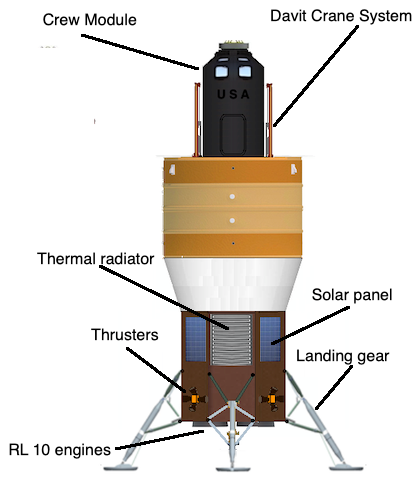
 

Notional reusable REUS-LV/Crew landing vehicle for lunar operations

Once the REUS-LV/Crew vehicle is on the Moon, a davit crane system could be used to lower astronauts, vehicles, and other equipment to the lunar surface and to retrieve astronauts and lunar material later for transport back to the NRHO Gateway. Solar panels positioned on four of the walls surrounding the LOX tank would provide electricity for the crew module plus electric power to keep the hydrogen and oxygen liquefied using the thermal radiators to assist its cryocooler refrigeration systems. 


Orbital Propellant Depots

Two REUS-LV/Crew vehicles could be deployed to LEO with a single SLS launch. But propellant depots would be required to fuel the vehicles at LEO and at NRHO in order to conduct crewed missions to and from the lunar surface and to return the spacecraft back to LEO. So the deployment of two propellant manufacturing water depots at LEO and at NRHO would be necessary for crewed lunar missions. 

Two REUS derived vehicles (REUS-OTV/Depot) could be utilized as propellant producing water depots capable of storing up to 150 tonnes of water for the production of  113 tonnes of LOX/LH2 propellant. 9 tonnes of water contains approximately 8 tonnes of oxygen and one tone of hydrogen. But only 7 tonnes of propellant could be manufactured from 9 tonnes of water since rocket fuel would require a ratio of 6 tonnes of oxygen per ton of hydrogen.   So each depot would be capable of storing approximately 16 tonnes of LH2 plus 97 tonnes of LOX) while wasting 32 tonnes of liquid oxygen. 

However if only 113 tonnes of water is converted into 97 tonnes of liquid oxygen and 13 tonnes of hydrogen then 100% of the water could be utilized as fuel if an  REUS-LV vehicle initially arrives at LEO from Earth with at least 3 tonnes of liquid hydrogen propellant. Two REUS-LV/Crew vehicles would only weigh 46 tonnes. And with an additional six tonnes of liquid hydrogen propellant, would still only be 52 tonnes of payload mass for a basic SLS vehicle capable of deploying at least 70 tonnes to LEO. Fully fueled with LH2, the first REUS-LV/Crew vehicles launched to LEO could require no liquid hydrogen from the LEO depot at all, only its liquid hydrogen.

Water could be continuously supplied to propellant producing depots at LEO by various private American launch systems (Space X, the ULA, and Blue Origin) who have vehicles  that are either currently operational or are very close to being operational: 

Falcon Heavy (Space X) - 63 tonnes to LEO

New Glenn (Blue Origin) - 45 tonnes to LEO

Vulcan-Centaur (ULA) - 27 tonnes to LEO


During the first SLS launch of two propellant depots to LEO, private launch companies could supply one depot with enough water to produce propellant that can be transferred to the second depot to deploy itself plus its solar array to NRHO. 


EUS derived propellant producing water depot approaching orbiting solar power plant @ NRHO where it will use photovoltaic power to electrolyze water into LOX and LH2.
 
Private launch vehicles could also be used to deploy water directly to NRHO once the propellant producing depot arrives. But it would be much cheaper and efficient for private launch companies to simply focus on supplying water to LEO.  Large reusable REUS-OTV (Orbital Transfer Vehicles) could transfer water from LEO to depots located at NRHO much more efficiently.  A single SLS launch would be required to deploy two such EUS derived vehicles into orbit probably with their LH2 tanks already filled with liquid hydrogen.


REUS-OTV plus optional  interstage connection ring for joining two OTV vehicles together. Such vehicles could be used to transport 60 to 120 tonnes of water and other  payloads between LEO and NRHO and to various lunar orbits and Earth-Moon Lagrange points.


Crewed Missions to the Moon and Reusability
 
For crewed missions to the lunar surface, An REUS-LV/Crew vehicle  would be fueled with propellant at LEO and then travel  four days  to the orbital outpost at NRHO. After arriving at NRHO, the REUS-LV/Crew vehicle would then be fueled with additional propellant at   for its round trip journey to the lunar surface and then back to NRHO. Once the crew returns to NRHO, only the minimum amount of propellant would be required to return the REUS-LV/Crew spacecraft back to LEO. 
 
 
Reusable REUS-LV/Crew vehicle docked at a notional single launch SLS derived MegaStation at NRHO. The notional EUS derived vehicle would be cable of round trips between NRHO and the lunar surface on substantially less than a full tank of LOX/LH2 propellant.   REUS-OTV vehicles could be used to deploy the habitat modules and the pressurized spent SLS core stage from LEO to NRHO.
 
 
RL-10 engines can be manufactured with a capability of 50 restarts. So a single REUS-LV/Crew vehicle should be capable of at least 6 round trips to the lunar surface starting and returning to LEO. The REUS-LV/Crew vehicle would be capable of  12 round trips if the spacecraft  is only utilized for trips between NRHO and the lunar surface. 

Two reusable REUS-LV/Crew vehicles could be deployed to LEO with a single SLS launch. And each vehicle deployed would be capable of at least 12 round trips between LEO and NRHO. So a single SLS launch could allow 12 round trips to the lunar surface-- if water can be supplied to LEO and then to NRHO. This would require two more SLS launches to deploy two solar powered propellant depots and two REUS derived orbital transfer vehicles (REUS-OTV) to transport water from LEO to NRHO. So three SLS launches would be required for 12 round trips to the lunar surface (four potential round trips to the lunar surface per SLS launch). 


Lunar Depots

REUS derived propellant producing water depots with landing gear could also be  deployed to the lunar surface with photovoltaic solar power units. If water ice resources are exploited at the lunar poles then propellant could be produced on the Moon. The REUS-LV/Crew vehicle could be fueled with propellant at LEO and travel directly to the lunar surface. And the same REUS-LV/ Crew could later be fueled with lunar propellant for its return trip directly to LEO. 

Reusable REUS-LV/Crew vehicle docked at a notional single launch SLS derived MegaStation at NRHO. The notional EUS derived vehicle would be cable of round trips between NRHO and the lunar surface on substantially less than a full tank of LOX/LH2 propellant.   REUS-OTV vehicles could be used to deploy the habitat modules and the pressurized spent SLS core stage from LEO to NRHO.

 Alternatively, propellant from Earth could be substantially reduced for lunar missions if tankers supplied water from the moon to NRHO depots. REUS-LV/Crew vehicles could then return to LEO using LOX/LH2 propellant produced on the Moon. 


Reusable Lunar Hopper  


The delta-v and travel times for possible crewed suborbital hops on the lunar surface. Fueled with liquid hydrogen and oxygen at a lunar base, a notional REUS-LV/Crew vehicle would be capable of traveling to any region on the surface of the Moon in less than an hour and return back to the lunar outpost on less than  a single tank of fuel.


Supplied with propellant on the lunar surface, the REUS-LV/Crew could also be used as a lunar hopper that could travel to any region on the surface of the Moon in less than an hour. The vehicle would also carry enough fuel to return to the lunar outpost where it was fueled in less than an hour.  With four trajectory burns for each round trip, each REUS-LV/Crew vehicle could travel to 12 regions on the lunar surface. So a single SLS launch could potentially explore 24 regions on the lunar surface if REUS-LV/Crew vehicles are refueled with lunar propellant. 


Repurposing Decommissioned Landing Vehicles 

REUS derived vehicles could still be put to good use after they are decommissioned from their original task.  REUS-LV/Crew vehicles that are no longer safely capable of crewed flights could  be repurposed for storing substantial quantities of water mined from the lunar ice and for storing sewage accumulated from the inhabitants of lunar outpost. With both a hydrogen and oxygen tank, substantial quantities of  water and sewage could be stored in the two different tanks of one vehicle.   The decommissioned vehicles could also be used to store excess oxygen from the production of propellant. LOX and LH2 could be stored in decommissioned spacecraft to produce electric power during the lunar night using fuel cells. Such fuel cells would not only produce electricity from the hydrogen and oxygen-- but also water. 

Decommissioned vehicles could also be used as temporary outpost in lunar regions of particular interest. They could be transported to their lunar locations by electric powered lunar cranes. And regolith bags could be deployed around the vehicle's habitat modules for additional protection against cosmic radiation and micrometeorites. 

Decommissioned REUS-OTV vehicles in orbit could be used in a similar fashion at NRHO for  storing water, or excess oxygen from the production of propellant. 


Deep Space Robotic Missions to Phobos and Deimos

At NRHO, the  REUS-LV/Crew vehicle could also be used for-- unmanned-- round trip  robotic missions to the moons of Mars. The delta-v requirements for such round trip missions between NRHO and the martian moons  would actually be less than round trip missions between NRHO and the lunar surface.  So a robotic REUS-LV would be fully capable of traveling to the surface of Deimos or Phobos and returning to NRHO with substantial quantities of rocks and regolith from those two tiny martian moons.  Roving vehicles could also be left behind that could be used to extensively explore each of the martian moons. The REUS-LV davit system could easily lower and retrieve such vehicles after landing on those tiny worlds.


 Links and References

Rocket to the Moon: What Is the Exploration Upper Stage?

Exploration Upper Stage

EUS on the Moon

 RL 10 Engine

 CECE: A Deep Throttling Demonstrator Cryogenic Engine
for NASA's Lunar Lander

Cis-Lunar Gateways and the Advantages of Near Rectilinear Orbits

Realistic Near-Term Propellant Depots: Implementation of a
Critical Spacefaring Capabilit

Large-Scale Demonstration of Liquid Hydrogen Storage With Zero Boiloff for In-Space Applications

Delta-v Calculator

Delta-v Budget

Deploying a Ginormous SLS Derived Dry/Wet Workshop Habitat with a Single SLS Launch

Travel on Airless Worlds

Reusable Hoppers and Orbiters for Rapid Lunar Transportation and Exploration


Monday, July 11, 2016

Substantially Enhancing the Capability of the SLS Architecture by Utilizing EUS Derived Propellant Depots and Reusable Orbital Transfer Vehicles

Left: Orion space capsule with hypergolic fueled Service Module; right:  notional Orion spacecraft with a reusable EUS derived orbital transfer vehicle.  
It now appears that Congress will direct NASA to return Americans to the surface of the Moon in order to prepare for future crewed journeys to the surface of  Mars. But the Moon could prove to be much more than just a beyond LEO testing ground for astronauts and components.

At minimum, an interplanetary round trip to the Red Planet would require several hundred tons of  water for drinking, washing, food preparation, radiation shielding, the production of air, and for the production of liquid oxygen (LOX) and liquid (LH2)  for rocket propellant.

Supplying the water needed for an interplanetary spacecraft parked at LEO  would require a delta-v ranging from  9.3 km/s to 10 km/s from the Earth's surface. Minimum energy launch windows during the 2030s would require an additional delta-v ranging from 3.59 km/s to 4.81 km/s for Trans Mars Injections (TMI)  that could send humans to Mars in less than a year.

But at different locations within cis-lunar space, substantially lower levels of delta-v could be taken advantage of in order to launch cargo and crew into a Trans Mars Injection. And these interplanetary launch points within cis-lunar space are most easily accessible from the lunar surface rather than from within the Earth's deep gravity well. So utilizing lunar ice resources could greatly reduce the cost and the complexity of sending humans to Mars.


Delta-v to important destinations within cis-lunar space

Earth surface to LEO - 9.3 km/s to 10 km/s

LEO to EML1 - 3.77 km/s (~3 days)

LEO to EML1 - 4.5 km/s (~2 days)

LEO to EML2 - 3.43 km/s (~8 days)

LEO to EML2 - 3.95 km/s (~4 days)

Lunar surface to EML1 - 2.52 km/s (~3 days)

Lunar surface to EML2 - 2.53 km/s (~3 days)


Delta-v from cis-lunar space to Trans Mars Injection

LEO to TMI (2030s) - 3.59 km/s to 4.81 km/s

EML1 to TMI (2030s) - 1.04 km/s to 1.3 km/s

Because of its shorter travel times from Earth orbit,  EML1 would appear to be the optimal region for locating Deep Space Habitats (DSH), reusable lunar shuttles,  propellant manufacturing water depots that receive water from the lunar surface and for launching cargoes and crew on interplanetary journeys to the orbits of Mars and Venus.

A delta-v of   3.77 can transport crews to EML1 in approximately 4 days. It would require 3.95 km/s to travel to EML2 in 4 days but 8 days of travel and radiation exposure would be required to take advantage of a lower delta-v to EML2 at 3.43 km/s. A delta-v of 2.52 km/s would be required for a 3 day journey between EML1 to the lunar surface. 2.53 km/s would be required for a similar journey between EML-2 and the lunar surface. The significant presence of habitats and depots and reusable vehicles at EML-2 could also interfere with future radio astronomy on the back side of the Moon.

Taking full advantage of polar ice resources on the Moon would require a space architecture that utilizes orbiting depots to supply water and propellant to reusable interplanetary spacecraft and landing vehicles. Some space advocates have argued that propellant depots make heavy lift vehicle's an unnecessary expense. However, heavy lift vehicles would make it possible to easily deploy propellant manufacturing water depots to  EML1  for crewed interplanetary journeys to the orbits of Mars and Venus.

Similar depots located at LEO could also enable large payloads  originally deployed  to LEO by heavy lift vehicles to be later  deployed by reusable orbital transfer vehicles practically anywhere within cis-lunar space.


Expendable EUS for SLS launch vehicle (Credit: NASA)


In 2018, NASA will launch the first SLS heavy lift vehicle with an unmanned Orion space capsule and a hypergolic fueled Service Module and an interim upper stage. But NASA currently envisions crewed SLS launches in the 2020s to include an Orion space capsule with a hypergolic fueled Service Module and a large LOX/LH2 fueled Exploratory Upper Stage (EUS). 

But two of the principal companies (Boeing and Lockheed Martin) currently developing the SLS/Orion architecture are also--  privately developing-- an alternate space architecture through their joint company, the  ULA (the United Launch Alliance). In this alternate architecture, the ULA  will utilize their emerging  IVF (Integrated Vehicle Fluids ) technology to deploy a reusable ACES upper stage that could eventually utilize LOX/LH2  propellant depots for travel within cis-lunar space during the 2020s. IVF technology allows a spacecraft to utilize hydrogen and oxygen ullage gases for attitude control, power production, and for autogenously pressurizing propellant tanks, eliminating  the need for hydrazine and liquid helium. 

NASA could greatly enhance the capability, efficiency, and the safety of the SLS/Orion architecture by taking full  advantage of the ULA’s  emerging IVF  technology. While there's no reason to stop Boeing from developing the EUS as an expendable upper stage for the SLS, it would still be technologically advantageous for NASA to commission the ULA to use its IVF technology to convert some EUS vehicles into  reusable orbital transfer vehicles and others into propellant depots.

EUS derived propellant manufacturing water depot and reusable Orion orbital transfer vehicle.

 An SLS/Orion architecture utilizing EUS derived Orbital Transfer Vehicles (OTV-125) and EUS derived propellant producing water depots (WPD-OTV-125) would no longer require the expense and the enhanced risk of launching astronauts on top of a super heavy lift vehicle. So for beyond LEO missions in the 2020s, under this scenario, astronauts would simply be transported to LEO by Commercial Crew vehicles that would have already been in operational service since 2018.

Once in orbit, the commercial crew capsule would dock directly with the Orion-OTV-125 reusable spacecraft, transferring its crew aboard the Orion for its beyond LEO mission. Alternatively, a crew capsule could dock at the port of  a space station where the Orion-OTV-125 would also be docked at a different port. Both scenarios would mean that the ATV based hypergolic Service Module being manufactured by the Europeans would not be required for crewed beyond LEO missions, and would only be used once during the 2018 test mission. So only  the domestically manufactured Orion capsule being developed by Lockheed Martin would be preserved in this architecture.

A single SLS Block I cargo launch could be used to deploy two WPD-OTV-125 depots to LEO plus a two 1 MWe solar arrays. With at least 35 tonnes of propellant, one of the water/propellant depots could self deploy itself to EML1 along with its 1.4 to 2.8  MWe solar array. Another basic SLS Block I cargo launch could be used to deploy two reusable Orion-OTV-125 vehicles to LEO. But once this reusable depot based extraterrestrial architecture is deployed by the SLS,  private commercial launch vehicles will only be required to conduct crewed beyond LEO missions. This will allow the SLS to be used exclusively as a cargo launcher for the deployment of large and heavy spacecraft and habitats and other large and heavy structures.

Notional lunar water ice extraction, storage, and LOX/LH2 manufacturing facility.

Water for the propellant manufacturing orbital depots could be regularly supplied to LEO and to EML1 from commercial launch vehicles (Atlas V, Delta IV heavy, Falcon 9, and the future Falcon Heavy, Vulcan, and Vulcan Heavy vehicles).  However, once water is being manufactured on the lunar surface, water transported to EML1 would be supplied  exclusively from the lunar surface.


Since the  Orion-OTV-125 would derived from the EUS, it would be capable of accommodating up to 125 tonnes of propellant. But less than 35 tonnes of propellant would be required for an Orion-OTV-125 to transport its crew to EML1. And an equal amount of fuel would be needed to return astronauts to LEO. No aerobraking would be required.

A reusable Extraterrestrial Landing Vehicle (ETLV) would transport astronauts from EML1 to the surface of the Moon and back  to EML1 with a single fueling of LOX/LH2. A single SLS Block I cargo launch could deploy three ten tonne ETVL-2 vehicles to LEO, each with enough propellant to travel to EML1. The ETLV-2 could also serve as an back up OTV in case one or both of the Orion-OTV-125 vehicles becomes inoperable.

Until new RS-25 engines are in production, perhaps by 2021 to 2023, NASA will only be able to launch four SLS vehicles. And one of those launches will be an unmanned test launch in 2018. So after 2018, only three SLS launches will be possible before the RS-25 engines go into production.

Notional EUS derived propellant manufacturing water depot @ EML1 after refueling a reusable Extraterrestrial Landing Vehicle.

But  just three basic  SLS Block I cargo launches would be required to deploy a reusable EUS derived cis-lunar transport architecture (WPD-OTV-125, Orion-OTV-125, and the ETLV-2) capable of transporting humans to EML1 and to the lunar surface and back.

However, the deployment of the lunar landing vehicles could be delayed until the new RS-25 engines are in production. This would allow NASA to use their last four Space Shuttle Main Engines to be used to launch a DHS (Deep Space Hab) to EML1. An SLS propellant tank derived habitat with over 510 cubic meters of pressurized habitable volume would have a dry weight of 22.4 tonnes. So in theory,  a single SLS Block I cargo launch could be used to deploy two or three pressurized habitats to LEO. A partially fueled Orion-OTV-125 could then be used to transport one of the pressurized habitats to EML1.
SLS propellant tank derived habitat (Credit: NASA).

This would leave one or two pressurized habitats at LEO with a combined pressurized habitable volume exceeding that of the ISS! All of that would be achieved with  a single SLS launch and a reusable propellant producing water depot architecture routinely and sustainably  supplied with water from commercial launch vehicles.


Links and References

Moon first, then Mars? Congress moves to shift space priorities

The return to the moon, Lori Garver, and the price of ambition

Lori Garver Questioned Astronauts about NASA's Next Destination?

Seeing the end of Obama’s space doctrine, a bipartisan Congress moves in

What about Mr. Oberth

Human Lunar exploration architectures

Earth Departure Options for Human Missions to Mars

A Study of CPS Stages for Missions beyond LEO

Deep Space Habitats

First Human Voyages to the Martian Moons Using SLS and IVF Derived Technologies

Congress Requires NASA to Develop a Deep Space Habitat

UltraFlex Solar Array Systems


Blog Archive

CINEMA FANTASTIC

Popular Posts