Showing posts with label Phobos. Show all posts
Showing posts with label Phobos. Show all posts
Saturday, April 23, 2022

Monday, December 16, 2019

Thursday, July 6, 2017
(Part III) A Practical Timeline for Establishing a Permanent Human Presence on the Moon and Mars using SLS and Commercial Launch Capability
 |
A rotating artificial gravity space station in Mars orbit beyond
the orbital arc of Deimos. One ETLV-4 crew lander is docked at the station's central docking port while a crewed ETLV-4 approaches the station after visiting
the surface of Phobos.
|
by Marcel F. Williams
Part III: Artificial Gravity and the Moons of Mars
While traveling from Earth to the Moon or the Earth-Moon Lagrange points only takes a few days, human voyages between Mars and cis-lunar space will require a several months of travel time. So astronauts will have to be adequately protected from the deleterious effects of cosmic radiation (especially its heavy nuclei components), solar storms, and the microgravity environment.
The notional crewed spacecraft proposed under this scenario all have habitat areas that provide at least 20 grams per centimeter squared of radiation shielding, enough to protect astronauts from the penetration of heavy ions and from harmful levels of radiation resulting from major solar events. Such levels of shielding in interplanetary vehicles should limit astronaut radiation exposure to less than 30 Rem per year during the worse cosmic ray conditions (the solar minimum). Permanently occupied space stations beyond the Earth's magnetosphere and that rotate to produce a simulated gravity will have their internal shielding (iron plates) gradually increased until levels of internal radiation exposure for its human inhabitants is below 5 Rem per year (the legal limit of radiation exposure allowed for radiation workers on Earth).
In order to mitigate or eliminate the deleterious effects of microgravity, under this architecture, artificial gravity environments (0.5g) will be provided for astronauts for multimonth interplanetary journeys. Simple rotating spacecraft (AGH-I) composed of three pressurized SLS propellant tank derived habitats joined together by cables and twin expandable and retractable booms will be used for interplanetary voyages between EML1 and high Mars orbit. Similar artificial gravity producing habitats will also be used for permanent space stations (AGH-SS) deployed in orbits within cis-lunar space and in orbit around Mars.
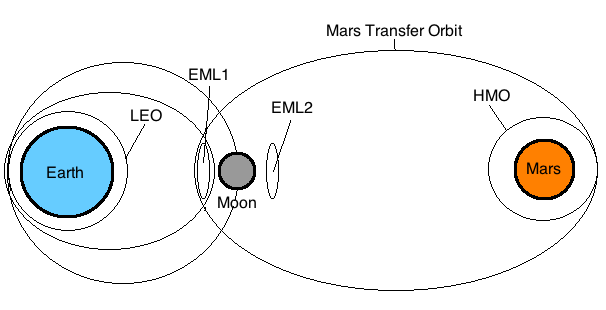 |
| Flight paths between LEO and EML1 and EML1 and high Mars orbit |
1. LOX/LH2 propellant allows astronauts to reach Mars faster than interplanetary vessels propelled by xenon gas, reducing radiation exposure and the psychological stress of longer travel times.
2. The continuous drive of xenon engines would make it difficult to accommodate artificial gravity habitats, forcing astronauts to endure the deleterious of effects and the physical and psychological stresses associated with a microgravity environment. So multi-month journeys within a microgravity environment could significantly increase that chances of fatal mishaps during an interplanetary mission.
3. Chemical rockets would have the advantage of being able to dump their water shielding just before their final trajectory burns, substantially reducing vehicle mass as the spacecraft enters high Mars orbit or cis-lunar space.
4.
A xenon based interplanetary spacecraft would be dependent on an expensive fuel that has to be launched out of the Earth's enormous gravity well. A LOX/LH2 producing water depot, on the other hand, could eventually use extraterrestrial sources of water and oxygen from the Moon, Mars, the moons of Mars, etc.
5. In order to reduce the mass required to be launched from the Earth's gravity well, a xenon based
interplanetary architecture would still require substantial amounts of extraterrestrial water for drinking, food preparation, washing, radiation protection, the production of air, and for the production of LOX/LH2 or LOX/methane propellant for vehicles landing and taking off from the surfaces of Mars or the moons of Mars. So it would be much simpler and cheaper for extraterrestrial resources to be used for the entire architecture instead of just part of it.
SLS and Commercial Launch Sequences to Establish a Permanent Human Presence in High Mars Orbit
2027
SLS Launches:
 |
| Bigelow BA-330 habitat which is inherently provided with enough shielding to protect astronauts from heavy nuclei penetration. |
SLS and Commercial Launch Sequences to Establish a Permanent Human Presence in High Mars Orbit
2027
SLS Launches:
SLS Launch 14: Two CLV-7B (Cargo Landing Vehicle) deployed to lunar outpost after refueling at EML1:
First CLV-7B will be carrying a second mobile hydrogen tanker (MHT) derived from the 2.4 meter cryotank technology plus four more Water Bug microwave water extraction robots.
Second CLV-7B will deploy at least 160 KWe of nuclear power to the lunar surface with at least a 10 year lifetime for the fueled reactors.
SLS Launch 15: SLS deploys first artificial gravity habitat to LEO (AGH-I). An OTV-125 (an IVF modified EUS) transports the AGH-I to EML1
SLS Launch 17: SLS deploys OTV-400 to EML1. The SLS propellant tank derived vehicle will be used to transport crews between high Mars orbit and cis-lunar space.
Commercial Launches:
1. First commercial deployment of reusable ACES-68 (ULA) and Shepard (Blue Origin) derived lunar landing tankers for transporting lunar water from the lunar surface to EML1 (at least 1000 tonnes to EML1 per year)
2. Commercial launches of twin satellite communications and navigation system to Sun-Mars L4 and L5 plus a trio of satellites into Aresynchronous orbit in order to establish uninterrupted communications between Earth and Mars and between Mars orbit and the martian surface.
Second CLV-7B will deploy at least 160 KWe of nuclear power to the lunar surface with at least a 10 year lifetime for the fueled reactors.
SLS Launch 15: SLS deploys first artificial gravity habitat to LEO (AGH-I). An OTV-125 (an IVF modified EUS) transports the AGH-I to EML1
SLS Launch 16: SLS deploys WPD-OTV-400 EML1. The propellant producing water depot will be capable of storing up to 400 tonnes of LOX/LH2 propellant and up to 1000 tonnes of water.
SLS Launch 17: SLS deploys OTV-400 to EML1. The SLS propellant tank derived vehicle will be used to transport crews between high Mars orbit and cis-lunar space.
Commercial Launches:
1. First commercial deployment of reusable ACES-68 (ULA) and Shepard (Blue Origin) derived lunar landing tankers for transporting lunar water from the lunar surface to EML1 (at least 1000 tonnes to EML1 per year)
2. Commercial launches of twin satellite communications and navigation system to Sun-Mars L4 and L5 plus a trio of satellites into Aresynchronous orbit in order to establish uninterrupted communications between Earth and Mars and between Mars orbit and the martian surface.
Notes:
1. 2027 will be the beginning of four SLS launches per year by NASA
2. The AGH-I will be provided with water 30 centimeters of internal water shielding from water depots located at EML1. In 2027, the crewed structure will test its ability to provide 0.5 g of simulated gravity and its ability to routinely expand and contract its cables and booms and to increase and decrease its rate of rotation.
3. The OTV-400 orbital transfer vehicle will be tested by sending it unmanned to Sun-Earth L2 and then back to cis-lunar space.
2. The AGH-I will be provided with water 30 centimeters of internal water shielding from water depots located at EML1. In 2027, the crewed structure will test its ability to provide 0.5 g of simulated gravity and its ability to routinely expand and contract its cables and booms and to increase and decrease its rate of rotation.
3. The OTV-400 orbital transfer vehicle will be tested by sending it unmanned to Sun-Earth L2 and then back to cis-lunar space.
 |
| SLS propellant tank derived Deep Space Hab (DSH). Requires additional water shielding to protect astronauts from heavy nuclei penetration (Credit NASA) |
2028
SLS Launches:
SLS Launch 18: Two DSH (Deep Space Habitats) deployed to LEO; one remains permanently at LEO while the other will be transported by an OTV-125 to EML1 and then to high Mars orbit
SLS Launch 19: Second WPD-OTV-400 to EML1
SLS Launch 20: SLS deploys third WPD-OTV-400 to EML1
SLS Launch 21: SLS deploys fourth WPD-OTV-400 to EML1
Notes:
1. Odyssey 1 (OTV-400 +AGH-1+ETLV-4) will travel to to SEL2 (Sun Earth Largrange Point 2) in order to test the Odyssey vehicles interplanetary capability. It will take about 30 days to reach ESL2 and 30 days to return to cis-lunar space. 30 days will be spent at SEL2.
2. LEO DSH (LEO Space Hab) will join the BA-330 as an additional way station for beyond LEO missions for NASA
 |
| SLS propellant tank derived artificial gravity habitat (AGH). Requires 30 cm of water shielding for crewed interplanetary journeys and 50 cm of iron shielding as a permanent space station deployed beyond the Earth's magnetosphere. |
2029
SLS Launches:
SLS Launch 22: Second AGH-I deployed to EML1
SLS Launch 23: Second OTV-400 deployed to EML1
SLS Launch 24: Two ETLV-4 + OTV-125 are launched to LEO for redeployment to EML1
SLS Launch 25: Two CLV-7B vehicles deployed to LEO for redeployment at EML1:
Cargo Langer One: mobile magnetic iron extraction robots + 3D iron panel manufacturing machines for internally radiation shielding AGH-SS space stations.
Commercial Launches:
1. Commercial launch of BA-330 to LEO and transported to EML1 by ACES-68 OTV. The BA-330 will be transported to high Mars orbit by an OTV-125; departs in February of 2029 to arrive in high Mars orbit in July of 2029.
Notes:1. Odyssey 2: Second crewed mission of the Odyssey spacecraft will be a 235 day round trip to SEL1 (Sun-Earth Lagrange point 1)
2. With four WPD-OTV-400 depots at EML1, one will depart for Mars in January of 2029 to arrive at high Mars orbit in July of 2029. A second WPD-OTV-400 depot will depart EML1 in February of 2029 to also arrive in high Mars orbit in July of 2029. Both propellant depots will carry at least 550 tonnes of water to high Mars orbit.
3. OTV-125 transports DSH to high Mars orbit; departing EML1 in January of 2029 to arrive at high Mars orbit in July of 2029.
 |
| LOX/LH2 fueled OTV-400 and EUS derived OTV-125. Both reusable vehicles will use the ULA's Integrated Vehicle Fluid technology for eliminate the need for helium and hydrazine while utilizing ullage gases for attitude control. |
2030
SLS Launches:
SLS Launch 26: Third OTV-400 deployed to EML1
SLS Launch 27: AGH-SS deployed to EML4 for DOD
SLS Launch 28: NASA deploys a second AGH-SS to EML1. The partially iron shielded artificial gravity space station will be transported to high Mars orbit by an OTV-400.
SLS Launch 29: Two Ares R-ETLV-4 deployed to EML1+ OTV-125
Commercial Launches:
1. First commercial crew shuttles to the lunar surface: reusable Xeus (ULA), reusable Lunar Shepard (Blue Origin)?
SLS Launch 26: Third OTV-400 deployed to EML1
SLS Launch 27: AGH-SS deployed to EML4 for DOD
SLS Launch 28: NASA deploys a second AGH-SS to EML1. The partially iron shielded artificial gravity space station will be transported to high Mars orbit by an OTV-400.
SLS Launch 29: Two Ares R-ETLV-4 deployed to EML1+ OTV-125
Commercial Launches:
1. First commercial crew shuttles to the lunar surface: reusable Xeus (ULA), reusable Lunar Shepard (Blue Origin)?
Notes:
1. Odyssey 3: Crewed Odyssey mission ( OTV-400/AGH-I/ETLV-4) to high Mars orbit with a flyby past Venus. Departs from EML1 in February of 2030, flying past Venus in July of 2030 and arriving at Mars in January 2031. The AGH-I will replenish its water shield by rendezvousing with one of the WPD-OTV-400 water depots. The Odyssey 3 will use one of the WPD-400 depots to refuel with LOX/LH2 propellant in order to depart Mars orbit in April 2031, returning to cis-lunar space in December of 2031.
During the crew's three months stay in Mars orbit, the crew will use the two ETLV-4 vehicles in Mars orbit to visit the surfaces of Deimos and Phobos. The crew will also visit the BA-330 storm shelter and the DHS previously deployed to high Mars orbit
2. Second ETLV-4 is not transported with the Odyssey vehicle but self deploys itself to high Mars orbit for utilization in the crewed mission, following the same flight pattern as the Odyssey 3.

 |
| Reusable ETLV-4 will allow astronauts to visit the moons of Mars. The ETLV-4 will also be used to transport the the ADEPT attached Ares-ETLV-4 to low Mars orbit for missions to the surface of Mars. |
2031
SLS Launches:
SLS Launch 30: Two ETLV-4 + OTV-125 are launched to LEO for redeployment to EML1
SLS Launch 31: OTV-125+ LRH (Lunar Regolith Habitat) to Moon for DOD
SLS Launch 32: SLS deploys OTV-125+LRH (agronomy hab) to lunar outpost
SLS Launch 33: Two CLV-7B cargo landers deployed to LEO to be transported to EML1.
CLV-7B One will transport four mobile crew vehicles to the lunar outpost; two for NASA and two for the DOD.
CLV-7B Two will transport two mobile optical telescopes to the lunar surface: one for NASA and one for the DOD
Commercial Launches:
1. Start of commercial launch of ADEPT deceleration shields to LEO by Vulcan launch vehicles. The ADEPT shields will be transported to high Mars orbit by reusable OTV-125 vehicles and possibly by ACES-68 vehicles.
Notes:
1. An OTV-400 will transport the partially shielded AGH-SS to high Mars orbit, departing in February of 2031 and arriving in high Mars orbit in September of 2031.
2. Second crewed Odyssey mission (Odyssey 4) will be transported to high Mars orbit by another OTV-400. The Odyssey 4 will depart EML1 in March of 2031, arriving in high Mars orbit in August of 2031. Beginning of permanent human occupation of Mars AGH-SS space station
3. Lunar manufactured iron radiation shielding plates for the AGH-SS will be transported to high Mars orbit over the years by several OTV-125 vehicles, decreasing cosmic radiation exposure to less than 30 Rem per year to less than 5 Rem per year during solar minimum conditions.
4. The two Ares R-ETLV-4 vehicles will rear dock with two ADEPT deceleration shields. An ETLV-4 will dock and transport an Ares R-ETLV-4 from high Mars orbit to low Mars orbit. The unmanned Ares-ETLV-4 will land on Mars, testing the ADEPT shield. Teleoperated robots will be deployed to collect regolith samples and samples of the martian atmosphere. The Ares R-ETLV-4 will return to low Mars orbit where it will be transported by an ETLV-4 back to high Mars orbit. Both Ares-R-ETLV-4 vehicles will be used multiple times, mating with other expendable ADEPT shields for unmanned sample retrieval missions to the martian surface. This will also test the reliability of the ADEPT shields for future crewed missions to the martian surface.
5. First DOD outpost on the lunar surface (just a few kilometers away from NASA’s lunar outpost). Mobile crew transport vehicles will be used to transport astronauts between NASA and DOD facilities.
 |
| Odyssey interplanetary space craft. After trajectory burns to insert the Odyssey into a Mars Transfer Orbit, the AGH-I will separate from the OTV-400 and the ETLV-4 in order to rotate and expand its cables and booms to provide 0.5g of simulated gravity in the twin counter-balancing habitat modules. The AGH will dump its water shield and reattach itself to the OTV-400 and the ETLV-4 for the final trajectory burns into orbit around Mars. |
A Permanent Human Presence in High Mars Orbit
So under this propellant depot architecture, the first crewed mission (Odyssey 3) to high Mars orbit will depart from EML1 in February of 2030 and arriving at Mars in January 2031, flying past the planet Venus during the nearly year long journey. Once the crew arrives, a DSH (Deep Space Habitat) and storm shelter (BA-330) will already be deployed in high Mars orbit in order to enhance their safety. After their orbital transfer vehicles (OTV-400) has been refueled by one of the twin propellant depots (WPD-OTV-400), the Odyssey 3 will depart from Mars in April 2031 and returning to cis-lunar space in December of 2031.
The second crewed mission to high Mars orbit (Odyssey 4) will depart from EML1 in March of 2031, arriving in high Mars orbit in August of 2031. This mission will include the first use of ADEPT deceleration shields to land R-ETLV-4 vehicles on the martian surface for the robotic retrieval of lunar regolith samples.
Landing Humans on Mars will be the last part (Part IV) of this article.
So under this propellant depot architecture, the first crewed mission (Odyssey 3) to high Mars orbit will depart from EML1 in February of 2030 and arriving at Mars in January 2031, flying past the planet Venus during the nearly year long journey. Once the crew arrives, a DSH (Deep Space Habitat) and storm shelter (BA-330) will already be deployed in high Mars orbit in order to enhance their safety. After their orbital transfer vehicles (OTV-400) has been refueled by one of the twin propellant depots (WPD-OTV-400), the Odyssey 3 will depart from Mars in April 2031 and returning to cis-lunar space in December of 2031.
 |
| WPD-OTV-400 propellant producing water depot in high Mars orbit refueling an OTV-400 that will transport the Odyssey back to cis-lunar space. |
The second crewed mission to high Mars orbit (Odyssey 4) will depart from EML1 in March of 2031, arriving in high Mars orbit in August of 2031. This mission will include the first use of ADEPT deceleration shields to land R-ETLV-4 vehicles on the martian surface for the robotic retrieval of lunar regolith samples.
 |
| Ares-ETLV-4 simply adds additional thrusters to the top of the ETLV-4 to provide sufficient attitude control while entering the martian atmosphere behind and ADEPT deceleration shield. |
 |
| Unmanned Ares-ETLV-4 attached to an ADEPT deceleration shield. Teleoperated robots will be deployed to retrieve regolith and atmospheric samples to be returned to low Mars orbit and back to the AGH-I. |
Landing Humans on Mars will be the last part (Part IV) of this article.
Saturday, November 28, 2015
First Human Voyages to the Martian Moons Using SLS and IVF Derived Technologies
 |
| Originally utilized for human operations withing cis-lunar space in the 2020s, the reusable LOX/LH2 fueled ETLV-2 now heads towards its first crewed rendezvous and landing on the surface of the martian moon, Phobos, in 2031. |
However, any serious efforts to transport humans on multi-year interplanetary voyages has to resolve the inherent problems of enhanced exposure to cosmic radiation and major solar events. Also, the deleterious effects of long term exposure to a microgravity environment over the course of several months and even years has to be resolved.
Mass shielding habitat areas with at least 30 centimeters of water could protect astronauts from the dangers of major solar storms while also enabling multiyear round trip missions to Mars and Venus without excessive exposure to cosmic radiation-- even during solar minimum conditions. The deleterious effects of microgravity on the human body could also be eliminated or, at least, substantially reduced by transporting astronauts aboard rotating interplanetary vessels with twin counterbalancing habitat modules.
However, a water shielded spacecraft with rotating habitat modules would substantially increase the mass of a crewed interplanetary vessel. One way to compensate for the increase in vehicle mass would be to launch the interplanetary vessel from one of the Earth-Moon Lagrange points-- instead of from LEO. This could shave off at least 2.8 km/s of delta-v requirement for an interplanetary mission. Dumping the water shielding for the twin habitat modules just a few hours, or a few days, before final trajectory burns into orbit could also substantially reduce the propellant requirements for an interplanetary vehicle. Finally, utilizing pre-deployed propellant producing water depots supplied with water from the Moon's low gravity well could also substantially reduce the propellant requirement for a reusable interplanetary vehicle.
The crewed interplanetary mission to Mars orbit presented in this article, combines Boeing's SLS propellant tank technology with the ULA's (United Launch Alliance) emerging IVF (Integrated Vehicle Fluid) technology to create reusable interplanetary spacecraft and propellant producing water depots for human interplanetary missions to the orbits of Mars and Venus.
In 2030, under this scenario, eight American astronauts and four foreign astronauts will depart from Earth-Moon Lagrange point four (EML4) towards a flyby of the planet Venus and then, a few months later, into high Mars orbit. During the interplanetary mission, astronauts will visit both of the martian moons, Phobos and Deimos, returning to Earth after the 22 month mission with a significant tonnage and variety of regolith samples from the moons of Mars. Water exported from the surface of the Moon from one of the lunar poles will be used to provide the water and propellant needed for the interplanetary mission.
 |
| Propellant producing water depot (WPD-LV-5A) on the lunar surface next to a mobile water tanker, LOX/LH2 cryotanker, and a Water Bug mobile microwave water extraction robot. |
Nomenclature:
ETLV-2 (Extraterrestrial Landing Vehicle): Reusable LOX/LH2 vehicle capable of landing crews on the surface of the Moon or on the moons of Mars.
LWS (LEO Way Station): Large pressurized microgravity habitat (8.4 meters in diameter) in low Earth orbit derived from SLS hydrogen propellant tank technology.
CLV-5B: Cargo landing vehicles originally utilized to land large payloads on the lunar surface but that are later utilized as reusable water tankers by latching a water bag to the top of the spacecraft.
CLV-5A: Reusable cargo landing vehicle specifically designed to transport water, regolith, or other heavy cargo from the lunar surface to the Earth-Moon Lagrange points.
OTV-400: Reusable SLS hydrogen tank derived orbital transfer vehicle capable of storing up to 400 tonnes of LOX/LH2 propellant. It uses IVF technology to power thrusters for attitude control.
WPD-OTV-400: OTV-400 derived water storage and propellant manufacturing and storage depot capable of storing up to 1000 tonnes of water and up to 400 tonnes of LOX/LH2 propellant.
AGH (Artificial Gravity Habitat): rotating pressurized artificial gravity habitats derived from SLS hydrogen propellant tank technology.
Odyssey: Crewed interplanetary vehicle with OTV-400, AGH, and ETLV-2 components capable of transporting 8 to 16 astronauts to the orbits of Mars and Venus.
Mars Mission Scenario:
February 2030: OTV-400 trajectory burns transports Odyssey interplanetary spacecraft from EML4 into a Venus-Mars Transfer Orbit.
July 2030: Odyssey spacecraft flyby of Venus with minor OTV-400 trajectory burn (`80 m/s delta-v)
February 2031: OTV-400 trajectory burn places Odyssey into a high Mars orbit.
February, March, and April of 2031: Two crewed ETLV-2 missions to the martian moon, Deimos and two crewed missions to the surface of Phobos
April 2031: OTV-400 trajectory burns transports Odyssey spacecraft from high Mars orbit into an Earth transfer orbit.
December 2031: OTV-400 trajectory burns places the Odyssey spacecraft back into a halo orbit at EML4.
Maximum radiation exposure during the 18 month mission during solar minimum conditions (under 30 cm of water shielding aboard the Odyssey and including 10 days of temporary full exposure during orbital insertion and ETLV-2 visits to Phobos and Deimos): less than 50 Rem.
 |
| CLV-5A water tanker capable of transporting more than 50 tonnes of lunar water to the Earth-Moon Lagrange points. Mobile water tanker and a mobile LOX/LH2 cryotanker are near the shuttle spacecraft. |
Cis-Lunar Space
During the early 2020s, a series of SLS cargo launches will be utilized to deploy a water and propellant producing and exporting infrastructure at one of the lunar poles . So starting in 2026, this will allow NASA to to focus its priorities on deploying the interplanetary infrastructure that will be necessary to take humans to the orbit of Mars in 2031-- and eventually to the surface of Mars in 2036. Under this scenario, the interplanetary infrastructure needed to accomplish these goals will mostly be derived from the technology and infrastructure developed for the cis-lunar program.
 |
| CLV-5A rendezvous with WPD-OTV-400 at EML4 to transfer more than 50 tonnes of lunar water. The orbiting depot will be capable of storing up to 1000 tonnes of water and up to 400 tonnes of LOX/LH2 propellant. |
2030
Access to Orbit
In February of 2030, three American Commercial Crew vehicles will launch eight American astronauts plus four foreign astronauts from terrestrial launch facilities to low Earth orbit (LEO). All three of the Commercial Crew vehicles will dock at LEO Way Station (LWS) that was originally deployed to LEO back in 2020. Simply derived from SLS hydrogen propellant tank technology and deployed by a single SLS launch, the LWS will be substantially cheaper than the hyper expensive ISS laboratory.
Rather than outsourcing technological participation from foreign space agencies, NASA will charge foreign space agencies $150 million for each foreign astronaut trained to participate in NASA's first interplanetary mission. So the inclusion of four foreign astronauts in the interplanetary mission will shave off $300 million in cost to NASA-- and the tax payers. Foreign space agencies whose astronauts are participating in the Mars orbital mission will receive up to 10 kilograms of material retrieved by astronauts and robots from the surfaces of the martian moons, Deimos and Phobos.
 |
| An OTV-400 interplanetary booster rendezvous with a WPD-OTV-400 at EML4 to receive up to 400 tonnes of LOX/LH2 propellant. The WPD-OTV-400 produces propellant from lunar water when it is docked to a 1.2 MWe solar array (seen in the background) which is also located at EML4. |
Docked at the LEO Way Station will be two reusable ETLV-2 vehicles. Originally deployed by the SLS during the lunar outpost program of the early 2020s, each ETLV-2 vehicle will perform orbital transfer duties, transporting the international crew of 12 from LEO to EML4 ( Earth-Moon Lagrange Point Four) in approximately two days at a slightly higher and more propellant expensive delta-v.
The LOX/LH2 propellant needed to fuel the ETLV-2 vehicles will come from a LEO orbiting propellant producing water depot (WPD-OTV-400). The LEO orbiting WPD-OTV-400 was originally deployed by the SLS in the 2020's for cis-lunar operations.
WPD-OTV-400 depots will be capable of storing up to 400 tonnes of LOX/LH2 propellant and up to 1000 tonnes of water. Some of the water for the orbital depot will arrive as additional payload from Earth aboard SLS and other launch vehicles with some extra payload availability beyond the regular payloads that they will be deploying. But most of the water for the LEO water/propellant depot will originate from the surface of the Moon.
When running low on water and propellant, the LEO orbiting WPD-OTV-400 uses the remaining 50 tones of stored propellant to transport itself to EML4. There it is supplied with water and propellant from another WPD-OTV-400 that is continuously being supplied with lunar water from the lunar poles from reusable CLV-5A and CLV-5B water shuttles. Once the WPD-OTV-400 filled with 240 tonnes of water in addition to being fully fueled with 400 tonnes of LOX/LH2 propellant, it will redeploy itself back to LEO where most of the 240 tonnes of water will be converted into LOX/LH2 propellant. Large solar arrays deployed by previous SLS launched at both LEO and EML4 will provide all of the electricity necessary to power the depot electrolysis plants and cryocoolers for converting water into liquid hydrogen and oxygen.
The Odyssey
Once at EML4, the two ETLV-2 vehicles with dock at the twin AGH ports for the Odyssey interplanetary vehicle, transferring the 12 astronauts to the vessel destined for Mars. The Odyssey interplanetary vehicle consist of an OTV-400 orbital transfer vehicle capable of storing up to 400 tonnes of LOX/LH2 propellant; an AGH artificial gravity habitat shielded with 30 cm of lunar water; and two ETLV-2 crew transport vehicles with only 6 tonnes of propellant within each vehicle. These Odyssey components will be deployed to EML4 by three separate SLS launches the previous year (2029).
Inside of the Odyssey, the 12 astronauts will be greeted by six others astronauts who are permanently stationed at an EML4 AGH (Artificial Gravity Habitat) space station. The permanent artificial gravity space station is protected from dangerous levels of cosmic radiation and major solar events with a shielding of lunar iron slabs that were manufactured by 3D printers on the surface of the Moon and exported to EML4 by reusable CLV-5A cargo landing vehicles. The EML4 stationed astronauts will return to their AGH space station after helping to prepare the crew of the Odyssey for their interplanetary launch.
 |
| Top: Odyssey trajectory burn configuration. 2nd from top: After the trajectory burn the OTV-400, AGH, and twin ETV-2 shuttles separate in preparation for vehicle reconfiguration. 3rd from top: After AGH shifts 90 degrees and then commences to rotate along an axis between the separated OTV-400 and the ETLV-2 vehicles. 4th from the top: AGH internal cables and external retractable booms expand to produce 0.5g of simulated gravity. Bottom: The two ETLV-2 vehicles rotate to match the rotation of the AGH before they dock with the structure at the pressurized central docking module. |
Interplanetary Space
Since the Odyssey mission will take a longer route to Mars that will allow it to also fly past the planet Venus, the OTV-400 will require maximum amount of propellant. But launching from EML4 instead of LEO will still shave off nearly 2.8 km/s of its delta-v requirements. The WPD-OTV-400 will fill the Odyssey's OTV-400 with nearly 400 tonnes of LOX/LH2 propellant and its twin AGH habitat modules with more than 200 tonnes of water for radiation shielding (142 tonnes) plus water for drinking, washing, food preparation, and the production of air.
Initially, the Odyssey will be in a linear configuration when it departs from cis-lunar space. But after the Mars Transfer Orbit trajectory burns, the Odyssey components will separate in order to reconfigure itself so that the AGH can rotate and expand the light weight retractable booms surrounding the cables connecting its twin habitat modules. Extending about 112 meters away from the central axis while rotating at 2 rpm, each of the twin modules will experience a simulated gravity of approximately 0.5g. The astronauts within each habitat module would, therefore, feel a simulated gravity half that of being on the surface of the Earth but still significantly higher than the gravity experienced on the surface of the Moon or Mars. In theory, the artificial gravity environment should substantially reduce and possibly even eliminate the deleterious effects associated with microgravity environments. Artificial gravity should also create a much more comfortable and familiar physical and psychological environment during their 22 month mission.
 |
| In a trajectory configuration, the Odyssey flies past the plant Venus on its way to Mars. |
Venus
In July of 2030, after nearly five months of interplanetary travel, the Odyssey will reconfigure itself into a linear configuration just a few days before it nears the planet Venus. This will allow the OTV-400 to make some minor trajectory burns as they Odyssey flies past Venus on its way to Mars. During the flyby, the astronauts aboard the Odyssey could utilize one of the ETLV-2 vehicles to get a better look at Venus during the flyby, taking photographs and videos of the veiled planet. After the trajectory burns, the Odyssey will once again reconfigure itself so that the AGH can once again produce an artificial gravity environment for the astronauts.
 |
| After the AGH habitats dump their water shielding, the Odyssey reconfigures to a linear position in order to enter high Mars orbit. |
2031
High Mars Orbit
Before the arrival of the Odyssey, two WPD-OTV-400 water/propellant depots will already be in high Mars orbit along with a pair of large solar electric arrays, originally launched to high Mars orbit during the previous launch window in 2028.
In February of 2031, several hours to a few days before the Odyssey’s rendezvous with Mars, the rotating AGH modules will dump their 142 tonnes of water shielding. This will cut the total inert mass of the Odyssey nearly in half which will substantially reducing the amount of propellant required to place the interplanetary vessel into a high Mars orbit. After the final trajectory burn places the Odyssey into orbit, the AGH will separate from the Odyssey to rendezvous with one of the WPD-OTV-400 water/propellant depots to replace the water shielding for its habitat modules.
Once the AGH modules are fully water shielded again, the Odyssey will reconfigure itself so that the AGH can produce 0.5 g of simulated gravity and so that the crew can begin to conduct their exploration of the two martian moons.
 |
| The WPD-OTV-400, in high Mars orbit, rendezvous with the AGH to replenish the 142 tonnes of water for radiation shielding the habitat modules. |
 |
| Fully water shielded again, the AGH begins to rotate again at 0.5 Gs, expanding its retractable boom and twin habitat modules. |
One of the ETLV-2 vehicles will dock with one of the orbiting water/propellant depots in high Mars orbit, accessing the amount of propellant needed for its crewed mission to the surface of Deimos and back to the Odyssey. Six astronauts will participate in the three day exploration of the outer martian moon. After the astronauts land on the surface of Deimos, a few mobile robots will be deployed that will be teleoperated by astronauts still remaining at the AGH. For over a month, these robots will explore various regions on the surface of Deimos, taking videos and photographs and collecting samples. These samples will be retrieved a month later by the second six person crew from the Odyssey to land on the surface of Deimos.
 |
| ETLV-2 on its way towards the first crewed landing on Deimos. |
Phobos
After the first crewed mission to Deimos, Phobos will be the next destination for a crewed ETLV-2.
Again, six astronauts will participate in three days of exploration. After the astronauts land on Phobos, mobile robots will be deployed to explore various regions on the surface of of the inner moon, taking videos and photographs and collecting samples. These samples will also be retrieved, a month later, by the second six person crew from the Odyssey sent to the surface of Phobos
Preparations for Departure
After two months in orbit around Mars, the OTV-400 will fill its tanks up with more than 300 tonnes of LOX/LH2 propellant from one of the WPD-OTV-400 water/propellant depots.
Reconfigured into a linear configuration, the Odyssey will depart from Mars in April of 2031. After the trajectory burns that launches the Odyssey into an Earth Transfer Orbit, the Odyssey will, once again, transform into an artificial gravity producing configuration.
One of the nearly depleted WPD-OTV-400 water/ propellant depots will also leave Mars for cis-lunar space in order to resupply itself with lunar water and propellant for a return to Mars orbit in 2033.
 |
| With the solar power plant for the WPD-OTV-400 in the background, the OTV-400 rendezvous with the propellant depot to add LOX/LH2 for the Odyssey's return journey to cis-lunar space. |
The Return to Cis-Lunar Space
In December of 2031, the AGH will once again dump its water shielding as it nears its rendezvous with cis-lunar space. Once it is linearly reconfigured, the final trajectory burns will place the Odyssey and its crew back in halo orbit at EML4.
The crew will then be transferred by two ETLV-2 shuttles to the EML4 AGH space station for a few days before being transferred again by two ETLV-2 shuttles to LEO. Commercial Crew vehicles will then transport the astronauts to the Earth's surface, pioneers and heroes to be welcomed back by the cheering crowds on Earth.
 |
| The Odyssey interplanetary spacecraft returns to EML4. Two ETLV-2 shuttles docked at a permanent AGH space station at the Earth-Moon Lagrange point will transport the crew back to the EML4 space station for a few days before the 12 person crew is eventually transported to LEO and then back to the surface of the Earth aboard Commercial Crew vehicles. |
The Next Interplanetary Mission
NASA, on the other hand, will be preparing for the next crewed mission to Mars orbit which will be launched from EML4 in 2033. The 2033 mission will deploy the first permanent iron shielded AGH space station into high Mars orbit. The 2033 mission will also deploy the first unmanned ADEPT protected ETLV-2 vehicles to the surface of Mars to test ETLV-2 s ability to land large masses on the surface of Mars while testing the ability of the ETLV-2 to return to orbit from the surface of Mars. Tele-operated robots will also be deployed by the ETLV-2 vehicles to retrieve regolith samples to be transported to Mars orbit and eventually back to Earth.
Links and References
Comparison of Deimos and Phobos as Destinations for Human Exploration and Identification of Preferred Landing Sites
Deimos and Phobos as Destinations for Human Exploration
Phobos and Deimos: The Moons of Mars
Mining the Moons of Mars
Cosmic Radiation and the New Frontier
A Cryogenic Propellant Production Depot for Low Earth Orbit
Evolving to a Depot-Based Space Transportation Architecture
A Study of CPS Stages for Missions beyond LEO
A Study of Cryogenic Propulsive Stages for Human Exploration Beyond Low Earth Orbit
Ames Research Center Mission Design Center Trajectory Browser
Delta-v budget
Establishing a Permanent Human Presence on Mars with a Lunar Architecture
Utilizing Lunar Water Resources for Human Voyages to Mars
Utilizing the SLS to Build a Cis-Lunar Highway
An SLS Launched Cargo and Crew Lunar Transportation System Utilizing an ETLV Architecture
SLS Fuel Tank Derived Artificial Gravity Habitats, Interplanetary Vehicles, & Fuel Depots
The SLS and the Case for a Reusable Lunar Lander
© Marcel F. Williams
New Papyrus Magazine
11/25/15
Sunday, July 21, 2013
Saturday, October 6, 2012
Tuesday, January 25, 2011
Saturday, January 3, 2009
Mining the Moons of Mars

by Marcel F. Williams
Moving towards a non carbon dioxide polluting energy economy does face a few problems as far as natural resources are concerned. Without breeder technologies, nuclear power faces the problem of limited terrestrial uranium resources. However, if emerging technologies designed to extract uranium from seawater come into fruition then there could be enough marine uranium resources to power all of human civilization for over 3000 years-- even without the reprocessing of spent fuel or the use of breeding technologies.
The new electric vehicle (EV) and plug-in hybrid vehicle (PHEV) technologies face the problem of limited lithium resources for their electric batteries. Here too, emerging technologies to extract lithium from seawater may be a partial solution. But PHEVs may have to fall back to using nickel-iron batteries in order to deal with the lithium shortage. This would reduce the projected range of these vehicles during electric mode to just 20 or 30 kilometers per charge instead of the 60 kilometer range, if billions of people on Earth are going to have access to these partially electric vehicles. The range for commuters could be doubled if they were able to recharge their vehicles again in cities that have recharging units located at every parking spot or parking lot in a city. That would be a very good infrastructure investment for the new Obama administration.
But its clear that synfuels are going to have to make up the brunt of power for the next generation of ground vehicles. Liquid fuel efficiency could be substantially increased, however, if future ground vehicles used methanol fuel cells. According to the Department of Energy, urban and rural biowaste in the US has the potential to produce up to 30% of our current transportation fuel needs within the next 20 or 30 years. But additional hydrogen is going to have to be added to the process if we are to take full advantage of 80% of the carbon dioxide wasted during synfuel production if we are going to completely replace petroleum for our transportation and industrial chemical needs. CO2 extracted from air could also be an additional source of carbon dioxide for carbon neutral synfuel production.
However, renewable sources of hydrogen could be a problem. The electrodes for the electrolytic production of hydrogen from water and the fuel cells required for high efficiency methanol and hydrogen ground vehicles requires-- platinum.
Platinum is an extremely rare metal that is 30 times rarer than gold. It occurs as only 0.003 ppb (parts per billion) in the Earth's crust. If all of the world's gold reserves were poured into an Olympic-size swimming pool, three such pools would be required to accommodate the total gold supply. But all of the world's platinum reserves would not even fill up one such Olympic-sized pool, only coming up deep enough to reach one's ankles.
Platinum currently sells at approximately $27 per gram. And 239 tonnes of platinum was sold in 2006. 80% of that supply came from South Africa with most of the rest coming from Russia and Canada. Approximately 130 tonnes of platinum was used for automobile catalytic converters, a demand that is likely to increase as rapidly growing economies like China and India begin to conform to Western automobile pollution standards. Another 49 tonnes was used for jewelry. The remaining 60 tonnes was utilized for various applications including electronics, chemical catalyst, electrodes, spark plugs and even anticancer drugs.
But if platinum were required for high efficiency fuel cells for automobiles, only 20% of the world's ground vehicles could be supplied. This of course doesn't even include the substantially higher demand for platinum if electrolysis became the primary means for producing hydrogen for a carbon neutral hydrocarbon fuel and industrial chemical economy.
While alternatives to platinum use in fuel cells and electrodes for electrolysis are currently being intensely pursued by researches, it is interesting to note that while platinum is rare in the regolith of Earth, it is extremely abundant in space-- in the form of asteroids. In fact, the largest sources of platinum on Earth occur in regions that appear to have been hit by large asteroid impacts in the more recent geologic past.
The total mass of the asteroid belt between the planets Mars and Jupiter is estimated to be about 3.0–3.6 quintillion tonnes (3.0 t0 3.6 billion billion tonnes of material). If all of this asteroid material were sprinkled over the entire land area of the Earth, it would be approximately 8 kilometers deep. Asteroids on average contain about 15,000 parts per billion (ppb) of platinum vs an average of only 0.003 ppb of platinum found in the Earth's crust.
Planetary scientist, John Lewis, estimated that if all of the total platinum wealth in the asteroid belt were divided amongst every person on Earth, each-- individual's-- share would come out to be over $30 billion. Furthermore, he estimated that if the total value of resources of the asteroids: iron, nickel, aluminum, titanium, gold, silver, uranium, etc. were divided amongst every individual on Earth then each individual's share would come out to be over $100 billion. So its clear that while we may live on a planet of limited industrial material resources, we also live in a solar system of virtually unlimited industrial material resources.
Interestingly, two additional potential sources of asteroid material may be in orbit around the fourth planet of our solar system. Mars has two moons, Phobos and Deimos. Both of these rocky moons resemble C type asteroids and may have originated elsewhere in the solar system before being permanently captured in orbit around the red planet. The inner moon, Phobos, orbits approximately 9377 kilometers from the center of Mars. The outer moon, Deimos, orbits more than 23,000 kilometers away from Mars. Our own Moon, orbits the Earth more than 384,000 kilometers away. It is interesting that Russia and China are currently planning a joint robotic mission to Phobos to be launched in 2009 to analyze-- and retrieve-- a sample of the material from the surface of Phobos for return to Earth.
 The Martian Moon Phobos
The new electric vehicle (EV) and plug-in hybrid vehicle (PHEV) technologies face the problem of limited lithium resources for their electric batteries. Here too, emerging technologies to extract lithium from seawater may be a partial solution. But PHEVs may have to fall back to using nickel-iron batteries in order to deal with the lithium shortage. This would reduce the projected range of these vehicles during electric mode to just 20 or 30 kilometers per charge instead of the 60 kilometer range, if billions of people on Earth are going to have access to these partially electric vehicles. The range for commuters could be doubled if they were able to recharge their vehicles again in cities that have recharging units located at every parking spot or parking lot in a city. That would be a very good infrastructure investment for the new Obama administration.
But its clear that synfuels are going to have to make up the brunt of power for the next generation of ground vehicles. Liquid fuel efficiency could be substantially increased, however, if future ground vehicles used methanol fuel cells. According to the Department of Energy, urban and rural biowaste in the US has the potential to produce up to 30% of our current transportation fuel needs within the next 20 or 30 years. But additional hydrogen is going to have to be added to the process if we are to take full advantage of 80% of the carbon dioxide wasted during synfuel production if we are going to completely replace petroleum for our transportation and industrial chemical needs. CO2 extracted from air could also be an additional source of carbon dioxide for carbon neutral synfuel production.
However, renewable sources of hydrogen could be a problem. The electrodes for the electrolytic production of hydrogen from water and the fuel cells required for high efficiency methanol and hydrogen ground vehicles requires-- platinum.
Platinum is an extremely rare metal that is 30 times rarer than gold. It occurs as only 0.003 ppb (parts per billion) in the Earth's crust. If all of the world's gold reserves were poured into an Olympic-size swimming pool, three such pools would be required to accommodate the total gold supply. But all of the world's platinum reserves would not even fill up one such Olympic-sized pool, only coming up deep enough to reach one's ankles.
Platinum currently sells at approximately $27 per gram. And 239 tonnes of platinum was sold in 2006. 80% of that supply came from South Africa with most of the rest coming from Russia and Canada. Approximately 130 tonnes of platinum was used for automobile catalytic converters, a demand that is likely to increase as rapidly growing economies like China and India begin to conform to Western automobile pollution standards. Another 49 tonnes was used for jewelry. The remaining 60 tonnes was utilized for various applications including electronics, chemical catalyst, electrodes, spark plugs and even anticancer drugs.
But if platinum were required for high efficiency fuel cells for automobiles, only 20% of the world's ground vehicles could be supplied. This of course doesn't even include the substantially higher demand for platinum if electrolysis became the primary means for producing hydrogen for a carbon neutral hydrocarbon fuel and industrial chemical economy.
While alternatives to platinum use in fuel cells and electrodes for electrolysis are currently being intensely pursued by researches, it is interesting to note that while platinum is rare in the regolith of Earth, it is extremely abundant in space-- in the form of asteroids. In fact, the largest sources of platinum on Earth occur in regions that appear to have been hit by large asteroid impacts in the more recent geologic past.
The total mass of the asteroid belt between the planets Mars and Jupiter is estimated to be about 3.0–3.6 quintillion tonnes (3.0 t0 3.6 billion billion tonnes of material). If all of this asteroid material were sprinkled over the entire land area of the Earth, it would be approximately 8 kilometers deep. Asteroids on average contain about 15,000 parts per billion (ppb) of platinum vs an average of only 0.003 ppb of platinum found in the Earth's crust.
Planetary scientist, John Lewis, estimated that if all of the total platinum wealth in the asteroid belt were divided amongst every person on Earth, each-- individual's-- share would come out to be over $30 billion. Furthermore, he estimated that if the total value of resources of the asteroids: iron, nickel, aluminum, titanium, gold, silver, uranium, etc. were divided amongst every individual on Earth then each individual's share would come out to be over $100 billion. So its clear that while we may live on a planet of limited industrial material resources, we also live in a solar system of virtually unlimited industrial material resources.
Interestingly, two additional potential sources of asteroid material may be in orbit around the fourth planet of our solar system. Mars has two moons, Phobos and Deimos. Both of these rocky moons resemble C type asteroids and may have originated elsewhere in the solar system before being permanently captured in orbit around the red planet. The inner moon, Phobos, orbits approximately 9377 kilometers from the center of Mars. The outer moon, Deimos, orbits more than 23,000 kilometers away from Mars. Our own Moon, orbits the Earth more than 384,000 kilometers away. It is interesting that Russia and China are currently planning a joint robotic mission to Phobos to be launched in 2009 to analyze-- and retrieve-- a sample of the material from the surface of Phobos for return to Earth.
 The Martian Moon Phobos
The potato shaped Phobos has a maximum diameter of nearly 27 kilometers with surface area of approximately 6100 square kilometers and an estimated mass of more than 10 trillion tonnes. So at possibly 15 parts per million, Phobos could contain 150 million tonnes of platinum, enough to supply the Earth at current levels for about 500,000 years and at ten times current consumption for 50,000 years.
 The Martian Moon Deimos
Deimos is the smaller outer moon of Mars. It has a maximum diameter of 15 kilometer and a total mass of approximately 1.5 trillion. So at 15 parts per million, Deimos could contain more than 20 million tonnes of platinum.
Even without platinum mining, the resources of the Martian moons would be extremely valuable for space exploration, space tourism and colonization and perhaps even for the extraterrestrial manufacturing and deployment of satellites in space. Because of the deleterious effects of cosmic and solar radiation, permanently manned facilities in orbit-- even within the Earth's magnetic field, are going to require at least hundreds to thousands of tonnes of shielding material. Phobos and Deimos with their low gravity wells have the potential to supply such shielding much more economically than such resources from the Earth or even the Moon-- if interplanetary lightsails are utilized to transport the material from the orbit of Mars. Approximately 40% of the chemical material of Phobos and Deimos is composed of oxygen, the principal oxidizer for rocket fuel and of course the essential element for breathing aboard space vehicles and orbiting space stations. Phobos and Deimos may also contain significant amounts of chemicals containing hydrogen, and essential rocket fuel and chemical component water (H2O) essential for human life and for growing food. Phobos and Deimos could also contain other valuable chemicals for growing food such as carbon and nitrogen. The metals and silicates from these Martian moons could also be used for manufacturing satellites for eventual deployment in Earth orbit.
Phobos has a tiny escape velocity of only 40 kilometers per hour (11.3 m/s). Deimos has an even tinier escape velocity of only 20 kilometers per hour. The Earth's moon, on the other hand, has an escape velocity of 2380 m/s. So transporting materials off the surfaces of these tiny Martian moons should be very inexpensive. However, Phobos and Deimos are still within the significant orbital influence of Mars which would require a delta v of 8.0 kilometers per second to transport material to low Earth orbit (LEO). So it would actually be cheaper to transport material from the lunar surface to Earth orbit than from the moons of Mars-- if chemical rockets were used.
However, there have been proposals to use lightsails (solar sails) for interplanetary travel. Unmanned lightsail space craft could transport hundreds or perhaps thousands of tonnes of freight practically anywhere within the inner part of the solar system from Mercury to Jupiter without any fuel cost. Lightsails simply use the reflected photons from the sun to provide acceleration for travel between the planets. While the acceleration of light sails is low compared to rockets, it is continuous. While a chemical rocket may fire its powerful engines for several minutes, a light sail can continue accelerating for hours, days, weeks, months and even years with zero cost of fuel. Such sails could be principally made of aluminum film as thin as 0.1 microns (one ten thousandth of a millimeter) and could be several kilometers in diameter while weighing less than 30 tonnes-- if constructed in space. Lightsails, therefore, could be the key towards giving humans affordable access to the vast material resources of the solar system.
Phobos has a tiny escape velocity of only 40 kilometers per hour (11.3 m/s).
 Deimos has an even tinier escape velocity of only 20 kilometers per hour. The Earth's moon, on the other hand, has an escape velocity of 2380 m/s. So transporting materials off the surfaces of these tiny Martian moons should be very inexpensive. However, Phobos and Deimos are still within the significant orbital influence of Mars which would require a delta v of 8.0 kilometers per second to transport material to low Earth orbit (LEO). So it would actually be cheaper to transport material from the lunar surface to Earth orbit than from the moons of Mars-- if chemical rockets were used.
However, there have been proposals to use lightsails (solar sails) for interplanetary travel. Unmanned lightsail space craft could transport hundreds or perhaps thousands of tonnes of freight practically anywhere within the inner part of the solar system from Mercury to Jupiter without any fuel cost. Lightsails simply use the reflected photons from the sun to provide acceleration for travel between the planets. While the acceleration of light sails is low compared to rockets, it is continuous. While a chemical rocket may fire its powerful engines for several minutes, a light sail can continue accelerating for hours, days, weeks, months and even years with zero cost of fuel. Such sails could be principally made of aluminum film as thin as 0.1 microns (one ten thousandth of a millimeter) and could be several kilometers in diameter while weighing less than 30 tonnes-- if constructed in space. Lightsails, therefore, could be the key towards giving humans affordable access to the vast material resources of the solar system.

Interplanetary light sail
So once material is transported out of the meager gravity well of a Martian moon, the delta v of getting the material out of Martian orbit would cost nothing since the cost of transporting material via light sail would only be determined by the capital cost of the sail plus the operational cost. In 1977, Eric Drexler determined that the cost of transporting material via lightsail could cost only 22 cents per kilogram; in 2009 dollars, that would be approximately 66 cents per kilogram ($66o per tonne, $660,000 per 1000 tonnes). However, if the source of material for light sail construction came from the low gravity wells of the Earth's moon or from the moons of Mars, then capital cost could potentially be even cheaper.But even if the Earth were annually importing a million tonnes of material from the moons of Mars, and all of the platinum from this material was extracted, it would still only supply the Earth with about 15 tonnes of platinum annually (about 16% of current annual demand). So as far as platinum mining is concerned, it might be substantially more efficient to extract and process the platinum on site, on the surface of the Martian Moons.
If we assume that full fledged mining and processing facilities operated by a few companies on each Martian moon could conservatively process 10,000 tonnes of material daily on each moon, then about 110 tonnes of platinum (46% of annual demand) could be exported to Earth annually. Such large scale mining operations on the Martian Moons would probably require a significant human presence on the surface of Mars which would allow humans to operate such facilities mostly by remote control in the relatively healthier gravitational environment on the surface of Mars. It would also be much more convenient and cheaper for humans to access the Martian moons via rocket from the surface of Mars than from Earth.
Of course it might be possible to extract 10 million tonnes of platinum from Phobos and Deimos every year for the next 1000 years in order to supply all of Earth's current needs for platinum. This would still mean that only 0.1 per cent to 1 per cent of the total mass of the Martian Moons would be commercially exploited. But I consider Phobos and Deimos 'natural wonders' and would be strongly against over exploiting the resources of these Martian moons. The over mining of Phobos and Deimos might be somewhat alleviated by using lightsails to capture and import asteroids ( perhaps 500 to 5000 tonnes in mass) from the asteroid belt and transporting them safely into Mars orbit for processing.
But there are also many other large asteroids in the asteroid belt where platinum could probably be processed on site. And these large asteroids could help contribute to the platinum supplies needed for the Earth currently and in the future. There are nearly 30 large asteroids in the asteroid belt that are larger than 200 kilometers in diameter; and thre are more than 200 asteroids in the asteroid belt larger than 100 kilometers in diameter (all larger than Phobos and Deimos). These large asteroids would be lonely outpost that would probably require orbiting manned rotating facilities capable of producing at least some marginal but significant simulated gravity. Such outpost, however, would probably require thousands to millions of tonnes of radiation shielding that could be cheaply supplied by the host asteroids that they're mining.
The US currently has a 10 to 20 billion dollar a year civilian space program predominantly dedicated towards the 'exploration' of space and an even more expensive military space program. In my opinion, the new Obama administration needs to reprioritize NASA's goals away from space exploration in order to utilize their funds in a manner that would be more economically beneficial to the American people. Exploiting the natural resources of the Martian Moons would be a good start in that direction, in my opinion, which would probably require manned facilities on Phobos and Deimos, in Martian orbit, and on the surface of Mars.
Perhaps in the future when people are off duty after working all day or all week on the Martian surface or in orbit on one of the Martian moons, they could spend at least some of their free time-- exploring-- the exotic places where they're living and working!
New Papyrus 2009
References and Links
1. The Hydrogen Economy and Peak Platinum
2. Platinum (Wikipedia)
3. Highly Efficient Hydrogen Generation via Water Electrolysis Using Nanometal Electrodes
4. Asteroid Composition Table
5. Going (almost) all the way to Mars
6. AsterAnts: A Concept for Large-Scale Meteoroid Return and Processing
7. Why Mars?
8. THE TECHNICAL AND ECONOMIC FEASIBILITY OF MINING THE NEAR-EARTH ASTEROIDS-M J Sonter
9. World Book at NASA (Asteroids)
10. Mining the Sky: Untold Riches from the Asteroids, Comets, and Planets
John S. Lewis
11. Out of the Cradle: Exploring the Frontiers beyond Earth
Williams Hartmann, Ron Miller, and Pamela Lee
12. Lightsails
13. Solar Sailing- Eric Drexler
14. Starsailing: Solar Sails and Interstellar Travel
Louis Friedman
1. The Hydrogen Economy and Peak Platinum
2. Platinum (Wikipedia)
3. Highly Efficient Hydrogen Generation via Water Electrolysis Using Nanometal Electrodes
4. Asteroid Composition Table
5. Going (almost) all the way to Mars
6. AsterAnts: A Concept for Large-Scale Meteoroid Return and Processing
7. Why Mars?
8. THE TECHNICAL AND ECONOMIC FEASIBILITY OF MINING THE NEAR-EARTH ASTEROIDS-M J Sonter
9. World Book at NASA (Asteroids)
10. Mining the Sky: Untold Riches from the Asteroids, Comets, and Planets
John S. Lewis
11. Out of the Cradle: Exploring the Frontiers beyond Earth
Williams Hartmann, Ron Miller, and Pamela Lee
12. Lightsails
13. Solar Sailing- Eric Drexler
14. Starsailing: Solar Sails and Interstellar Travel
Louis Friedman
Subscribe to:
Posts (Atom)
CINEMA FANTASTIC


Popular Posts
-
 by Marcel F. Williams Tuscany is renowned for its beautiful cities of Florence and Siena, and is historically famous as the birthplace ...
 -
 by Marcel F. Williams Congress has now made it clear that they want the immediate development of a heavy lift vehicle and a crew explorato...
 -
 by Marcel F. Williams During the Great Depression, the Roosevelt administration decided to create jobs in the US by expanding electric power...
 -
 Buzz Aldrin on the surface of the Moon (Credit: NASA) by Marcel F. Williams I n July of 2016, researchers on the health of NASA astro...
 -
 by Marcel F. Williams Moving towards a non carbon dioxide polluting energy economy does face a few problems as far as natural resources ar...
 -
 Mars and its inner moon, Phobos by Marcel F. Williams T he average woman on Earth is born with an approximately 38% chance of devel...
 -
 X-Ray of a notional regolith shielded 16 meter in diameter biosphere (Credit: NASA) by Marcel F. Williams A t least 0.1 g is required...


