Showing posts with label LEO. Show all posts
Showing posts with label LEO. Show all posts
Sunday, May 31, 2020

Tuesday, June 18, 2019
Commercial Launch Demand to Private Microgravity Habitats at Low Earth Orbit
 |
| Notional 7 meter in diameter Blue Origin space habitat (Credit: NASA & Blue Origin) |
By Marcel F. Williams
A 2018 Pew Research poll suggest that 42% of Americans would be interested in traveling into space. But, so far, only seven super wealthy individuals have been able to do so with their own private funds. Multimillionaire Dennis Tito was the first tourist to travel into space to the ISS. Billionaire Charles Simonyi was the first space tourist to pay for two trips to the ISS.
The Russian space agency has charged these super wealthy individuals between $20 million to $40 million to travel to the ISS. And because of the extraordinarily high cost of space travel, space tourism has been exclusively for the super wealthy.
 |
| Multimillionaire Dennis Tito (far left) became the first space tourist in April of 2001 |
There are over 2100 billionaires on Earth. 52,000 people in the world who are worth over $100 million with 15,000 of those individuals living in the US alone. So there are at least 52,000 people on Earth who could afford to travel to a space and to a space station at current prices.
Companies like Bigelow Aerospace have also been developing their own private space habitats that they hope to deploy some time during the next decade. And NASA has recently presented space habitat concepts from several private space companies including Blue Origin and Lockheed Martin.
 |
| Notional 8.4 meter in diameter SLS derived microgravity habitat (Credit NASA) |
A large microgravity recreational area should also be available for guest. And the recreational area should be at least as spacious as the accommodations experienced by astronauts aboard the old 6.6 meter in diameter Skylab facility. Notional habitats derived from the New Glenn upper stage (7 meters in diameter), Bigelow's Olympus: BA-2100 (12.6 meters in diameter), and SLS propellant tank technology derived habitats (8.4 meters in diameter) should provide spacious environments for microgravity recreational activities.
A Cupola window viewing area of the Earth should be continuously available for guest.
 |
Samantha Cristoforetti taking photos within the ISS Cupola (Credit: NASA) |
 |
| Notional FlexCraft single person vehicle (Credit: NASA) |
If the polls are correct then their should be at least 6300 super wealthy Americans who desire to travel to a space station-- and can afford to do so. And if there is a similar statistical desire world wide, then there should be at least 22,000 super wealthy people who want to travel into space-- and can afford to do so.
Annually, if just 10% of the super wealthy who desired to travel into space (2200 people)-- did so-- that would require 440 to 550 private commercial launches every year. In 2018, there were only 111 successful space launches with only four them being crew launches. So space tourism should create dramatic increase in the launch rate accompanied by substantial reductions in launch cost. But even if it were only 1%, that would require 44 to 55 private commercial launches every year.
But what if there was a national or even an international lotto system that could allow private individuals to risk an American dollar for a chance to travel into space? What if 42% of adult Americans risked $5 a year, on average, for a chance to travel into space through a Space Lotto system? That would generate approximately $1.2 billion a year for crew launches. And that would be enough money to send 24 average Jane's and Joe's into space every year (5 to 6 additional crew launches).
But you could add even more incentive for Americans to purchase Space Lotto tickets if winners were given a monetary prize of $250,000 (less than 1% of the cost for the round trip ticket to space). Winners could be given $125,000 initially for their time off from work for astronaut training and traveling into space. An additional $125,000 would be given to them once they returned from space.
If 42% of the world's adult population were willing to participate in Space Lotto system with a similar financial reward but only risked $2 per year, that would still generate $5 billion a year. That could purchase enough tickets for 100 winners per year (20 to 25 additional crew launches).
Optimally, a single private space habitat might be able to accommodate 36 tourist flights per year for a 10 day stay. Ten habitats would be required to accommodate 360 flights per year. So, obviously, there would also be a significant launch demand just to deploy the private habitats needed to accommodate potential tourist.
Recreational activity within the interior of the 6.6 meter in diameter Skylab space station.
References and Links
Space tourism? Majority of Americans say they wouldn’t be interested
NASA LEO Commercialization Study ResultsSpace Tourism
Space Adventures
FlexCraft
Bigelow aims to sell rides to space station on SpaceX Dragon ships for $52M a seat
The World's BillionairesYou're not rich until you have $100 million, says rich people
Ultra high-net-worth individual
Here's where the world's richest 0.00168% live
Tuesday, June 5, 2018
Cis-Lunar Gateways and the Advantages of Near Rectilinear Orbits
 |
| Computer illustration of Near Rectilinear Orbits between EML1 and EML2 (Credit: NASA). |
NASA appears to have settled on a Near Rectilinear L2 Halo Orbit (NRO) for its future Deep Space Habitat (DSH). NROs are a subset of of L1 or L2 halo orbits. NRO's have large amplitudes over either the north or south lunar poles with shorter periods that pass closely to the opposite pole. Station keeping at an NRO would require a delta-v of only 5 m/s per year. With an impulsive departure from LEO at about 3.124 km/s, a crewed spacecraft would reach an L2 NRO in about 5.33 days. Orbital capture would require a delta-v of 0.829 km/s.
An EML1 location for a DSH would only require a delta-v of 3.77 km/s and four days of travel time. But 2 days of travel time would be required for a journey from EML1 to Low Lunar Orbit (LLO). An NRO location, however, would only require 12 hours of travel time to LLO. So the surface of the Moon could be accessed from a NRO located Deep Space Hab in just 12 hours.
Possible Cis-Lunar Locations for a DSH (Deep Space Habitat)
EML1(Earth-Moon Lagrange Point One):
Travel time to and from LEO: ~4 days (3.77 km/s)
Station keeping: < 10 m/s per year
Travel time to and from LLO: ~ 2 days (0.750 km/s)
EML2 (Earth Moon Lagrange Point Two):
Travel time to and from LEO:~ 8 days from LEO (3.43 km/s)
Station keeping < 10 m/s per year
Travel time to and from LLO:~ 3 days to LLO (0.8 km/s)
DRO (Distant Retrograde Orbit):
Travel time to and from LEO: ~ 6 days
Station keeping: 0 m/s per year
Travel time to and from LLO: ~ 4 days (0.83 km/s)
NRO: (Near Rectilinear Halo Orbit):
Travel time to and from LEO:~5 days from LEO (3.95 km/s)
Station keeping: 5 m/s per year
Travel time to and from LLO:~ 12 hours to LLO (0.730 km/s)
Significantly shorter flight times from LEO to NRO could be achieved with higher delta-v levels that could easily be achieved by future reusable LOX/LH2 fueled spacecraft such as the ULA's XEUS and Lockheed Martin's MADV which could be used for round trip journeys to the lunar surface from a NRO and for transporting crews between LEO and NRO.
Links and References
Tuesday, September 14, 2010
NASA's Next Crew Launch Vehicle?
by Marcel F. Williams
As the the President, Congress, NASA, and private industry weigh in on what NASA's next crew launch vehicles should be, here is a brief evaluation of the various viable options.
As the the President, Congress, NASA, and private industry weigh in on what NASA's next crew launch vehicles should be, here is a brief evaluation of the various viable options.
Shuttle derived core vehicle (SD-CV) with ACES 41 Service Module (SM) upper stage


ACES 41: Credit ULA (United Launch Alliance)
Launch Reliability: A two stage to orbit launch vehicle with engine out capability in both stages. Combined with a launch abort system for the CM (Command Module), this would be a safer manned launch vehicle than the Ares I and could be the safest manned launched vehicle ever developed.
Environmental Impact: carbon neutral liquid hydrogen/oxygen fuel that's easy to derive from carbon neutral resources (nuclear, hydroelectric, wind, solar, etc.) via the electrolysis of water.
Commercial Viability: With a probable payload capacity of 30 tonnes plus, the this vehicle should be capable of easily delivering an Orion capsule, Boeings CST-100 capsule, or a Dream Chaser space plane easily into orbit plus at least 10 to 20 tonnes of liquid hydrogen and oxygen fuel to LEO orbiting fuel depots for manned beyond LEO missions within cis-Lunar space. Hydrogen and oxygen can also be used as backup electric power aboard a space station using fuel cells with water as a valuable by product. Oxygen, of course, could be used to supply air to a space station.
Environmental Impact: carbon neutral liquid hydrogen/oxygen fuel that's easy to derive from carbon neutral resources (nuclear, hydroelectric, wind, solar, etc.) via the electrolysis of water.
Commercial Viability: With a probable payload capacity of 30 tonnes plus, the this vehicle should be capable of easily delivering an Orion capsule, Boeings CST-100 capsule, or a Dream Chaser space plane easily into orbit plus at least 10 to 20 tonnes of liquid hydrogen and oxygen fuel to LEO orbiting fuel depots for manned beyond LEO missions within cis-Lunar space. Hydrogen and oxygen can also be used as backup electric power aboard a space station using fuel cells with water as a valuable by product. Oxygen, of course, could be used to supply air to a space station.
Shuttle derived core vehicle (SD-CV) with stretched hypergolic Service Module (SM) upper stage

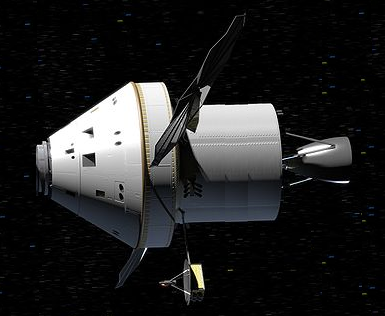
Launch Reliability: A two stage to orbit vehicle with no engine out capability in the upper hypergolic stage. This makes this an inherently less reliable two stage spacecraft than the SD-CV/ ACES 41 SM but still more reliable than an Ares I.
Environmental Impact: carbon neutral liquid hydrogen/oxygen fuel that's easy to derive from carbon neutral resources (nuclear, hydroelectric, wind, solar, etc.) via the electrolysis of water.
Commercial Viability: Should be capable of delivering an Orion capsule, Boeings CST-100 capsule, or a Dream Chaser space plane into orbit.
Atlas V with ACES 41 Service Module (SM) upper stage

Atlas V and ACES 41 with command module (credit: United Launch Alliance)
Launch Reliability: A two stage to orbit launch vehicle with engine out capability only in the second stage.
Environmental Impact: First stage utilizes greenhouse gas polluting RP-1 (Refined Petroleum 1) fuel with liquid oxygen. However, the production of RP-1 rocket fuel from carbon neutral resources may be a possibility in the near future.
Commercial Viability: Should be able to lift an Orion capsule (without the SM) and a Boeing CST-100 into orbit. However, launching the much heavier Dream Chaser space plane with a rear positioned LAS (Launch Abort System) may require additional solid rocket boosters which would inherently lower the space vehicle's launch reliability relative to other vehicles.
Environmental Impact: First stage utilizes greenhouse gas polluting RP-1 (Refined Petroleum 1) fuel with liquid oxygen. However, the production of RP-1 rocket fuel from carbon neutral resources may be a possibility in the near future.
Commercial Viability: Should be able to lift an Orion capsule (without the SM) and a Boeing CST-100 into orbit. However, launching the much heavier Dream Chaser space plane with a rear positioned LAS (Launch Abort System) may require additional solid rocket boosters which would inherently lower the space vehicle's launch reliability relative to other vehicles.
Falcon 9


Launch Reliability: A two stage to orbit vehicle with engine out capability only in the first stage. The Falcon 9 should be inherently safer than the Ares 1.
Environmental impact: Both first and second stages utilizes greenhouse gas polluting RP-1 (Refined Petroleum 1) fuel with liquid oxygen which would make the Falcon 9 the least green of any crew launch vehicle. However, the production of RP-1 rocket fuel from carbon neutral resources may be a possibility in the near future.
Commercial Viability: The Falcon 9's high inherent launch safety should be attractive to customers for manned spaceflights. Space X argues that the Falcon 9 could be the cheapest manned launch vehicle ever developed.
Environmental impact: Both first and second stages utilizes greenhouse gas polluting RP-1 (Refined Petroleum 1) fuel with liquid oxygen which would make the Falcon 9 the least green of any crew launch vehicle. However, the production of RP-1 rocket fuel from carbon neutral resources may be a possibility in the near future.
Commercial Viability: The Falcon 9's high inherent launch safety should be attractive to customers for manned spaceflights. Space X argues that the Falcon 9 could be the cheapest manned launch vehicle ever developed.
Ares I

Man-rated SD-HLV


Launch Reliability: A two stage to orbit vehicle with no engine out capability in the solid rocket booster first stage and no engine out capability in the single engine LOX/LH2 second stage. So the Ares I would be inherently less safe than the SD-CV, Atlas V, and Falcon 9 launch vehicles.
Environmental Impact: Upper stage uses carbon neutral liquid hydrogen/oxygen fuel that's easy to derive from carbon neutral resources (nuclear, hydroelectric, wind, solar, etc.) via the electrolysis of water. The CO2 produced from the polymers contained in the single solid rocket booster would be relatively tiny compared to the CO2 pollution that would be produced from vehicles such as the Atlas V and the Falcon 9.
Commercial Viability: It seems doubtful that private companies would be attracted to launching humans aboard a spacecraft with a liquid hydrogen/oxygen upper stage on top of a huge solid rocket booster.
Environmental Impact: Upper stage uses carbon neutral liquid hydrogen/oxygen fuel that's easy to derive from carbon neutral resources (nuclear, hydroelectric, wind, solar, etc.) via the electrolysis of water. The CO2 produced from the polymers contained in the single solid rocket booster would be relatively tiny compared to the CO2 pollution that would be produced from vehicles such as the Atlas V and the Falcon 9.
Commercial Viability: It seems doubtful that private companies would be attracted to launching humans aboard a spacecraft with a liquid hydrogen/oxygen upper stage on top of a huge solid rocket booster.
Man-rated SD-HLV

Launch Reliability: Three boosters are required to reach orbit. And there is with no engine out capability in the two SRBs (solid rocket boosters). This makes the SD-HLV inherently less safe than the Ares I and a lot less reliable than both versions of the SD-CV.
Environmental Impact: Core booster uses carbon neutral liquid hydrogen/oxygen fuel that's easy to derive from carbon neutral resources (nuclear, hydroelectric, wind, solar, etc.) via the electrolysis of water. The CO2 produced from the polymers contained in the two solid rocket boosters is relatively tiny compared to the CO2 that would be produced from vehicles such as the Atlas V and the Falcon 9.
Commercial Viability: Because of the unnecessary addition of two SRBs, this would be a much more expensive manned launch vehicle than the SD-CV, Atlas V, or a Falcon 9. However, these cost might be mitigated if the cargo shroud also carried valuable cargo such as multiple satellites, hydrogen and oxygen for space depots, and water and oxygen for space stations. With a minimal payload capacity of at least 65 tonnes, the SD-HLV should be able to carry crew plus at least 40 to 50 tonnes of cargo to orbit-- which is much more cargo than the Space Shuttle.

Commercial Viability: Because of the two SRBs, this would be a much more expensive manned launch vehicle than the SD-CV, Atlas V, or a Falcon 9. But like the SD-HLV, these cost might be mitigated if the cargo shroud also carried valuable cargo such as multiple satellites, hydrogen and oxygen for space depots, and water and oxygen for space stations.
Commercial Viability: Because of the unnecessary addition of two SRBs, this would be a much more expensive manned launch vehicle than the SD-CV, Atlas V, or a Falcon 9. However, these cost might be mitigated if the cargo shroud also carried valuable cargo such as multiple satellites, hydrogen and oxygen for space depots, and water and oxygen for space stations. With a minimal payload capacity of at least 65 tonnes, the SD-HLV should be able to carry crew plus at least 40 to 50 tonnes of cargo to orbit-- which is much more cargo than the Space Shuttle.
Sidemount Shuttle

Credit NASA
Launch Reliability: Three boosters are required to reach orbit with no engine out capability in the two solid rocket boosters (SRBs). This makes the SD-HLV statistically not as safe as the Ares I and a lot less safe than an SD-CV. The placement of the crew capsule and LAS (launch abort system) on the side of the external tank also makes the Sidemount less safe than the inline SD-HLV.
Environmental Impact: Core booster uses carbon neutral liquid hydrogen/oxygen fuel that's easy to derive from carbon neutral resources (nuclear, hydroelectric, wind, solar, etc.) via the electrolysis of water. The CO2 produced from the polymers contained in the two solid rocket boosters is relatively tiny compared to the CO2 that would be produced from vehicles such as the Atlas V and the Falcon 9.Commercial Viability: Because of the two SRBs, this would be a much more expensive manned launch vehicle than the SD-CV, Atlas V, or a Falcon 9. But like the SD-HLV, these cost might be mitigated if the cargo shroud also carried valuable cargo such as multiple satellites, hydrogen and oxygen for space depots, and water and oxygen for space stations.
Man-rated Delta IV Heavy


Launch Reliability: Three core stages and perhaps an upper stage would be required to transport humans to orbit. There would be no engine out capability in the three cores stages. This vehicle would be less inherently safe than the Ares I and only the LAS ( Launch Abort System) makes the Delta IV heavy inherently safer launch than the Space Shuttle.
Environmental impact: carbon neutral liquid hydrogen/oxygen fuel in core stage and upper ACES 41 stage that's easy to derive from carbon neutral resources (nuclear, hydroelectric, wind, solar, etc.) via the electrolysis of water.
Commercial viability: Should be capable of delivering an Orion capsule, Boeing CST-100, or a Dream Chaser space plane into orbit plus 10 to 20 tonnes of liquid hydrogen and oxygen fuel to LEO orbiting fuel depots.
Environmental impact: carbon neutral liquid hydrogen/oxygen fuel in core stage and upper ACES 41 stage that's easy to derive from carbon neutral resources (nuclear, hydroelectric, wind, solar, etc.) via the electrolysis of water.
Commercial viability: Should be capable of delivering an Orion capsule, Boeing CST-100, or a Dream Chaser space plane into orbit plus 10 to 20 tonnes of liquid hydrogen and oxygen fuel to LEO orbiting fuel depots.
Space Shuttle


Launch Reliability: Three boosters are required to reach orbit with no engine out capability in the two solid rocket boosters (SRBs). No LAS (Launch Abort System). However, there has only been one fatal launch accident in the nearly 30 year launch history of the Space Shuttle with no fatal launch accidents in the last 24 years.
Environmental Impact: Core booster uses carbon neutral liquid hydrogen/oxygen fuel that's easy to derive from carbon neutral resources (nuclear, hydroelectric, wind, solar, etc.) via the electrolysis of water. The CO2 produced from the polymers contained in the two solid rocket boosters is relatively tiny compared to the CO2 that would be produced from vehicles such as the Atlas V and the Falcon 9.
Environmental Impact: Core booster uses carbon neutral liquid hydrogen/oxygen fuel that's easy to derive from carbon neutral resources (nuclear, hydroelectric, wind, solar, etc.) via the electrolysis of water. The CO2 produced from the polymers contained in the two solid rocket boosters is relatively tiny compared to the CO2 that would be produced from vehicles such as the Atlas V and the Falcon 9.
Relative Safety Levels to Low Earth Orbit
Links and References
Safety Level One: SD-CV with ACES 41 (SM) upper stage
Safety Level Two: Atlas V + ACES 41 SM upper stage; Falcon 9
Safety Level Three : Ares I
Safety Level Four: SD-HLV
Safety Level Five: Delta IV Heavy
Safety Level Six: Space Shuttle
The SD-CV and the Delta IV heavy would have the least environmental impact as far as global warming is concerned while the JP-1 fueled Atlas V (first stage) and Falcon 9 (first and second stages) would have the most deleterious greenhouse effect on the environment. While the global environmental impact of manned space launches (less than a dozen per year) is currently meager compared to other manned transportation systems, the emergence of space tourism could dramatically increase the number of manned space launches to hundreds or even thousands by mid-century as the high demand for manned spaceflights begins to dramatically reduce the cost of rocket engines and space vehicles in general. And this doesn't include the the growing demand for commercial and military satellites and space solar power satellites. Therefore, NASA needs to join the US military in helping to develop aerospace fuels that are derived from carbon neutral resources in order to mitigate the environmental impact of global warming from government and private commercial launched space vehicles.
Safety Level Two: Atlas V + ACES 41 SM upper stage; Falcon 9
Safety Level Three : Ares I
Safety Level Four: SD-HLV
Safety Level Five: Delta IV Heavy
Safety Level Six: Space Shuttle
Relative Greenhouse Gas Impact Levels
Of the crew launch options presented above, the SD-CV with an ACES 41 upper stage would have the safest inherent crew launch architecture. The Atlas V, the Falcon 9, and Boeing's SD-CV with a stretched hypergolic SM (Service Module) would be the next most inherently reliable launch vehicles with configurations inherently more reliable than the Ares I. Because of the addition of a LAS (Launch Abort System) the SD-HLV, Sidemount Shuttle, and a man-rated Delta IV heavy would be inherently safer than the Space Shuttle but still less reliable in their architecture than the less complex Ares I.Zero CO2 pollution: SD-CV (both versions); Delta IV Heavy
Relatively Minor CO2 pollution: Space Shuttle, SD-HLV, Ares I, Sidemount Shuttle
Highest CO2 pollution: Falcon 9, Atlas V
Relatively Minor CO2 pollution: Space Shuttle, SD-HLV, Ares I, Sidemount Shuttle
Highest CO2 pollution: Falcon 9, Atlas V
The SD-CV and the Delta IV heavy would have the least environmental impact as far as global warming is concerned while the JP-1 fueled Atlas V (first stage) and Falcon 9 (first and second stages) would have the most deleterious greenhouse effect on the environment. While the global environmental impact of manned space launches (less than a dozen per year) is currently meager compared to other manned transportation systems, the emergence of space tourism could dramatically increase the number of manned space launches to hundreds or even thousands by mid-century as the high demand for manned spaceflights begins to dramatically reduce the cost of rocket engines and space vehicles in general. And this doesn't include the the growing demand for commercial and military satellites and space solar power satellites. Therefore, NASA needs to join the US military in helping to develop aerospace fuels that are derived from carbon neutral resources in order to mitigate the environmental impact of global warming from government and private commercial launched space vehicles.
Links and References
1. Conquering Cis-Lunar Space with Shuttle and ULA Derived Technologies
2. No time for NASA complacency on crew safety
3. National Launch System
4. Heavy Lift Launch Vehicles with Existing Propulsion Systems (Boeing Phantom Works)
5. A Commercially Based Lunar Architecture
6. DIRECT
7. Completed SD HLV assessment highlights low-cost post-shuttle solution
8. Boeing's New HLV Concept could be the DC-3 of Manned Rocket Boosters
9. ULA: Upper Stage Evolution
2. No time for NASA complacency on crew safety
3. National Launch System
4. Heavy Lift Launch Vehicles with Existing Propulsion Systems (Boeing Phantom Works)
5. A Commercially Based Lunar Architecture
6. DIRECT
7. Completed SD HLV assessment highlights low-cost post-shuttle solution
8. Boeing's New HLV Concept could be the DC-3 of Manned Rocket Boosters
9. ULA: Upper Stage Evolution
Subscribe to:
Posts (Atom)
CINEMA FANTASTIC


Popular Posts
-
 S tena Line , one of the largest ferry operators in the world, recently announced that it will convert its 1500 passenger ferry, the Stena...
 -
 by Marcel F. Williams Congress has now made it clear that they want the immediate development of a heavy lift vehicle and a crew explorato...
 -
 by Marcel F. Williams Tuscany is renowned for its beautiful cities of Florence and Siena, and is historically famous as the birthplace ...
 -
 X-Ray of a notional regolith shielded 16 meter in diameter biosphere (Credit: NASA) by Marcel F. Williams A t least 0.1 g is required...
 -
 Notional crewed ELV-3 on the surface of the Moon by Marcel F. Williams D uring NASA's Constellation program, the American spa...
 -
 by Marcel F. Williams During the Great Depression, the Roosevelt administration decided to create jobs in the US by expanding electric power...
 -
 The Earth seen rising above the Lunar horizon aboard Apollo 17, the last human mission to the Moon (Credit: NASA) by Marcel F. Willia...
 -
 Notional MADV on the surface of Mars (Credit: Lockheed Martin) by Marcel F. Williams At the 68th International Astronautical Congress...


