Trans Lunar Injection Successful!
Links and References
 |
| Notional reusable EUS derived REUS-LV/Crew vehicle descending to the lunar surface using side thrusters for the final descent and soft landing |
The current development of the Exploration Upper Stage (EUS) for NASA's Space Launch System offers Boeing Aerospace an opportunity to produce reusable variants of the spacecraft that could greatly enhance the capability of Boeing's super heavy lift vehicle system.
Reusable Lunar Crew Lander
By simply adding a pressurized crew module at the top of the spacecraft and landing gear at the bottom of the vehicle could allow the EUS to land humans on the surface of the Moon. I will refer to this notional crew landing EUS variant as the REUS-LV/Crew.
Replacing gaseous helium with gaseous oxygen and hydrogen for
pressurizing liquid oxygen and liquid hydrogen tanks should allow the
REUS-LV to be reused at least 50 times. The gaseous hydrogen and oxygen could also power
thrusters for attitude control. However, with RL 10 engines capable of only 50 starts, reusability for such a vehicle might be limited to only six round trips between LEO and the lunar surface.
 |
Artist depiction of an expendable EUS for the Space Launch System (Credit NASA) |
NASA is intent on establishing its deep space Gateway at an NRHO (Near Rectilinear Halo Orbit), a seven day polar orbit around the Moon. The human occupied Gateway habitat would allow 12 hour trips to the lunar surface every seven days. A weeks stay on the lunar surface would also allow a return to NRHO in just 12 hours time.
Assuming a dry mass of 23 tonnes for a crewed version of the REUS-LV, the space vehicle should be cable of round trips to the lunar surface utilizing less than 70 tonnes of propellant. So substantial amounts of additional payload could be deployed with crewed missions to the Moon if 113 tonnes of the vehicle's total fuel capacity is utilized.
Private commercial launch vehicles could transport passengers to the REUS-LV/Crew spacecraft orbiting independently at LEO or docked at a LEO orbiting space station.
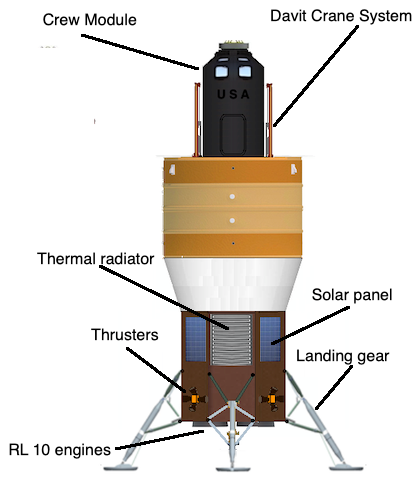 |
| Notional reusable REUS-LV/Crew landing vehicle for lunar operations |
Once the REUS-LV/Crew vehicle is on the Moon, a davit crane system could be used to lower astronauts, vehicles, and other equipment to the lunar surface and to retrieve astronauts and lunar material later for transport back to the NRHO Gateway. Solar panels positioned on four of the walls surrounding the LOX tank would provide electricity for the crew module plus electric power to keep the hydrogen and oxygen liquefied using the thermal radiators to assist its cryocooler refrigeration systems.
Orbital Propellant Depots
Two REUS-LV/Crew vehicles could be deployed to LEO with a single SLS launch. But propellant depots would be required to fuel the vehicles at LEO and at NRHO in order to conduct crewed missions to and from the lunar surface and to return the spacecraft back to LEO. So the deployment of two propellant manufacturing water depots at LEO and at NRHO would be necessary for crewed lunar missions.
Two REUS derived vehicles (REUS-OTV/Depot) could be utilized as propellant producing water depots capable of storing up to 150 tonnes of water for the production of 113 tonnes of LOX/LH2 propellant. 9 tonnes of water contains approximately 8 tonnes of oxygen and one tone of hydrogen. But only 7 tonnes of propellant could be manufactured from 9 tonnes of water since rocket fuel would require a ratio of 6 tonnes of oxygen per ton of hydrogen. So each depot would be capable of storing approximately 16 tonnes of LH2 plus 97 tonnes of LOX) while wasting 32 tonnes of liquid oxygen.
However if only 113 tonnes of water is converted into 97 tonnes of liquid oxygen and 13 tonnes of hydrogen then 100% of the water could be utilized as fuel if an REUS-LV vehicle initially arrives at LEO from Earth with at least 3 tonnes of liquid hydrogen propellant. Two REUS-LV/Crew vehicles would only weigh 46 tonnes. And with an additional six tonnes of liquid hydrogen propellant, would still only be 52 tonnes of payload mass for a basic SLS vehicle capable of deploying at least 70 tonnes to LEO. Fully fueled with LH2, the first REUS-LV/Crew vehicles launched to LEO could require no liquid hydrogen from the LEO depot at all, only its liquid hydrogen.
Water could be continuously supplied to propellant producing depots at LEO by various private American launch systems (Space X, the ULA, and Blue Origin) who have vehicles that are either currently operational or are very close to being operational:
Falcon Heavy (Space X) - 63 tonnes to LEO
New Glenn (Blue Origin) - 45 tonnes to LEO
Vulcan-Centaur (ULA) - 27 tonnes to LEO
During the first SLS launch of two propellant depots to LEO, private launch companies could supply one depot with enough water to produce propellant that can be transferred to the second depot to deploy itself plus its solar array to NRHO.

| EUS derived propellant producing water depot approaching orbiting solar power plant @ NRHO where it will use photovoltaic power to electrolyze water into LOX and LH2. |

| REUS-OTV plus optional interstage connection ring for joining two OTV vehicles together. Such vehicles could be used to transport 60 to 120 tonnes of water and other payloads between LEO and NRHO and to various lunar orbits and Earth-Moon Lagrange points. |
 |
| Reusable REUS-LV/Crew vehicle docked at a notional single launch SLS derived MegaStation at NRHO. The notional EUS derived vehicle would be cable of round trips between NRHO and the lunar surface on substantially less than a full tank of LOX/LH2 propellant. REUS-OTV vehicles could be used to deploy the habitat modules and the pressurized spent SLS core stage from LEO to NRHO. |
Two reusable REUS-LV/Crew vehicles could be deployed to LEO with a single SLS launch. And each vehicle deployed would be capable of at least 12 round trips between LEO and NRHO. So a single SLS launch could allow 12 round trips to the lunar surface-- if water can be supplied to LEO and then to NRHO. This would require two more SLS launches to deploy two solar powered propellant depots and two REUS derived orbital transfer vehicles (REUS-OTV) to transport water from LEO to NRHO. So three SLS launches would be required for 12 round trips to the lunar surface (four potential round trips to the lunar surface per SLS launch).
Lunar Depots
REUS derived propellant producing water depots with landing gear could also be deployed to the lunar surface with photovoltaic solar power units. If water ice resources are exploited at the lunar poles then propellant could be produced on the Moon. The REUS-LV/Crew vehicle could be fueled with propellant at LEO and travel directly to the lunar surface. And the same REUS-LV/ Crew could later be fueled with lunar propellant for its return trip directly to LEO.
 |
| Reusable REUS-LV/Crew vehicle docked at a notional single launch SLS derived MegaStation at NRHO. The notional EUS derived vehicle would be cable of round trips between NRHO and the lunar surface on substantially less than a full tank of LOX/LH2 propellant. REUS-OTV vehicles could be used to deploy the habitat modules and the pressurized spent SLS core stage from LEO to NRHO. |
Alternatively, propellant from Earth could be substantially reduced for lunar missions if tankers supplied water from the moon to NRHO depots. REUS-LV/Crew vehicles could then return to LEO using LOX/LH2 propellant produced on the Moon.
Reusable Lunar Hopper
 |
| The delta-v and travel times for possible crewed suborbital hops on the lunar surface. Fueled with liquid hydrogen and oxygen at a lunar base, a notional REUS-LV/Crew vehicle would be capable of traveling to any region on the surface of the Moon in less than an hour and return back to the lunar outpost on less than a single tank of fuel. |
Supplied with propellant on the lunar surface, the REUS-LV/Crew could also be used as a lunar hopper that could travel to any region on the surface of the Moon in less than an hour. The vehicle would also carry enough fuel to return to the lunar outpost where it was fueled in less than an hour. With four trajectory burns for each round trip, each REUS-LV/Crew vehicle could travel to 12 regions on the lunar surface. So a single SLS launch could potentially explore 24 regions on the lunar surface if REUS-LV/Crew vehicles are refueled with lunar propellant.
Repurposing Decommissioned Landing Vehicles
REUS derived vehicles could still be put to good use after they are decommissioned from their original task. REUS-LV/Crew vehicles that are no longer safely capable of crewed flights could be repurposed for storing substantial quantities of water mined from the lunar ice and for storing sewage accumulated from the inhabitants of lunar outpost. With both a hydrogen and oxygen tank, substantial quantities of water and sewage could be stored in the two different tanks of one vehicle. The decommissioned vehicles could also be used to store excess oxygen from the production of propellant. LOX and LH2 could be stored in decommissioned spacecraft to produce electric power during the lunar night using fuel cells. Such fuel cells would not only produce electricity from the hydrogen and oxygen-- but also water.
Decommissioned vehicles could also be used as temporary outpost in lunar regions of particular interest. They could be transported to their lunar locations by electric powered lunar cranes. And regolith bags could be deployed around the vehicle's habitat modules for additional protection against cosmic radiation and micrometeorites.
Decommissioned REUS-OTV vehicles in orbit could be used in a similar fashion at NRHO for storing water, or excess oxygen from the production of propellant.
Deep Space Robotic Missions to Phobos and Deimos
At NRHO, the REUS-LV/Crew vehicle could also be used for-- unmanned-- round trip robotic missions to the moons of Mars. The delta-v requirements for such round trip missions between NRHO and the martian moons would actually be less than round trip missions between NRHO and the lunar surface. So a robotic REUS-LV would be fully capable of traveling to the surface of Deimos or Phobos and returning to NRHO with substantial quantities of rocks and regolith from those two tiny martian moons. Roving vehicles could also be left behind that could be used to extensively explore each of the martian moons. The REUS-LV davit system could easily lower and retrieve such vehicles after landing on those tiny worlds.
Links and References
CECE: A Deep Throttling Demonstrator Cryogenic Engine
for NASA's Lunar Lander
Realistic Near-Term Propellant Depots: Implementation of a
Critical Spacefaring Capabilit
Large-Scale Demonstration of Liquid Hydrogen Storage With Zero Boiloff for In-Space Applications
 |
| Notional RLV-4 Cargo vehicle in a distant Near Rectilinear Halo Orbit awaiting depot refueling before transporting a multilevel Lunar Regolith Habitat to an outpost at one of the lunar poles. |
by Marcel F. Williams
Privately financing the development of a reusable SLS deployed lunar landing vehicle should be a priority for the major Space Launch System partners: Boeing, Lockheed Martin, Aerojet Rocketdyne, and Northrup Grumman. A reusable single stage LOX/LH2 fueled vehicle (RLV-4 Crew) could be commercially successful as a crew lander by simply adding a-- pressurized habitat module-- already being developed by Lockheed Martin for the Blue Origin National Team.
 |
Notional RLV-4 Crew vehicle with Lockheed Martin derived habitat module with crew deployment davit system. |
By financing a single stage vehicle rather than a two stage vehicle, development cost could be substantially reduced by simply developing one vehicle instead of two. Further cost reductions could result from using engines and propellant tank technology that already exist. So a notional RLV-4 could use RL-10 derived CECE engines already developed by SLS partner Aerojet Rocketdyne and super lightweight composite propellant tanks already developed by Boeing.
I envision the RLV-4 Crew and RLV-4 Cargo vehicles going into operation by the year 2026. If we assume a development cost of $6 billion for the RLV-4 over the course of six years, then each SLS partner would be required to supply at least $250 million a year of funding for the development of the reusable RLV-4.
 |
| Notional RLV-4 Cargo vehicle capable of being filled with up to 56 tonnes of LOX/LH2 propellant. |
Similar to the RLV-4 Crew vehicle, I envision the RLV-4 Cargo as being launched-- in pairs-- within the 9.1 meter in diameter dynamic envelope of a 10 meter in diameter SLS payload fairing. At its corners, the maximum diameter of the RLV-4 octagon would be 8.44 meters with a distance between each opposite 3.23 meter side of the octagon being approximately 7.8 meters. With the legs folded during launch, the RLV-4 could easily fit within the internal 9.1 meter in diameter dynamic envelope of the 10 meter in diameter SLS payload fairing.
Each RLV-4 Cargo vehicle would weigh approximately 8 tonnes. The 10 meter in diameter payload fairing would add an additional 10 tonnes in weight headed for orbit. Since an SLS Block I would be capable of deploying up to 70 tonnes to LEO, up to 44 tonnes of propellant could be added to one of the vehicles in preparation for a mission.
Alternatively, one RLV-4 Crew vehicle could be launched with one RLV- 4 Cargo vehicle. Before launch, the crew vehicle would be filled with enough propellant to transport a crew to NRHO. The cargo vehicle would simply remain in orbit at LEO until its ready to dock with a payload and be fueled for a mission.
The reusable RLV-4 Cargo vehicle would be able to dock securely with large payloads (up to 10 meters in diameter) subsequently deployed to LEO by the SLS. Payloads deployed to orbit by the SLS would be equipped with flat standardized docking bases configured to securely join with the octagonal payload floor of the RLV-4. Propellant depots deployed to LEO, NRHO (Near Rectilinear Halo Orbit) and eventually on the lunar surface would be used to fuel and refuel the RLV-4 Cargo vehicles.
 |
| Octagon shaped payload floor of notional RLV-4 Cargo vehicle. |
Fueled at LEO with up to 56 tonnes of propellant, the RLV-4 could deploy up to 10 tonnes of cargo to the lunar surface. Alternatively, the RLV-4 could transport up to 30 tonnes of cargo to NRHO where it could then be refueled to transport its 30 tonne payload to the lunar surface.
If the SLS deployed payload has an upper attachment area that could allow an additional RLV-4 to dock then two RLV-4 Cargo vehicles could be utilized for a single cargo mission. This could allow up to 60 tonnes of payload to be transported to NRHO. A single fully fueled RLV-4 Cargo vehicle could deploy up to 50 tonnes of payload to the lunar surface. But two vehicles would be required to deliver a 60 tonne payload to the surface. One vehicle would only travel to lunar orbit and then back to NRHO while the second vehicle would travel to the lunar surface with its 60 tonnes of payload.
So the reusable RLV-4 cargo system would be capable of delivering 10 tonnes to 60 tonnes of payload from the lunar surface from LEO. And that means the SLS could deploy up to 60 tonnes of payload to the lunar surface with a single launch if it used a reusable RLV-4 Cargo transport system.
 |
| Notional RLV-4 Cargo deployed lunar crane for unloading large cargo and for lunar regolith deposition. |
Large lunar cranes might be one of the most valuable initial payloads for the RLV-4 Cargo. Using a davit system, a pair of large cranes could be deployed to the lunar surface. Such electric or hybrid electric (pressurized hydrogen fuel cell/battery) vehicles could be used to unload large and heavy payloads from a large variety of lunar landing craft. If we assume that each lunar crane weighs at least 8 tonnes, lunar regolith could be used to provide an additional 24 tonnes of counter weight. So each lunar crane should be capable of offloading more than 30 tonnes of payload. However, if the iron and other metals that inherently exist within lunar regolith are magnetically extracted to increase the counterweight capabilities of lunar regolith then payloads weighing more than 60 tonnes could be unloaded. Lunar cranes could also be used to deposit regolith within the surrounding walls of large habitats and within the foundation floor for inflatable biospheres and surrounding bio-tori.
 |
| RLV-4 Cargo vehicle carrying twin lunar regolith cranes to be deployed to the lunar surface using davit system. |
Pressurized 8.4 meter in diameter cylinders derived from SLS propellant tank technology could provide multilevel habitats for the lunar surface up to 20 meters tall if deployed within an SLS 10 meter in diameter payload fairing. With a self deploying regolith walls, lunar cranes could provide appropriate radiation shielding by simply dumping lunar regolith within the cavity of the surrounding wall.
 |
| Lunar regolith crane about to remove a Lunar Regolith Habitat from a RLV-4 Cargo vehicle. |
But even longer 8.4 meter in diameter cylinders could be deployed to the lunar surface after being to deployed to LEO by the SLS. 40 meter habitats could be deployed to the lunar surface using the RLV-4 Cargo. Such habitats could be unloaded by large lunar cranes and deployed horizontally to the lunar surface and then covered with lunar regolith bags. The use of the larger horizontal habitats for agriculture could even allow for the growing of orchard trees for the production of apples, oranges, peaches, lemons, etc. The horizontal habitats could also be used for aquaculture, raising shrimp, crabs, fish, clams, etc.
 |
| X-Ray of an SLS propellant tank technology derived Lunar Regolith Habitat |
If the RLV-4 Cargo is used to deploy inflatable Kevlar biosphere and
bio-tori then substantially larger habitats could be deployed. 50 meter
in diameter Kevlar biospheres that are pressurized with half the
atmospheric pressure on Earth could easily be deployed to the lunar
surface by an RLV-4 Cargo. An additional SLS launch would be required
to launch the surrounding 25 meter wide bio-torus. And another SLS launch would be required to deploy the expandable connecting tunnel and regolith base for the biosphere and bio-torus on top.
A 15 meter high SLS deployed lunar regolith hab might provide five spacious 8.4 meter in diameter habitat floor levels (55 square meters per floor).
But the
bottom half of a 50 meter in diameter biosphere could provide up to 9
habitat levels with each floor averaging about 25 meters in diameter
(490 square meters per floor). That would be up to 16 times the floor
area for just the bottom half of the biosphere. The upper half of the
biosphere (the biodome) would provide the astronauts, military personal,
and guest with spacious recreational area with a ceiling up to 25
meters high. Such an area could easily accommodate a large circular
recreational swimming pool 30 meters in diameter. This might also be
room enough to strap on a pair of wings and fly about within the 50
meter wide biodome. The surrounding bio-torus or tori could be used for
agriculture and aquaculture and storage.
 |
| Notional lunar biosphere and bio-torus covered with regolith bags and connected to twin Lunar Regolith Habitats on the sintered surface of a lunar outpost area. |
Once propellant is being produced on the lunar surface, extraterrestrial vehicles like the RLV-4 crew should make it substantially cheaper to travel to the lunar surface after departing the Earth's surface aboard a commercial crew vehicle. If a lunar habitat was deployed to the lunar surface and utilized as a hotel for astronauts, tourist, and military personal, the owners could reasonably charge its guest perhaps $10 million each for a 30 day stay. This, of course, doesn't include the cost of the round trip from Earth to the Moon. If we assumed that an individual habitat was continuously occupied by at least 4 to 8 personal (astronauts, military personal, tourist) then an individual habitat could make between $480 million to $960 million per year in revenue. With up to 16 times the floor area for the bottom half of a biosphere, a single biosphere/bio-tori complex could make more than $15 billion a year in revenue if it were continuously fully occupied with up to 128 people. Providing water, food, and air for the lunar guest would be insignificant if such resources are derived from ice and carbonaceous and nitrogenous resources in the lunar regolith at the poles or from similar resources deep within lava tubes. Assuming a minimum 20 year lifetime for such habitats, such SLS deployed facilities should be highly profitable.
Links and References
 |
| Notional SLS deployed RLV-4 Crew lunar landing vehicle with a crew davit deployment system. |
 |
| LOX/LH2 tank configuration in Boeing's Altair lunar lander concept (Credit: Boeing) |
The notional RLV-4 would be octagon shaped like Boeing's Altair lunar descent vehicle concept. But it will use a simplified propellant tank architecture requiring just two LH2 tanks and two LOX tanks, similar to Blue Origin's octagon shaped Blue Moon lunar lander which is basically a
smaller-- simplified-- version of of the Altair lunar
lander.
 |
| Top view of LOX/LH2 tank configuration for Boeing's Altair lunar lander concept (Credit: Boeing) |
The propellant tanks for the RLV-4 will be derived from Boeing's
super light weight composite cryotank technology with the two large
3.8 meter in diameter hydrogen tanks and and the two smaller liquid oxygen tanks approximately 2.4 meters
in diameter. Both cryotanks will stand nearly 6 meters high within the
interior of the RLV-4 octagon. Gaseous compressed hydrogen will be used to
pressurize the liquid hydrogen tanks and compressed gaseous oxygen for pressurizing the liquid
oxygen tanks during liftoff and trajectory burns-- replacing gaseous helium. Gaseous hydrogen and oxygen
will also be utilized for the vehicle attitude thrusters in this notional vehicle design. So hydrogen and oxygen will provide the propellant, attitude control, and tank pressurization for the RLV-4.
 |
| Notional Boeing 3.8 meter in diameter composite LH2 tank and 2.4 meter in diameter LOX tank. |
The RLV-4 would be somewhat similar in height with Boeing's Altair concept. But it would be able to store more than twice as much
propellant (56 tonnes) thanks to the substantially larger cryotank diameter of the
liquid hydrogen tank and the larger diameter and height of the liquid
oxygen tanks relative to those conceived for the Altair. So the RLV-4
would be capable of accommodating up to 56
tonnes of propellant which would be more than enough fuel to land a 16 tonne crew vehicle from LEO to the surface of the Moon.
The restartable engines for the RLV-4 could be provided by SLS partner,
Aerojet Rocketdyne, who is currently developing the expendable RS-25 engines for
the SLS core vehicle and the RL-10 engines for the upper stage vehicle.
The RL-10 derived CECE engines would be capable of throttling between 104% down to
just 5.9% and would be capable of at least 50 in space starts. So the
CECE engines should be capable of performing at least 12 round trip
missions between NRHO and the lunar surface before having to be
replaced. Using them in pairs would give the RLV-4 engine-out capability, enhancing crew safety.
However, the RLV-4 propellant tanks should be capable
of at least 50 refills (50 round trips if missions between NRHO and the
lunar surface are conducted on a single fueling of propellant). So if
two more engines were added to the RLV-4, 24 round trips could be
possible if only two engines were used during a journey-- while propellant
flow was shut off to the other pair of engines. Replacing the engines
after 24 round trips with four more CECE engines could maximize the
RLV-4's reusability allowing the vehicle to conduct up to 48 round trips to the lunar surface before-- if it is refueled less than 50 times.
 |
| Basic RLV-4 cargo lunar lander with solar panels on four sides of the octagon shaped vehicle and radiators on four sides of the vehicle |
At its corners, the maximum diameter of the RLV-4 octagon would be 8.44 meters with a distance between each opposite 3.23 meter side of the octagon being approximately 7.8 meters. With the legs folded during launch aboard an SLS vehicle within a 10 meter fairing, the RLV-4 could easily fit within the internal 9.1 meter dynamic envelope of the payload fairing.
 |
| Notional RLV-4 LOX/LH2 cyotank configuration within the octagon shaped vehicle |
While
NASA currently envisions only an 8.4 meter fairing for it's use of the
SLS, it would be in the economic interest for the SLS partnership to quickly develop its originally intended 10 meter fairing in order to have a
clear competitive advantage over vehicles like the Space X's future
Starship which will have a 9 meter payload bay with probably an 8.1
meter dynamic envelope. However, Blue Origin's 7 meter in diameter New
Glenn launch vehicle could be competitive since it should also be
capable of accommodating payload fairings up to 10 meters in diameter.
With an 8.4 meter diameter for the SLS
core vehicle, the SLS should be capable of accommodating payload
fairing sizes up to 12 meters in diameter with internal dynamic
envelopes up to 11.1 meters in diameter.
SLS partner,
Lockheed Martin, could supply basically the same Orion derived crew
habitat module for the RLV-4 as it will for the Artemis National Team
(Blue Origin, Lockheed Martin, Northrup Grumman, Draper) that will
deploy a lunar crew lander to the Moon for NASA-- but without the added complexity and the expense
of the ascent propellant architecture.
Utilizing propellant depots deployed at LEO, the RLV-4 should be able to transport crews from LEO to NRHO with less than 24 tonnes of propellant.
But round trips between NRHO and the lunar surface could require nearly 48 tonnes of LOX/LH2.
Supplying a propellant depot at LEO with enough propellant for a RLV-4 crew mission to NRHO would only require a single Vulcan-Centaur launch (Vulcan-Centaur 562).
However, supplying water or propellant to depots located at NRHO for a single lunar mission would require eight Vulcan-Centaur launches for the round trip between NRHO and the lunar surface plus an additional four Vulcan-Centaur launches to NRHO to fuel the return trip of the RLV-4 back to LEO from NRHO.
So a single lunar mission would require at least 13 Vulcan-Centaur propellant launches costing more than a billion dollars in propellant cost alone for a single mission. But such cost would still be competitive with architectures that require at least one SLS/Orion launch plus additional commercial launches for a lunar crew missions.
However, propellant cost for the RLV-4 architecture would fall dramatically once hydrogen and oxygen were being produced on the lunar surface. And that would mean that only a single Vulcan-Centaur propellant launch to LEO would be required for a lunar mission.
Propellant destined for depots
located at NRHO could come from the lunar surface. And a RLV-4 tanker
variant could supply nearly 50 tonnes of water or propellant to an NRHO depot per launch from the surface of the Moon, up to 1200 tonnes of water or propellant until its four engines would have to be replaced, and up to 2400 tonnes
of water or propellant to NRHO before the entire vehicle would have to
be replaced. So two RLV-4 tanker vehicles deployed-- by a single SLS
launch-- might be able to deploy 2400 to 4800 tonnes of lunar propellant to NRHO.
Simple solar powered RLV-4 variants could serve as orbital propellant depots at LEO and NRHO and on the lunar surface. Each depot could store up to 56 tonnes of propellant plus up to 100 tonnes of water for possibly making propellant. The appropriate solar arrays for lunar and orbital RLV-4 derived propellant depots could be developed by SLS partner Northrup Grumman which already specializes in developing and deploying extraterrestrial solar arrays.
By
sharing the cost for the development and deployment of the RLV-4,
starting in 2021, Space Launch System partners: Boeing, Aerojet
Rocketdyne, Lockheed Martin, and Northrup Grumman could have the RLV-4
lunar lander and its variants ready to be deployed within a 10 meter in diameter SLS payload fairing by the year 2027.
By 2030, future RLV-4 passengers (astronauts and tourist) would simply have to take a Vulcan-Centaur-Dream Chaser or another commercial crew configuration to a commercial orbital habitat at LEO-- such as a commercial SLS derived Dry/Wet Shop mega habitat. At the orbiting habitat, passengers would transfer to an RLV-4 that has already docked at the habitat and already refueled at a nearby RLV-4 derived propellant depot or another commercial depot.
It would take the
RLV-4 about four days to transport up to 8 people to another private
microgravity habitat located at NRHO which would serve as a gateway to the lunar surface. There, passengers would transfer to another RLV-4
vehicle that was fueled on the lunar surface at a lunar outpost
with enough propellant to transport them to the surface of the Moon in
just 12 hours time. Or the RLV-4 that they arrived in could be refueled to transport them to the lunar surface.
The RLV-4 Crew vehicles located at NRHO could also utilize the cheap
lunar propellant exported to NRHO depots for bi-weekly crewed missions
to other areas on the lunar surface-- lasting 6 days-- before returning
the the NRHO Gateway. But if two RLV-4 vehicles are available at an NRHO Gateway, then weekly missions practically anywhere on the lunar surface could be conducted by a group of astronauts on a weekly basis.
Once passengers have completed their stay on the lunar surface, lunar propellant could be used to transport them on a four day trip from the Moon all the way back to LEO where they could take a Dream Chaser back to Earth, landing at any accommodating airport or spaceport in America.
But as advantageous the RLV-4 would be
as a commercial extraterrestrial crew lander, it would be even more
economically viable as a lunar cargo vehicle for transporting
exceptionally large and heavy SLS LEO launched payloads to the lunar
surface. The RLV-4 as a heavy cargo vehicle will be discussed in my next
article on the Reusable Landing Vehicle IV.
Links and References
Lunar Lander Vehicle Design Overview
Concept for a Crewed Lunar Lander Operating from the Lunar Orbiting Platform-Gateway
System Architecture Design and Development for a Reusable Lunar Lander
Boeing's Composite Tank Could Greatly Improve Launch Vehicles
Blue Origin's National Team Lunar Lander