by Marcel F. Williams

Congress has now made it clear that they want the immediate development of a heavy lift vehicle and a crew exploratory vehicle capable of beyond LEO missions and as a back up transport to the ISS. They have also made it clear that they want NASA to utilize technologies derived from both the Space Shuttle and Ares I/V programs since billions of tax payer money has already been invested in these technologies.
Some, however, have argued that utilizing a heavy lift vehicle as a crew transport to LEO violates the philosophy of
improving safety by not combining crew transport with cargo transport. This was part of the driving philosophy of former NASA director, Griffin, when he decided to advocate the development of the
Ares I as an ultra-safe crew transport vehicle and the
Ares V as a mega-heavy lift cargo vehicle.
Recently, NASA has been promoting a philosophy of developing new transport systems that can be utilized not only by NASA but also potentially by the military space program and by private commercial space programs. The advantage of such a philosophy is that increased demand for common transport systems or components could reduce cost for everyone that utilizes such vehicles or components.
The deployment of space depots has been argued as another means for reducing the cost of space travel beyond LEO. And the development of reusable space craft that utilize in situ resources on the Moon or the asteroids has also been proposed as a way to reduce the cost of space travel.
But is there a way that NASA could cheaply incorporate all of these ideas? I believe the answer is yes!

The first step is to develop a simple shuttle derived core vehicle similar to that proposed by
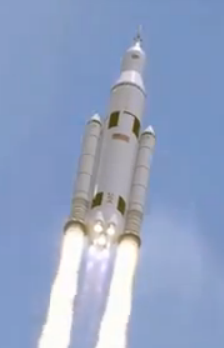
Boeing. The Boeing shuttle derived core vehicle could be utilized to transport humans into orbit without using solid rocket boosters (SRBs). But with SRBs, the Boeing core vehicle could be used as a heavy lift vehicle.
Boeing, however, advocates using four of the cheaper
RS-68B engines for their crew launch vehicle concept while using the more fuel efficient
RS-25E (disposable SSME) for the heavy lift vehicle.
Man-rating the RS-68 rocket engines will probably increase the cost of these engines while making the RS-25 expendable will probably reduce their cost. Using the same engines in both the crew launch and the heavy lift vehicle will increase demand, further reducing production cost.
So I advocate using the RS-25E in both the crew launch vehicle and the heavy lift vehicle.Boeing also proposed using a stretched
hypergolic fueled
SM (Service Module), requiring an extra
8 to 9 metric tons of fuel in order for the crew launch vehicle to transport a
20 metric ton capsule and crew to LEO. The United Launch Alliance (ULA), however, has proposed using an
ACES 41 as a LOX/LH2 fueled Service Module. Utilizing an ACES 41 SM with a shuttle derived crew launch booster which I'll call the
SD-CV (shuttle derived core vehicle) could potentially lift more than
30 metric tons to LEO. Since the ULA plans to use the ACES 41 as a common upper stage for both the Atlas and the Delta IV, the high production demand for the ACES 41 by NASA and the ULA should help to reduce cost for the ACES 41.
SD-CV (Shuttle Derived Core Vehicle) and ULA's ACES 41 (credit ULA) concept used as a Service Module for an Orion capsule. Boeing's heavy lift vehicle concept with an EDS could lift up to 120 metric tons to LEO while the crew vehicle could lift more than 30 metric tons to LEO (150 metric tons in combination).
That's enough capacity to launch nearly 60 metric tons of payload to trans lunar injection or to the Earth-Lunar L1 Lagrange point. An SD-CV crew vehicle with the ability to launch over 30 metric tons into orbit would also give it approximately the same capabilities as the current space shuttle with the exception of not being able to return large payloads back to Earth. But the SD-CV should be substantially cheaper to operate than the shuttle since it does not require SRBs. The SD-CV could also be one of the safest manned launch vehicles ever developed since it would only have two stages, with each stage having multiple engines capable of supplementing a failed engine in both stages. Being hydrogen fueled would also make it potentially the greenest manned space vehicle ever developed.
While a manned launched SD-HLV would still be safer than a space shuttle launch, the SD-CV should be equally as safe as a man rated Atlas V-401 and a substantially safer vehicle than an SD-HLV, Delta IV heavy, or a Falcon 9 (the two stage Falcon 9 only has one engine for the upper stage so a single engine failure in the upper stage would terminate the mission).Any space capsule chosen by NASA for the Orion CEV (Crew Exploratory Vehicle) should be able to be used by NASA and private industry on top of an ACES 41 which could be used by an Atlas V or a Delta IV heavy. Again, the higher the demand for a particular crew capsule, the lower the capsule's production cost will be.
An SD-HLV lunar mission would launch an Altair into Earth orbit for a rendezvous with a CM-SM-ACES 41, or it could use the Altair to transport unmanned payloads (lunar base modules, vehicles, oxygen factories, etc.) weighing more than 10 metric tons to the lunar surface.
Because of its large payload capacity, some might question the private commercial viability of the SD-CV as a crew launcher against much smaller potentially manned rated launch vehicles like the Atlas 5 and the Falcon 9. However, if a payload carrier is placed between the command module and the service module, the shuttle derived crew carrier could also transport and additional 20 metric tons of cargo to LEO.
While the space shuttle is banned from carrying commercial loads into orbit, a private commercial company would have no such restrictions!SD-CV could be launched into to orbit for a rendezvous with the Altair for a lunar mission or it could be used to transports crew and cargo to the ISS or to private commercial space stations.
There are two principal options for the EDS (Earth Departure Stage) for the unmanned heavy lift vehicle: one that uses a single JX-2 engine and one that uses multiple RL 10 engines. Since the ACES 41 in this concept and the Altair lunar lander would also use RL-10 engines, using RL-10s in the EDS, Service Module, and Altair lunar lander would obviously increase the demand for the RL-10 which should reduce the production cost for the engine.

After the Orion-CM-SM-ACES 41 docks with the Altair and EDS (Earth Departure Stage), the EDS provides most of the delta-v for transferring the Altair and the Orion to the L1 Lagrange point.
The SM-ACES 41 provides the rest of the delta-v requirements for reaching L1 in addition to the delta-v for returning passengers to Earth. Limiting the Orion CM-SM-ACES 41 to L1 would substantially reduce the delta-v requirements for a lunar mission.  The single stage Altar vehicle would transport up to three metric tonnes of payload (crew transport module, cargo, and crew) from L1 to the lunar surface and back to L1. L1 departure for the Altair vehicle enhances the ability of the lunar lander to conveniently land at practically any point on the lunar surface.
 The Altair lunar landing vehicle was originally proposed to have a LOX/LH2 descent stage and a hypergolic fueled ascent stage. However, there is no reason why a lunar landing vehicle can't be a single stage vehicle by simply using the descent stage to land and lift a small crew module weighing about 3 metric tons with four passengers and payload.
This would mean that NASA would only have to develop one lunar vehicle instead of two, substantially reducing development cost. Plus the Altair descent stage would use an RL-10 engine which would further reduce the cost of the RL-10 engine used by both NASA and the ULA.
A single stage Altair vehicle with a crew transport module would be much cheaper to develop than the two stage Altair concept that uses both a LOX/LH2 descent stage and a hypergolic fueled ascent stage. For long term missions to a lunar base facility, a simple light weight aluminum sun shade could be used to cover and shield the vehicle from direct sunlight on the lunar surface in order to reduce hydrogen and oxygen fuel boil-off.
Any Moon base program that involves the production of oxygen and even hydrogen from lunar resources would have a dramatic effect on reducing the cost of space travel within cis-lunar space. Without the need for a vehicle to carry oxygen and hydrogen fuel to the lunar surface for its eventual return to orbit, manned missions to a lunar base could carry several metric tons of additional cargo plus additional passengers to the lunar surface instead of just a few hundred kilograms with crew as currently envisioned by the Constellation program. Lunar oxygen and hydrogen could also allow an Altair to be used as a reusable manned vehicle operating from the lunar surface to lunar orbit or from the lunar surface to L1.
 A reusable single stage Altair crew transport vehicle could be fueled with oxygen and hydrogen from an L1 space depot for transporting passenger to the Moon and with in situ oxygen and hydrogen from the lunar surface for returning passengers to L1 requiring a much smaller vehicle that simply uses shorter cryogenic 0xygen and hydrogen fuel tanks.
 A stretched Altair vehicle, using longer hydrogen and oxygen fuel tanks, combined with an ACES 41 tanker could be used to supply an L1 depot with oxygen and hydrogen produced on the lunar surface. Such a tanker could also be used to supply lunar bases not located near the poles with hydrogen.
So some day a paying tourist or a lunar lotto winner aboard a Falcon 9, Atlas V, Delta IV heavy, or a SD-CV could simply fly into orbit and dock with another ACES 41 (originally fueled with lunar oxygen and hydrogen at an L1 space depot) to travel to L1. At the Lagrange point, passengers would dock with an L1 fueled reusable Altair vehicle which would transport them to the Moon where they could perhaps stay at an appropriately mass shielded a Bigelow lunar hotel. The same lunar vehicle could be refueled with lunar oxygen and hydrogen for the tourist's return to L1 where they would dock with a CM-SM-ACES 41 equipped with an aerobreaking hypercone that would take them back to Earth orbit. There they would dock with a space capsule or Dreamchaser space plane that would finally return them to the Earth. That might be a very interesting vacation perhaps 15 or 20 years from now!
References and Links1. Heavy Lift Launch Vehicles with Existing Propulsion Systems (Boeing Phantom Works)2.
Ambitious Ares Test Flight Proposed for HLV Demonstration3.
NASA Heavy Lift and Propulsion Trade Study
4.
Completed SD HLV assessment highlights low-cost post-shuttle solution5.
ULA: Upper Stage Evolution6.
A Commercially Based Lunar Architecture7.
National Launch System8.
DIRECT9.
Boeing's New HLV Concept could be the DC-3 of Manned Rocket Boosters10.
No time for NASA complacency on crew safety11.
All of a Sudden, Everyone Wants to Be a Rocket Scientist12.
PWR Offers Shuttle Engine Alternative


 Congress has now made it clear that they want the immediate development of a heavy lift vehicle and a crew exploratory vehicle capable of beyond LEO missions and as a back up transport to the ISS. They have also made it clear that they want NASA to utilize technologies derived from both the Space Shuttle and Ares I/V programs since billions of tax payer money has already been invested in these technologies.


 A NASA heavy lift vehicle based on the same core vehicle would of course greatly benefit from the lower cost due to the high demand for the core booster by private industry. Eventually, the low cost of the core vehicle might become so attractive that NASA might contemplate replacing the SRBs with two additional core vehicles for heavy lift launches in a configuration similar to what is seen with the Delta IV heavy. This would be similar to one of the National Launch System (NLS) proposals of the 1990s.