|
| Three Mars Regolith Habitats (MRH) connected to a transparent martian biosphere covered with a water shielded biodome. |
by Marcel F. Williams
Part IV: Mars
Once NASA has established a permanent human presence in high Mars orbit in the form of a microgravity storm shelter (BA-330), microgravity Deep Space Habitat (DSH), and a rotating simulated gravity producing space station (AGH-SS), the American space agency can then proceed to establish a permanent human presence on the surface of Mars.
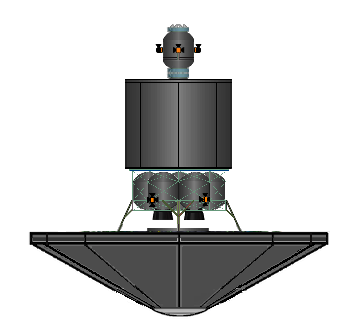 |
| An Ares CLV-7B with payload joined with an ADEPT deceleration shield needed to safely enter the martian atmosphere before landing. An additional attitude control module is added to enable thrusters to control the angle of the vehicle's entry into the martian atmosphere. |
2032
SLS Launches:
SLS Launch 34: Two CLV-7A (Cargo Landing Vehicle) to LEO to be deployed to high Mars orbit by OTV-125 vehicles and deployed to the martian surface by ADEPT decelerators
The First CLV-7A will have an ATHLETE robot that will deploy electric powered excavation vehicles, sintering vehicles, backhoe, lifting crane
The Second CLV-7A will deploy at least 160 KWe of nuclear power to the martian surface with at least a 10 year lifetime for the fueled reactors.
SLS Launch 35: Two CLV-7A (Cargo Landing Vehicle) to LEO to be deployed to high Mars orbit by OTV-125 vehicles and deployed to the martian surface by ADEPT decelerators
The first CLV-7A will deploy a mobile hydrogen tanker (MHT) plus four Water Bug regolith water extraction robots to the martian surface
The second CLV-7B will carry two mobile water tankers (MWT), two mobile LOX tankers (MLT)
SLS Launch 36: Two CLV-7A (Cargo Landing Vehicle) to LEO to be deployed to high Mars orbit by OTV-125 vehicles and deployed to the martian surface by ADEPT decelerators
The first CLV-7A will deploy a second mobile hydrogen tanker (MHT) plus four Water Bug regolith water extraction robots to the martian surface
The second CLV-7B will carry two mobile ground transport vehicles
SLS Launch 37: Two Ares-ETLV-4 crew landers to LEO. They will self deploy themselves to high Mars orbit and deploy themselves to the martian surface attached to ADEPT decelerators
Commercial Launches:
1. Private commercial launch companies will continue to deploy ADEPT deceleration shields to LEO. The deceleration shields will be transported to high Mars orbit by NASA's growing fleet of Orbital Transfer Vehicles (OTV-125). The ADEPT shields will allow NASA to use cargo landing vehicles (CLV-7B) and crew landing vehicles (ETLV-4), originally designed for lunar missions, to deploy cargo and crews to the martian surface.
2. ACES 68 WPD-LV will be deployed to the lunar surface and to the surface of Mars and Deimos, replacing NASA's WPD-LV-7A propellant producing water depots
Note:
1. All SLS and commercial launched vehicles for Mars will be deployed to Mars during the 2033 launch windows.
2. Reusable OTV-125 will continue to be deployed to LEO with every SLS launch that uses an upper payload fairing
 |
| Two Lunar Regolith Habitats (LRH) next to a lunar biosphere domed with lunar regolith bags to protect it against excessive cosmic ration, micrometeorites, and extreme thermal fluctuations. |
2033
SLS Launches:
SLS Launch 38: A single CLV-7B carrying a Mars Regolith Habitat (MRH) will be launched to LEO to be deployed to high Mars orbit by an OTV-125 and deployed to the martian surface by ADEPT decelerators
SLS Launch 39: A second CLV-7B carrying a Mars Regolith Habitat (MRH) with a equipped with a medical level will be launched to LEO to be deployed to high Mars orbit by an OTV-125 and deployed to the martian surface by ADEPT decelerators
SLS Launch 40: A single CLV-7B carrying a Lunar Regolith Habitat (LRH) will be deployed to LEO. The lunar habitat will be used as an aquaculture facility for raising shrimp and fish.
SLS Launch 41: Two CLV-7A (Cargo Landing Vehicle) to LEO to be deployed to the lunar surface.
The First CLV-7B will deploy an inflatable 32 meter in diameter Kevlar biosphere to the lunar surface
The Second CLV-7B will deploy the biosphere's connecting airlocks (2.4 meters in diameter),
Environmental Control and Life Support Systems (ECLSS) and panel components for the internal construction of housing and work spaces and geodesic dome components.
Notes:
1. Odyssey 5 crew will depart EML1 during an April 2033 launch window, arriving in high Mars orbit in October 2033 to join 12 astronauts who are already in Mars orbit from the previous Odyssey flight.
2. Mars surface outpost components will be transported by OTV-125 spacecraft from EML1 during May 2033 launch windows, arriving in high Mars orbit in September of 2033.
3. A crew of six (four Americans and two foreign guest astronauts) will be the first humans to set foot on the surface of Mars in November of 2033, landing an ADEPT shielded Ares-ETLV-4 on the martian surface. A second landing of six will occur, three months later in February of 2034. Afterwards, crewed flights to the martian surface from high Mars orbit will occur every six months.
4. The Ares ETLV-4 crew lander can land on the surface of Mars with enough propellant to return to low Mars orbit. A second option lands the Ares ETLV-4 on the surface of Mars with only enough hydrogen to return to Mars orbit; liquid oxygen would be supplied by mobile LOX tankers (MLT) deriving their oxygen supplies from propellant depots located near the martian outpost. A third option lands the Ares ETLV-4 on the martian surface almost empty with both LOX and LH2 supplied from the Mars outpost for its return trip to orbit.
5. Eight Odyssey 4 and Odyssey 5 crew members will depart Mars orbit in January 2035, returning to cis-lunar space in September of 2035 aboard the Odyssey 4. They will leave 16 crew members behind in Mars orbit aboard the AGH-SS and on the surface of Mars at the Mars outpost.
6. The inflatable lunar Kevlar biosphere will 32 meters in diameter with a safety factor of four. Lunar regolith bags two meters thick will shield the upper hemisphere from micrometeorites, excessive radiation, and from extreme thermal fluctuations. The upper hemisphere of the lunar biosphere will provide a spacious recreational area under the geodesic dome. The lower hemisphere of the lunar biosphere will provide ample accommodations for housing, laboratories, and food production: agronomy, aquaculture, poultry.
3. A crew of six (four Americans and two foreign guest astronauts) will be the first humans to set foot on the surface of Mars in November of 2033, landing an ADEPT shielded Ares-ETLV-4 on the martian surface. A second landing of six will occur, three months later in February of 2034. Afterwards, crewed flights to the martian surface from high Mars orbit will occur every six months.
4. The Ares ETLV-4 crew lander can land on the surface of Mars with enough propellant to return to low Mars orbit. A second option lands the Ares ETLV-4 on the surface of Mars with only enough hydrogen to return to Mars orbit; liquid oxygen would be supplied by mobile LOX tankers (MLT) deriving their oxygen supplies from propellant depots located near the martian outpost. A third option lands the Ares ETLV-4 on the martian surface almost empty with both LOX and LH2 supplied from the Mars outpost for its return trip to orbit.
5. Eight Odyssey 4 and Odyssey 5 crew members will depart Mars orbit in January 2035, returning to cis-lunar space in September of 2035 aboard the Odyssey 4. They will leave 16 crew members behind in Mars orbit aboard the AGH-SS and on the surface of Mars at the Mars outpost.
6. The inflatable lunar Kevlar biosphere will 32 meters in diameter with a safety factor of four. Lunar regolith bags two meters thick will shield the upper hemisphere from micrometeorites, excessive radiation, and from extreme thermal fluctuations. The upper hemisphere of the lunar biosphere will provide a spacious recreational area under the geodesic dome. The lower hemisphere of the lunar biosphere will provide ample accommodations for housing, laboratories, and food production: agronomy, aquaculture, poultry.
 |
| Crewed Ares ETLV-4 coupled with a protective ADEPT deceleration shield. The Ares ETLV-4 can land on the martian surface with enough propellant to return to low mars orbit. |
2034
1. SLS Launch 42: An MRH (Mars Regolith Habitat) agronomy habitat will be deployed to LEO with an Ares-CLV-7B and an OTV-125 destined for the martian surface.
2. SLS Launch 43: An MRH aquaculture habitat will be deployed to LEO with an Ares-CLV-7B and an OTV-125 destined for the martian surface.
3. SLS Launch 44: Two Ares ETLV-4 spacecraft plus an OTV-125 will be deployed to LEO destined for high Mars orbit.
4. SLS Launch 45: Two Ares CLV-7A (Cargo Landing Vehicle) to LEO to be deployed to LEO destined for the martian surface:
The First Ares CLV-7B will deploy an inflatable 32 meter in diameter Kevlar biosphere to the martian surface
The Second Ares CLV-7B will deploy the biosphere's connecting airlocks (2.4 meters in diameter),
Environmental
Control and Life Support Systems (ECLSS) and panel components
for the internal construction of housing and work spaces and transparent Kevlar biodome.
Notes:
1. Mars biosphere: The the top hemisphere of the inner dome of the Mars biosphere will be covered with a transparent UV filtering layer. The outer area will be shielded from excessive cosmic radiation with a transparent water filled biodome. This will allow natural sunlight to enter the dome.
 |
| The martian moon Deimos will be utilized for the production of hydrogen, oxygen, and water eliminating the need to import water from the Earth's moon in order to provide water and propellant for interplanetary vessels returning to cis-lunar space. |
2035
1. SLS Launch 46: Two CLV-7B spacecraft will be deployed to LEO destined for the surface of the martian moon, Deimos:
The first CLV-7B will deploy mobile ground excavation vehicles, lifting cranes, and regolith sintering vehicles.
The second CLV-7B will deploy four small nuclear reactors for providing up to 160 KWe of electric power.
2. SLS Launch 47: An OTV-125 plus two CLV-7B spacecraft will be deployed to LEO destined for the surface of the martian moon, Deimos:
The first CLV-7B will have two cargo levels and will deploy mobile water, hydrogen, and water tankers to the surface of Deimos
The second CLV-7B will have two cargo levels and will deploy a plasma arc pyrolysis and syngas refinery to Deimos for the production of water, hydrogen, and water. The upper level will deploy another mobile hydrogen tanker.
3. SLS Launch 48: An OTV-125 plus a single CLV-7B carrying a Lunar Regolith Habitat (LRH) will be deployed to LEO. The lunar habitat will be used as poultry facility for producing chickens and eggs.
4. SLS Launch 49: An OTV-125 plus two CLV-7B will be deployed to LEO destined for the lunar surface
The First CLV-7B will deploy an inflatable 32 meter in diameter Kevlar biosphere to the lunar surface
The Second CLV-7B will deploy the biosphere's connecting airlocks (2.4 meters in diameter),
Environmental
Control and Life Support Systems (ECLSS) and panel components
for the internal construction of housing and work spaces and geodesic
dome components.
Notes
1. With five habitat modules and two biospheres, NASA's lunar outpost would be complete and capable of housing up to 200 personal-- if desired.
2. Deimos water and propellant producing facility will allow NASA to fuel spacecraft operating in Mars orbit and interplanetary spacecraft heading back to cis-lunar space.
3. Launch windows to Mars from cis-lunar space will occur in June and July of 2035 with payloads and personal arriving to high Mars orbit in December of 2035 or January of 2036.
So, under this architecture, NASA will have permanent outpost on both the Moon and Mars, and artificial gravity outpost in high Mars orbit by the middle 2030s. The DOD will have permanent outpost on the Moon and an artificial gravity outpost at EML4 by early 2030s. This will be possible thanks to a combination of regular launches by the SLS (up to four launches a year by the late 2020s) and private commercial launch vehicles in the 2020s and the 2030s.
Propellant producing water depots are the key to substantially enhancing the payload capabilities of both the SLS and private commercial launch vehicles under this scenario. However, NASA's current plan of relying on propellants that have to be terrestrially produced and launched from the Earth's enormous gravity well would severely curtail the payload capabilities and sustainability of the SLS and private commercial launch vehicles.
Links and References
A Practical Timeline for Establishing a Permanent Human Presence on the Moon and Mars using SLS and Commercial Launch Capability
Part I
Part II
Part III