Showing posts with label plasma arc pyrolysis. Show all posts
Showing posts with label plasma arc pyrolysis. Show all posts
Tuesday, August 20, 2019

Wednesday, November 28, 2018
Mitigating Forest Fires by Harvesting Potentially Hazardous Woodland Biomass for the Production of Renewable Methanol
 |
| California Fires 2018 (Credit: David McNew/Getty) |
by Marcel F. Williams
California's forest, woodland areas, and its nearby residents are the latest victims of climate change as the world's fossil fuel dominated energy economy continues to increase greenhouse gasses in the Earth's atmosphere to dangerous levels.
The state of California has 33 million acres of forest land. Less than 400,000 of that acreage burned in California from 1980 to 1990. But just last year, 1.4 million acres burned in California. And so far this year, 1.8 million acres of California land has burned.
Why?
California has grown 3 degrees warmer during the autumn seasons over the past 40 years while rainfall in the state has decreased by about one third during the same period of time.
The Federal government owns about 57% of the woodlands in California. Privately owned forest accounts for about 40% of California's woodland areas. But the State of California only owns about 3% of Califorinia's forest.
It is currently estimated that California's woodland areas have approximately 129 million dead trees. . Ironically, removing dead trees actually enables the spread of grasses and combustible weeds that make forest more likely to burn. Dry kindling, brush, bushes and twigs are the principal catalyst for the rapid spread of wildfires. So such vegetation also has to be safely managed.
Some of the worst forest fires in California have been caused by power lines. This has prompted some in the state to suggest burying power lines that transverse forested areas. But their are more than 176,000 miles of power lines in California. And putting power lines underground would cost ten times as much as stringing them on poles.
Controlled burning of woodland vegetation has long been a method for fire mitigation since before the arrival of Europeans in North America. But burning woodland vegetation would increase the amount of excess carbon dioxide put into the Earth's atmosphere, exacerbating the problem of rising temperatures that have helped to enhance the fire danger in California in the first place.
But there is an alternative solution that could make the mitigation of forest fires in California economically sustainable while also reducing California's dependence on fossil fuels. And such measures cold eventually lead California's energy production and use becoming completely carbon neutral. And all it would take would be for two legislative measures to pass within the State of California.
Its my view that the State government in California should pass legislation that:
1. Mandates that all utilities producing electricity within the State of California produce at least 5% of that electricity for their customers by using-- bio-methanol-- directly derived from the dead trees and potentially dangerous woodland biomass in California’s forest and wooded residential areas by the year 2025 and up to 10% by the year 2030
and
2. Requires all gasoline sold in California to contain at least 5%-- bio-gasoline-- synthesized from bio-methanol that is directly derived from the dead trees and potentially dangerous woodland vegetation in California's forest and wooded residential areas by the year 2025 and up to 10% by the year 2030.
That's it!
 |
| Methanol electric power plant at Point Lisas, Trinidad (Credit: Mendenhall Technical Services) |
Approximately 33% of the electricity produced in California is generated by natural gas power plants. About 53% of California's electric power is produced by carbon neutral renewable and nuclear power energy sources.
Its neither difficult nor exorbitantly expensive to modify an existing natural gas electric power plant to use methanol instead of natural gas. Additionally, methanol electric power plants would have a higher electric power output than burning natural gas thanks to wood alcohol's low heating value, low lubricity, and low flash point.
Gasoline can be blended with methanol up to 15% without any modifications to an automobile. But
energy companies have been able to synthesize methanol directly into high octane gasoline since the 1970s. And this would allow any level of mixing with gasoline from petroleum. In theory, you could have gasoline that is 80% derived from bio-methanol and 10% from petroleum with the remaining 10% of the fuel being composed of ethanol. Such an automotive fuel would be-- 90% derived-- from renewable biomass, reducing the utilization of gasoline from oil by 90%.
Any increases in the cost of gasoline containing bio-gasoline from bio-methanol could encourage Californians to purchase more fuel efficient electric and plug-in-hybrid electric vehicles. But a vehicle fuel mix of 10% ethanol (Federally mandated), 10% gasoline from bio-methanol, and 80% gasoline from petroleum could substantially reduce oil demand, possibly mitigating any additional cost related to a mandated use of 10% bio-gasoline.
Methanol could also be directly used in high fuel efficiency hybrid fuel cell vehicles. Using methanol directly in automobiles would, of course, be cheaper than converting methanol into gasoline. Bio-methanol derived from California's forest could also be used to produce biodiesel.
There is also a growing global interest in using methanol to power sea vessels. Methanol powered ships would be cleaner and bio-methanol ships with no sulfur emissions and lower nitrogen oxide emissions relative to current marine vessels powered by fuels synthesized from petroleum. Marine methanol ferries are already operating between Sweden and Germany.
Legislation mandating the use of bio-methanol from California's forest should provide a strong economic incentive for energy companies selling electricity and gasoline in California to hire forest workers to aggressively harvest dead trees and other potentially dangerous woodland vegetation from California forest and residential woodland areas for conversion into methanol. This should substantially reduce the level of fire danger in California's woodland areas while also reducing the amount of CO2 put into the atmosphere as the result of the reduction in forest fire and forest fire intensity.
Beyond the reduction in fire danger, hiring people to harvest potentially dangerous woodland biomass should have a positive economic impact for nearby residential communities. Converting at least 10% of the natural gas power plants in California for methanol utilization should also have some positive economic impact for communities near such energy producing facilities. And the deployment of pyrolysis and synthesis facilities designed to convert biomass into methanol within California should have positive economic impact for the entire state.
 |
| Notional Flying Whale airship (Credit: Flying Whales) |
The enhanced harvesting of dead trees and potentially dangerous woodland vegetation from remote forest might also encourage energy companies within California to utilize the next generation of airship technology. And airships might also greatly enhance the ability of the State of California and the US Federal government to fight fires in California's forest.
Airships being developed by the French company, Flying Whales, are being designed to transport up to 60 tonnes of lumbar within forested areas. Such airship technology could obviously be of use in California for removing the hundreds of dead trees that currently exist in California forest.
Lockheed Martin, on the other hand, is developing an airship that could transporting payloads up to 20 tonnes in mass within a large cargo bay. Forest kindling, grass, bushes, twigs and other potentially dangerous vegetation could be removed from California forest by Lockheed Martin's airships.
Similar airship technology could also be used by the State and Federal government to fight forest fires, dousing woodland fires and residential areas near forest with tonnes of water routinely retrieved from nearby lakes. The Lockheed Martin airships could also be used to rescue residents and fire fighters that might be trapped by raging forest fires.
The aggressive utilization of airship technology in California could help California businesses to lead the US and the world in the new age of airships. And, in theory, such airships could be fueled with dimethyl ether, derived from methanol derived from California's forest my modifying the diesel engines to use dimethyl ether.
 |
| Lockheed Martin airship (Credit: Lockheed Martin) |
The introduction of a methanol economy into California could also enhance the ability of the state to become-- completely carbon neutral by mid century. This, however, would require the production of hydrogen through renewable or nuclear resources-- or a combination of both. Hydrogen could be used to synthesize methanol from wasted CO2 from the pyrolysis of urban and rural biomass and from the CO2 waste from the flu gasses of methanol electric power plants.
For California to be completely carbon neutral, all of the natural gas electric power plants in California would have to be converted into methanol power plants. The gradual conversion of electric power production from natural gas to renewable methanol would make California carbon negative during the transition from fossil fuels to renewable biomass, with more CO2 being extracted from the Earth's atmosphere than being returned to the atmosphere. However, once all fossil fuel power plants have been replaced by methanol power plants that recycle CO2 from methanol synthesis and flu gas, then electric energy production and consumption in California would be carbon neutral.
 |
| Synthesis of renewable methanol from biomass. |
Hydrogen in California could be produced from large solar or nuclear facilities located near biomass pyrolysis plants and methanol electric power plants. Alternatively, such facilities located near California coastlines could liquefy the carbon dioxide, exporting the CO2 by tankers to remote ocean nuclear power or renewable (floating wind, solar, or OTEC) facilities in remote US territorial waters where methanol and other renewable synthetic fuels could be safely manufactured. The Exclusive Economic Zones (EEZ) surrounding remote island territories such as: Wake Island, Howland Island, Baker Island, Johnston Atoll, Jarvis Island, etc. could be regions where floating vessels could use carbon neutral energy sources to produce methanol, jet fuel, dimethyl ether, gasoline and diesel fuel far away from urban populations. Methanol could then be shipped by methanol powered tankers back to the California coastline to fuel its methanol electric power plants or for conversion into renewable gasoline.
But once the transition from fossil fuels is complete, California energy production and consumption would be carbon neutral. Eventually, California will have a shortage of bio-carbon resources for its energy economy which would require the extraction of additional CO2 directly from the atmosphere or from seawater or both.
Links and References
Senate Passes Legislative Packagein Response to Wildfire Danger
Thinning California's fire-proneforests: 5 things to know aslawmakers move toward a plan
What fire researchers learnedfrom California’s blazes
Methanol for Power Generation
Methanol as a Low Cost Alternative Fuel for Emission Reduction in Gas Turbines
Methanol - Gaining Twice: Improving Both the Quality of Air as well as Providing a Reliable Electricity Supply
Renewable Methanol as Liquid Electricity
The Methanol Alternative: 2012 Methanol Forum
The Production and Utilization of Renewable Methanol in a Nuclear Economy
Methanol Fuel Blending
The Production of Bio-MethanolThe rise, rise, rise of bio-methanol for fuels and chemical markets
In France, whales soon will fly
Lockheed Martin LMH-1 (P-791)
Gigantic airships aim to dampforest fires
Tuesday, December 20, 2016
Siting Ocean Nuclear Power Plants in Remote US Territorial Waters for the Carbon Neutral Production of Synfuels and Industrial Chemicals
 |
US island territorial waters most suitable for floating nuclear synplexes:
Uninhabited islands: Jarvis Island, Palmyra Atoll and Kingman Reef, Johnston Atoll, Howland and Baker Islands, Aleutian Islands (Near Islands, the Rat Islands, Buldir Island and the Island of the Four Mountains)
Islands exclusively occupied by the US military: Wake Island, Midway Atoll
|
by Marcel F. Williams
The fossil fuel dominated energy economy of modern human civilization has now pushed the carbon dioxide (CO2) component of our atmosphere above 400 parts per million. This is a 40% increase in carbon dioxide levels in the atmosphere since the start of the industrial revolution. The Pliocene epoch was last time CO2 levels in the atmosphere were as high , the geologic period that preceded the Pleistocene and the emergence of our genus (Homo). So modern humans are currently living within an atmosphere that is not only alien to our species but also to are genus.
The enhanced greenhouse effect resulting from the ever increasing amounts of carbon dioxide being put into the atmosphere by human activity is already starting to melt the the polar icecaps. And melting icecaps are gradually increasing global sea levels. Rising sea levels caused by increased amounts of atmospheric CO2 is nothing new in the natural history of the Earth. But the deposition of carbon dioxide into the atmosphere by human activity is something new. And it threatens to rapidly expose our species and the other plant and animal species currently living on our planet to higher global temperatures and sea levels not seen in millions of years. In the decades and centuries to come, the results of global warming from human activity could drown our coastlines and our coastal cities while causing the mass extinction of many, if not most, of the plant and animal species on our planet.
Politicians have tended to expressed concern about the long term consequences of carbon dioxide induced climate change from human civilization. But in reality, there has actually been very little serious pressure placed on the global energy companies to shift from a fossil fuel economy to a carbon neutral energy economy. Fear that a shift from fossil fuels could threaten economic prosperity has often been expressed by the global energy companies. And some politicians beholden to the economic might of the energy companies have even denied that CO2 induced global warming is a problem at all. Of course, since the energy companies have trillions of dollars invested in the fossil fuel economy, they really have no incentive to move away from a fossil fuel economy.
Top Ten Greenhouse Gas Emitters in 2014
China - 29.55%
USA - 14.95%
European Union - 9.57%
India - 6.56%
Russia - 4.95%
Japan - 3.58%
Iran - 1.73
South Korea - 1.71%
Canada - 1.58%
Brazil - 1.40%
World Energy Consumption
China - 20.2%
USA - 19.0%
Russia - 5.8%
India - 4.4%
Japan - 4.3%
Germany - 2.7%
Canada - 2.6%
France - 2.1%
No Shortage of Uranium
Despite the phobia that surrounds the industry, nuclear energy would seem to be the simplest and the most rapid way to deal with the threat of human greenhouse gas induced climate change. Nuclear power produces nearly 20% of the electricity in the US and nuclear energy represents approximately 6% of the world's energy consumption.
The current world demand for uranium is over 70,000 tonnes per year. Terrestrial uranium resources exists in ore reserves that are economically viable at $59 per pound in US dollars. But it is estimated that there are approximately 5.5 million tonnes of proven uranium reserves at a cost below $130 per kilogram. With the resurgence of nuclear power, the exploration for new uranium sources could increase total terrestrial uranium reserves to more than 16 million tonnes. So there should be enough uranium to supply current global nuclear power demand for at least 200 years. But this is clearly not enough provided electric power and synthetic fuels and industrial chemicals for all of civilization.
Nuclear breeding technologies such as fast neutron reactors or ADS accelerator reactors could increase fuel supplies by a factor of 140 since fissile uranium 235 only represents about 0.7% of natural uranium. But terrestrial reserves of fertile thorium are even more plentiful. There is at least 3 times as much terrestrial thorium 232 as there is uranium 238. Thorium would be one of the easiest ways to recycle the plutonium produced from the fission of uranium 235 within fertile uranium 238. So nuclear technologies that also utilize fertile uranium and thorium supplies in breeding technologies could provide civilization with all of the electric power, fuel, and chemicals that it needs.
While terrestrial deposits rich in uranium and thorium are relatively limited, the Earth's oceans contain about 4.6 billion tonnes of uranium. That's also enough nuclear fuel to provide electric power and synthetic fuels and industrial chemicals for human civilization for at least a few thousand years without the need for breeding technologies.
However the uranium content of the oceans is naturally replenished by a natural equilibrium between the hydrosphere and the terrestrial environment. And the rocks that chemically interact with the Earth's hydrosphere contain nearly 100 trillion tonnes of uranium. So whenever uranium is extracted from seawater, it is replenished by is chemical interaction with the Earth's rocks and soil, leaching their uranium content into the rivers and oceans. Marine uranium, therefore, is a renewable resource that could provide all of humanity's energy needs for the next billion years, about the time when the Earth's oceans will probably disappear because of the continuing natural increase in the sun's luminosity.
Current technology can extract uranium from seawater at a price of $200/lb of U3O8. Nuclear fuel, however, only represents less than 12% of the total cost of electricity from nuclear power plants and the uranium ore itself, only represents about 46% of the total cost of the fuel before it is enriched and fabricated for use in a nuclear reactor. So even at quadruple the current price of uranium, marine uranium would only increase the cost of electricity from nuclear power by a meager 15%.
Environmentally Safest Commercial Energy Technology on Earth
Despite a few serious accidents in Japan, the Ukraine, and in the US, commercial nuclear power is still statistically the safest form of electric energy production. Unfortunately, we live in a global society that still has an inordinate fear of ionizing radiation. This is despite the fact that humans and all other plant and animal species on this planet live on a world and within a universe that is naturally radioactive-- and always has been!
Global Mortality Rate related to commercial energy production (deaths/trillion kWhr)
Coal (global average) 170,000
Oil - 36,000
Biofuel/Biomass - 24,000
Natural gas - 4000
Hydroelectric (global average) - 1400
Solar panels (rooftop) - 440
Wind - 150
Nuclear (global average) - 90
Wind and solar energy have long been touted as-- safe long term solutions-- to climate change. But such renewable systems are extremely land intensive and only produce energy when the wind is blowing or when the sun is shining. While the storage of wind and solar energy would solve this problem, it would also require a substantial increase in the number of wind and solar power facilities in order to make up for the majority of time when energy is not being produced and the lowered efficiency of energy storage and power production from stored energy. Wind and solar power plants also have significantly shorter lifespans than commercial nuclear power plants that can last at least 60 years or longer. So replacing old wind and solar power plants with new facilities could double or even quadruple the number of units required to produce the same amount of energy as nuclear power plants could.
Solar power currently produces less than 0.1% of the energy consumed in the US. So even if solar energy production were increased by 100 times, it would still produce less than 10% of America's current energy needs-- and even less for the even larger American populations thirty to forty years from now.
The manufacture of solar panels produces at least 10,000 times as much toxic waste as nuclear power plants. The spent fuel from commercial nuclear power plants is so tiny that all of the spent fuel ever produced by the commercial nuclear industry in the US could be housed in an area the size of a football stadium only a few meters high. Of course, most of the content from spent fuel could be recycled to produce even more carbon neutral electricity.
Environmentally, wind power plants are well known to be deleterious to predatory birds and bats that feed on pest that either harmful to humans or their food supplies. And while some find them aesthetically beautiful, others find them eyesores the destroy the beauty of the local landscape.
No American lives have ever been lost as the result of exposure to excessive amounts of radiation from the commercial nuclear industry. and America currently has the most commercial nuclear reactors currently operating. But as remarkably safe as nuclear power plants are today, they would be even safer if they were deployed on the Earth's oceans.
 |
| MIT floating nuclear reactor concept (Credit: MIT) |
Lack of coolant (water) caused the partial meltdowns at the Light Water reactors at Fukushima in Japan and at Three Mile Island in the US. However, the deployment of light water nuclear reactors out to sea could offer the commercial nuclear industry an inherently safe environment for producing carbon neutral energy. The ocean's almost infinite heat sink of seawater would completely eliminate the possibility of nuclear fuel meltdowns for light water reactors deployed out at sea.
Most proponents of floating nuclear reactors would like to moor such power plants just 10 to 20 kilometers offshore. While this might be convenient for supply electric power to coastal towns, cities, and industries, it might also leave such facilities easily vulnerable to attacks from both the sea and air by hostile entities. While such attacks on a floating nuclear facility would probably pose little danger to the public and to the environment, the resulting sociological and political effects could be financially devastating for companies that own or who manufacture such facilities.
 |
| US Navy floating modular platform concept (Credit: US Navy) |
Deploying a floating nuclear reactor within the cavity of a pair of floating storm shelters, cement barriers designed to enclose and shield the facility from severe weather and from potential aerial and ocean attacks, could greatly enhance the protection of floating nuclear reactors. Such floating barriers could easily be derived from the US Navy's modular floating platform concepts. They could completely envelope a floating reactor by simply using tugs to pull the larger half of a shelter over the smaller half of the shelter. While such barriers wouldn't make it absolutely impossible for floating nuclear power plants to be seriously damaged, they would make it very difficult and extremely expensive for potential terrorist to damage a floating nuclear facility.
 |
| Floating storm shelters derived from the US Navy floating platform concepts. Under this concept, the floating reactor would mostly be housed within the smaller shelter. Normally, the cavity of the larger shelter would face the cavity of the smaller shelter less than 100 meters away. This would allow sea vessels to easily arrive and depart from the floating reactor. During a major storm, tug boats would move the larger shelter over the smaller shelter, completely enclosing the floating reactor within the two storm shelters. This would also be the configuration in case some entity attempts to damage the floating reactor by air or by ship. |
How Many Reactors?
US Energy Consumption in 2015
(Credit: Lawrence Livermore National Laboratory):
39.0% - Electricity
28.4% - Transportation
21.8% - Industrial chemical and other processes (minus the electricity utilized)
6.7% - Non-electrical residential heating and cooking
4.1% - Non-electrical commercial heating, cooking, and other processes
About 409 1.1 GWe (1100 MWe) terrestrial nuclear reactors would be required to completely replace all of the electricity currently produced in the US by other sources of electricity (coal, natural gas, hydroelectricity, wind, solar, etc.). That would require a five fold increase in current nuclear electric power production. Some of the electricity could be used to convert urban and rural biomass into methanol for the production of electricity during peak load hours. Such a substantial increase in nuclear electric power production in America could easily be accomplished by simply accommodating up to eight 1.1 GWe nuclear reactors at every existing site in America.
A five fold increase in terrestrial nuclear power would still only meet about 39% of America's total energy needs. And, of course, these figures don't even account for future American electricity demand 30 to 40 years from now due to simple population growth. This figure also doesn't include the probable increase in electricity demand from the growth in the number of automobiles that either partially or totally use electricity. This figure also doesn't include the increase in domestic electricity demand if all Americans switched from using natural gas to electricity for cooking, space heating, and water heating.
Even with a shift towards electric vehicles, the demand for transportation fuel for planes, ships, and ground vehicles is still going to be enormous. And huge amounts of energy will also be required for the production of industrial chemicals and fertilizers.
Major carbon neutral synthetic fuels and industrial chemicals that could be manufactured at remotely sited floating nuclear synplexes
1. Methanol
2. Gasoline
3. Diesel Fuel
4. Jet fuel
5. Dimethyl ether
6. Liquid hydrogen
7. Liquid oxygen
8. Fresh water
9. Sodium Chloride
10. Ammonia
11. Urea
12. Formaldehyde
13. Chlorine
14. Uranium
It would require at least 964 synthetic fuel producing nuclear reactors (1100 MWe each) to replace America's current gasoline needs. 441 reactors would be required to replace America's diesel fuel demand. 152 reactors would be needed to replace current civilian and military jet fuel demand. These figures, of course, don't account for future demand over the next 30 or 40 years due to population growth. So 1557 1.1 GWe floating nuclear reactors would be needed to provide the carbon fuels for all of America's-- current transportation needs.
Number of 1.1 GWe (1100 MWe) nuclear reactors needed to annually supply all of America's current transportation fuel needs:
964 floating reactors - carbon neutral gasoline production
441 floating reactors - carbon neutral diesel fuel production
137 floating reactors - carbon neutral production of civilian jet fuel
15 floating reactors - carbon neutral production of military jet fuel
An additional 1195 floating reactors would be needed to meet America's industrial chemical and fertilizer needs. So just to replace fossil fuels for transportation, industrial chemicals and chemical fertilizers would require 2752 1.1 GWe floating nuclear reactors.
And, again, these figures don't include the inevitable increase in energy demand due to population growth. And there's also the daunting reality that America only consumes about 20% of the world's energy needs. Could America or other nations provide for the rest of the world's clean energy needs?
Exclusive Economic Zones
America is a nation that's still finding it politically difficult to keep a little more than 100 nuclear reactors currently operational within the US. And with only four new nuclear reactors (~4.4 GWe) currently under construction, its rather difficult to imagine Americans adding more than 3000 terrestrial nuclear reactors to the continental United States-- over the next 30 to 40 years.
It would be equally as politically daunting, in my opinion, to attempt to deploy thousands of floating nuclear reactors along the coastlines of the United States over the next 30 to 40 years. So why even go through the process of attempting to deploy floating nuclear power plants near any populated American coastline at all when its totally unnecessary!
Public and environmental fears about deploying floating nuclear facilities and floating synthetic fuel producing facilities off the populated coast of continental North America could be completely eliminated by simply transporting such facilities-- far out to sea.
America has economic control over vast amounts of ocean territory thousands of kilometers away from populated coastlines. Some of these Exclusive Economic Zones surround uninhabited islands or islands exclusively occupied by small numbers of US military personal.
Wake Island, for instance, has about 7.1 square kilometers of land area surrounded by a US Exclusive Economic Zone (EEZ) of over 407 thousand square kilometers. Administered by the United States Air Force, the island is only occupied by 94 US personal. The airfield on Wake Island is currently used as a mid-Pacific refueling stop for US military aircraft.
 |
| The US territory of Wake Island. |
If just one quarter of the Wake Island EEZ territory that is at least 50 kilometers away from the island's land and lagoon area were allowed to be utilized for the deployment of floating nuplexes and synplexes, nearly 100,000 square kilometers of territorial waters would be available. This region could be used to produce carbon neutral synthetic fuels and industrial chemicals. Another 100,000 square kilometers of territorial water on the opposite side of the island could be exclusively used for potential Seasteading, aquaculture, and floating farms while the rest of the territorial water (more than half) would be under conservation including the 50 kilometer stretch of water encircling the island.
Floating nuplexes could consist of eight to sixteen 1.1 GWe nuclear reactors floating along the arc of a circle four kilometers in diameter. A cruise ship could be placed at the center of the circle, to kilometers away from each floating reactor, to house the nuclear workers when they're off duty and may also serve as a floating home for their families.
Each floating nuplex would provide between 8.8 GWe to 17.6 GWe of power (more than four to eight times more power than the typical two unit nuclear plants in the continental USA).
The fuel and industrial chemical producing synplexes could be positioned between five to ten kilometers away from the nuclear facilities to ensure that any accidental chemical explosions can't potentially damage any of the nuclear facilities or to their protective storm shelters.
Power to the floating synplexes would come from submarine cables connecting them to the floating nuplexes. So the entire 8.8 GWe to 17.6 GWe nuplex and surrounding synplexes could be deployed within a circle up to 24 kilometers in diameter. In reality, of course, the floating nuplexes and synplexes would physically only occupy an extremely tiny fraction of this 452 square kilometer area.
Within the proposed 100,000 square kilometer area, more than 221 nuplexes and their surrounding synplexes could be produce between 1945 GWe to 3890 GWe of electric power. So this one remotely sited region alone could potentially provide the United States will all of its energy needs.
But if we add a quarter of the EEZ waters surrounding the remote uninhabited islands of the Johnston Atoll, Palmyra Atoll, Jarvis Island, and Baker Island and the US Navy occupied Midway Island Atoll then more than 23 TWe of electric power could be produced, more than enough to provide all of the energy needs for the entire planet!
Beyond the tropical Pacific islands, Alaska might be the only State in the Union that might be willing to accommodate thousands of floating nuclear reactors with its Exclusive Economic Zone. This might be particularly true in the vast EEZ waters both north and south of the Aleutians. Less than 8500 people live on a few of the Aleutian islands with more than half living on the island of Unalaska. But Alaska has more than 3.7 million square kilometers of EEZ territory. So just a quarter of Alaska's EEZ territory could provide energy for the entire planet.
Of course, the US shipyards could manufacture and deploy floating nuclear reactors to some of the vast remote EEZ areas controlled by other nations. It might be in the interest of the United States to deploy at least some of their Ocean Nuclear assets in the Atlantic within the remote and EEZ areas of strategic allies such as Europe. The UK Ascension Island EEZ in the South Atlantic might be a particularly suitable for for the deployment of American and possibly British Ocean Nuclear facilities and synplexes.
Using Renewable Methanol in Natural Gas Power Plants and Methanol Power Barges
Beyond the ocean production of transportation fuels and industrial chemicals, remotely sited synplexes could also easily supply all of the world's electricity needs by simply producing methanol. Remotely sited nuclear synplexes could produce methanol by importing biowaste and other carbon waste imported from coastal towns and cities. Coastal communities would probably pay to have their garbage towed away, reducing or eliminating the cost of ocean transport. A floating plasma arc pyrolysis plant could convert the imported garbage into syngas which could then be converted into methanol. However, since approximately 66% of the carbon in this process is CO2 waste , substantially more methanol could be produced through the production of hydrogen through the electrolysis of water distilled from seawater.
The US Navy's new synfuel from seawater technology could also be used to produce carbon neutral synthetic fuels and industrial chemicals.
Ironically, the infrastructure for utilizing methanol for electric power use on continental America already exist thanks to some of the fossil fuel utility companies. Only minor modifications are required to covert natural gas turbine electric power plants into turbines capable of using methanol to produce electric power. This was demonstrated decades ago. So the rapid growth of natural gas power plants could be a back door for the emergence of nuclear power in the form of methanol remotely produced far out to sea at floating synplexes. And the tankers that could ship methanol to continental America could also be powered by methanol as a growing number of vessels are today.
Existing cryogenic carbon capture technology, could liquify up to 99% of the CO2 produced from the flu gasses of methanol power plants. That CO2 could then be transported by tankers back to the floating nuclear synplexes for the production of more methanol. Such a fuel cycle could make methanol from nuclear energy, carbon negative (permanently extracting CO2 from the atmosphere as the number of methanol power plants grow). So if floating nuclear synplex are used to replace existing fossil fuel power plants and even carbon neutral nuclear and renewable power plants, floating nuclear synplexes for electricity production would actually be carbon negative-- gradually reducing the amount of CO2 in the atmosphere until such facilities finally reach the point where they completely replace other forms of electricity production. So while the growth of terrestrial nuclear reactors would be carbon neutral, the growth of Ocean Nuclear Power plants exporting methanol for electricity production and recycling the CO2 would be carbon negative.
 |
| 106 MWe natural gas powered electric energy barge (Credit: Wartsila Corporation) |
The waste heat from the methanol power barges could also be used to desalinate seawater, providing both electricity and palitable water to coastal towns and cities. Such electricity and freshwater producing barges might be particularly attractive to states like California which is currently in the middle of a multi-year drought.
Jobs, the Reindustrialization of America, and Seasteading
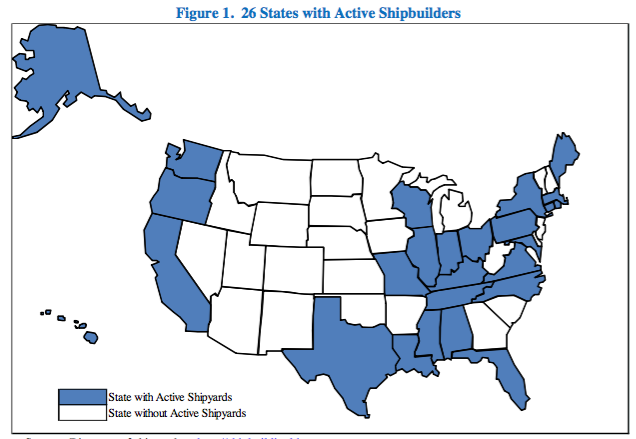 |
| States with active Shipyards (Credit: MARAD). |
 |
| Employment related to shipbuilding and repair (Credit: MARAD) |
If natural gas is eventually banned in the US for domestic and commercial use for heating and cooking then there will probably be a dramatic increase the use of electricity. And that would probably require an additional 100 land based nuclear power plants.
Replacing the additional 100 land based nuclear reactors with synfuel from Ocean nuclear reactors would require 400 floating reactors. If all 500 land based nuclear power plants were replace by synfuel from Ocean Nuclear power plants then at least 2000 reactors would be required. This is because of the substantial inefficiency of converting electricity into to carbon fuels, transporting the fuel to coastal towns and cities and then converting those carbon fuels back into electricity again.
However, the cost of electricity at ocean nuclear sites should be dramatically lower than that of land based nuclear sites because Ocean Nuclear reactors are likely to be centrally mass produced. And most of the cost of nuclear electricity is due to it high capital cost. The recycling of flu gases from power plants using fuels from Ocean Nuclear technology could also significantly increase the fuel production since electricity wouldn't have to be used to for the extraction of CO2.
The deployment of floating nuclear reactors, floating protective structures, floating synplexes, cruise ships, methanol tankers, methanol power barges and methanol powered tankers for the transport of other synthetic fuels and industrial chemicals will, of course, require a resurgence of the US shipbuilding industry. And that would mean a resurgence of hundreds of thousands of new jobs at shipyards in States along the Atlantic and Pacific Coast and the Gulf Coast and even within the Great Lakes region.
Major shipbuilding activities in an Ocean Nuclear economy
Floating nuclear power plants
Floating nuclear storm shelters
Methanol fueled tankers:
Methanol tankers
Gasoline tankers
Diesel fuel tankers
Jet fuel tankers
CO2 tankers
Industrial chemical tankers
Barges:
Methanol electric power barges
Synfuel production barges
Biowaste transport barges
Cruise ships designed to house floating nuclear power plant workers and synplex personal
Artificial islands and breakwater structures for ocean nuplex and synplex workers (Seasteading)
But millions of jobs would be created for US citizens operating far out to seas at ocean nuclear synplexes. And this might well be the beginning of still another major ocean oriented shipyard industry, the creation of artificial residential islands for all of those millions of Americans working far out at sea! Ocean Nuclear and Ocean Synplex workers may end up being the first large group of American Seasteaders.
There should still be a place for terrestrial nuclear reactors in the US, in my opinion. But the future of terrestrial nuclear power is in the mass production of small nuclear reactors that are placed underground for enhanced safety. But most of the energy for electricity, synfuels, and industrial chemicals in the 21st century will probably be produced by floating synplexes powered by remotely sited floating nuclear power plants.
Links and References
Uranium (Wikipeidia)
Advances in extracting uranium from seawater announced in special issue
Uranium Seawater Extraction Makes Nuclear Power Completely Renewable
Fueling our Nuclear FutureThe Economics of Nuclear Power
How deadly is your kilowatt?
Solar industry grapples with hazardous wastes
Jinko Solar Apologizes for Pollution
Will Russia and China Dominate Ocean Nuclear Technology?
The Future of Ocean Nuclear Synfuel Production
The Floating Stable Platform: Office of Naval ResearchMethanol to Power Demonstration Project
Simple Cycle Methanol Power Plant
Methanol Economy
The Production and Utilization of Renewable Methanol in a Nuclear Economy
The feasibility and current estimated capital costs of producing jet fuel at sea using carbon diox-ide and hydrogen
Market and Economic Assessment of Using Methanol for Power Generation in the CaribbeanRegion
Exclusive Economic Zones
What is the EEZ
U.S. Maritime Limits & Boundaries
Plasma arc gasification
Power Barges around the world
Waller Marine Power Barges
Tuesday, April 28, 2015
The Production and Utilization of Renewable Methanol in a Nuclear Economy
 |
| 10.7 MWe rated methanol electric power plant at Point Lisas, Trinidad (Credit: Mendenhall Technical Services) |
Methanol (CH3OH) is, of course, the simplest alcohol, producing only carbon dioxide (CO2) and water after combustion with oxygen. The production of methyl alcohol through the pyrolysis of carbon based materials and their distillation has been known since the time of the ancient Egyptians. Modern techniques of methanol production utilize pyrolysis to produce syngas (synthetic natural gas), a gaseous mixture of consisting of carbon monoxide, carbon dioxide, and hydrogen that is then converted into methanol.
Since approximately 65% to 75% of the CO2 content is wasted during the synthesis of syngas into to methanol, introducing additional hydrogen into the synthesis process could potentially increase the production of methanol by three to four times. Sources of carbon neutral hydrogen could, therefore, be produced through nuclear, hydroelectric, wind, and solar electric power through the electrolysis of water.
Plasma arc pyrolysis plants, a commercial technology that's already in existence, could be used for the conversion of urban and rural biowaste (garbage and sewage) into syngas. Additional hydrogen can be added to the mix through the production of hydrogen through the electrolysis of water at an electrolysis plant. The syngas and additional hydrogen can then converted into methanol at a alcohol methanol synthesis plant.
 |
| Diagram of a methanol biowaste complex for the production of methanol and electricity. |
Carbon neutral sources of electricity could come from nuclear, hydroelectic, wind, and solar power plants. Because the sun doesn't always shine and the wind doesn't always blow, wind and solar facilities only offer intermittent supplies of carbon neutral electricity to the electric grid. While hydroelectric power plants can supply carbon neutral electricity to the grid 24/7, this renewable energy source has already reached its maximum capacity in the US and can actually supply less power to the grid during periods of drought-- as is currently the occurring in drought stricken California.
Nuclear power plants, on the other hand, can supply carbon neutral electricity to the grid 24 hours per day. Except during periods of refueling (once every three years), current light water nuclear power plants in the US have an electrical capacity exceeding 90%. Nuclear power currently produces about 20% of America's electricity supply. But there is currently enough room-- at existing US nuclear sites-- to increase nuclear power production in the US by at least four to five times the current nuclear capacity without the need to add new locations within the continental US. This could easily be done by gradually adding the next generation of Small Modular Reactors (SMR) to existing sites over the next twenty to thirty years.
A methanol complex using carbon neutral electricity from nuclear and
renewable energy could produce methanol from the pyrolysis of urban and
rural garbage and sewage-- solving the problems of urban and rural refuse while also producing clean energy. The production of hydrogen from the
electrolysis of water could substantial increase methyl alcohol production. Domestic sources of carbon neutral methanol could then be used to fuel methanol
electric power plants during peak load demands. The production
of electricity from a methanol electric power plant could be further increased if the waste oxygen from the production of hydrogen were utilized during fuel combustion instead of air which contains only 20% oxygen and 80% nitrogen.
Any excess production of methanol from a methanol electric complex would be a valuable commodity that could be exported. Exported methanol could be used for the base load production of electricity in areas with no access to nuclear power or it could be converted into gasoline or dimethyl ether for trucks and automobiles. Methanol would also be of value to industrial chemical companies.
 |
| TVA’s, Sequoyah Nuclear Plant (Credit TVA). |
The Earth's oceans, of course, are certainly no strangers to nuclear power. There are over 140 nuclear powered ships and submarines roaming the Earth's oceans and seas with more than 12,000 reactor years of marine operations accumulated since 1954.
More than 100 million Americans currently live within 80 kilometers of a commercial nuclear reactor. But undersea electric cables more than 1000 kilometers away from coastlines are possible. Floating nuclear power facilities could be deployed more than 300 kilometers from an American coastline while still being within the US's 200 nautical mile (370 kilometer) exclusive coastal economic zone. Such floating reactors could, therefore, be deployed far beyond the 80 kilometer exclusion zone recommended by the United States during the height of the Fukushima nuclear accident.
Of course, a Fukushima type of incident would be impossible for a floating nuclear facilities located in the open ocean since water is a natural coolant for light water reactor fuel. Ocean waters would serve as an infinite heat sink for fissile material-- essentially making nuclear meltdowns impossible for floating reactors placed below the water level. Floating nuclear reactors placed dozens of kilometers offshore would also be immune to potential damage from earthquakes and tsunamis.
The safety of floating nuclear facilities from potential harm from terrorist or other hostile political groups could be enhanced by naval security from US Coast Guard or other US government authorized security forces. Potential damage to the reactor from a torpedo could also easily be prevented with an extensive network of torpedo nets surround the nuclear power facilities.
But, again, even if an attack on a floating nuclear facility was successful, the ocean water would immediately prevent any melting of the nuclear material to occur. Water also acts as a natural radiation shield. Just a few meters of water can reduce ionizing radiation to harmless levels of exposure near the radioactive material.
 |
| Japanese Methanol Tanker (Credit: SHIN KURUSHIMA DOCKYARD CO) |
Ocean Nuclear power plants could also
be remotely deployed, more than a thousands of kilometers away from
coastlines for the production of electricity. Methanol powered ships
could transport garbage from coastal towns and cities to floating
biowaste pyrolysis, water electrolysis, and methanol synthesis plants
remotely powered by underwater electric cables from Ocean Nuclear Power
plants just a few kilometers away. The methanol could then be shipped to
coastal towns and cities all over the world for the production of
electricity or for conversion into gasoline or dimethyl ether for diesel
fuel engines.
 |
| First Methanol Fueled Ferry (Credit Stena Line) |
Combined with nuclear and renewable energy, renewable methanol fueled
peak load power plants could finally end the need for greenhouse gas
polluting coal and natural gas power plants in the US and in the rest of
the world.
Links and References
How Deadly Is Your Kilowatt? We Rank The Killer Energy Sources
Plasma gasification
Plasma Arc Gasification of Municipal Solid Waste
Some Processes for the Management of Municipal Solid Waste
Waste to Energy
Fuel Synthesis from Syngas
Capturing CO2
Market and Economic Assessment of Using Methanol for Power Generation in the Caribbean Region
Sustainable fuel for the transportation sector
How Deadly Is Your Kilowatt? We Rank The Killer Energy Sources
Plasma gasification
Plasma Arc Gasification of Municipal Solid Waste
Some Processes for the Management of Municipal Solid Waste
Waste to Energy
Fuel Synthesis from Syngas
Capturing CO2
Market and Economic Assessment of Using Methanol for Power Generation in the Caribbean Region
Sustainable fuel for the transportation sector
Methanol to Power Demonstration Project
Simple Cycle Power Plants: Trinidad
The Future of Ocean Nuclear Synfuel Production
MIT Floating Nuclear Power Plant Design
The Methanol Alternative
Northumberland building world's longest undersea cable
Stena Line to Convert Passenger Ferry to a Methanol Fueled Sea Vessel
Simple Cycle Power Plants: Trinidad
The Future of Ocean Nuclear Synfuel Production
MIT Floating Nuclear Power Plant Design
The Methanol Alternative
Northumberland building world's longest undersea cable
Stena Line to Convert Passenger Ferry to a Methanol Fueled Sea Vessel
Subscribe to:
Posts (Atom)
CINEMA FANTASTIC


Popular Posts
-
 by Marcel F. Williams Tuscany is renowned for its beautiful cities of Florence and Siena, and is historically famous as the birthplace ...
 -
 by Marcel F. Williams Congress has now made it clear that they want the immediate development of a heavy lift vehicle and a crew explorato...
 -
 by Marcel F. Williams During the Great Depression, the Roosevelt administration decided to create jobs in the US by expanding electric power...
 -
 Buzz Aldrin on the surface of the Moon (Credit: NASA) by Marcel F. Williams I n July of 2016, researchers on the health of NASA astro...
 -
 by Marcel F. Williams Moving towards a non carbon dioxide polluting energy economy does face a few problems as far as natural resources ar...
 -
 Mars and its inner moon, Phobos by Marcel F. Williams T he average woman on Earth is born with an approximately 38% chance of devel...
 -
 X-Ray of a notional regolith shielded 16 meter in diameter biosphere (Credit: NASA) by Marcel F. Williams A t least 0.1 g is required...


