|
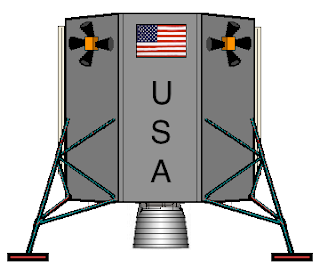
| Notional crewed ELV-3 on the surface of the Moon |
by Marcel F. Williams
During NASA's Constellation program, the American space agency chose Boeing's Altair concept as the landing vehicle design to return American astronauts to the surface of the Moon. As a two staged (descent and ascent) crew landing vehicle and as a single stage cargo landing vehicle, the Altair was supposed to be housed in the large payload fairing of the Ares V super heavy lift rocket. But in 2010, the Constellation program was canceled by the Obama administration, a decision that became law in April of 2011. And this ended the development of Ares V and Altair lunar landing vehicle.
 |
| Notional Altair crew landing vehicle (Credit: NASA) |
 |
| Notional Altair cargo landing vehicle (Credit: NASA) |
A year later, Congress began funding a new heavy lift program, the Space Launch System (SLS), while continuing to fund the development of the Orion component of the Constellation program. While there has been no significant Congressional funding for a lunar landing vehicle, a large variety of a vehicle concepts have been proposed to return American astronauts and cargo back to the lunar surface by several space companies.
 |
| 2.4 meter super lightweight cryotank (Credit: Boeing Aerospace) |
Here, I propose another reusable extraterrestrial cargo and crew landing vehicle (the ELV-3) concept that would be much simpler than Boeing's Altair vehicle. The ELV-3 would be launched by the SLS and utilized to deploy very large and heavy cargo or crews to the lunar surface. And with the addition of a HIAD or an ADEPT deceleration shield, the ELV-3 could also deploy largo cargoes and crew to the surface of Mars.
 |
| Notional ELV-3 lunar lander display retractable panel |
 |
| X-ray view of three tank configuration for ELV-3 |
 |
| View of ELV-3 radiator and side thrusters |
 |
| Top x-ray view of ELV-3 and its three tank configuration |
Technologically, the notional ELV-3 spacecraft proposed here would be a substantially simpler vehicle than Boeing's canceled Altair spacecraft. Instead of the Altair's descent vehicle's four liquid oxygen tanks accompanied by four liquid hydrogen tanks, the ELV-3 would have just two 2.4 meter in diameter hydrogen tanks plus one 2.4 meter in diameter liquid oxygen tank, all linear aligned within an octagonal shaped cruciform.
The problems associated with eight feedlines, differential tank pull due
to unuasable propellant, increased tank heating resulting from the
numerous tank penetrations, problems with pressure control during burns
and long coastal phases caused by the large number of tanks are
significantly reduced by reducing the cryotank numbers from eight down
to just three. Utilizing just three tanks also reduces the overall mass
of the tank weight.
Problems associated with the RL-10 exhaust plume just a few meters above
the lunar surface during landings could be alleviated by using side
thrusters positioned well above the surface. Additionally, the IVF (Integrated Vehicle Fluids) ullage gas fueled thrusters
could also be automatically extended outwards away from the side panels
(more than 8.4 meters in diameter) for exceptionally large payloads that
extend beyond the diameter of the octagonal panels.
While the deck of the ELV-3 would be approximately two meters higher
than the Altair, the ELV-3 would have the advantage of a substantial
amount of empty space on each side of the linear aligned propellant
tanks. Twin retractable wall panels on each side could accommodate a
rectangular cargo area at least 7.2 meters high by 2.2 meters by 2.8
meters.
ELV-3 - Cargo Lander
One 2.4 meter in diameter LOX tank
Two 2.4 meter in diameter LH2 tanks
IVF thrusters utilize ullage gasses
Dry mass: 8 tonnes
Propellant mass: 31 tonnes
Maximum cargo mass to lunar surface from NRO (Near Rectilinear Orbit): 30 tonnes
Maximum cargo mass to lunar surface from LLO: 39 tonnes
 |
| Twin mobile lunar cranes stored within the ELV-3 side cargo areas with additional cargo located at the top central area |
The large dimensions of the side cargo areas would also be able to
accommodate twin mobile lunar cranes with telescopic booms extending
well above the the top deck. Each electric powered crane would be
equipped with a cable hook for unloading large payloads and with cable
clamshells for digging up and redepositing lunar regolith. With each
mobile crane already weighing more than 12 tonnes, the deposition of
lunar regolith (weighing approximately 1.5 tonnes per square meter) into
the automatically expanded regolith bins of the other vehicle could
increase each crane's counter weight by more than 18 tonnes. This would
allow each mobile crane to be able to easily offload payloads on top of
the ELV-3 weighing nearly 30 tonnes. If devices are deployed to the
lunar surface to magnetically extract iron and other metallic dust from
the top ten centimeters of lunar regolith then the deposition of this
much heavy material into the regolith bins could easily increase the
counter weights of the mobile cranes by more than 100 tonnes.
 |
| Panel deployment of twin mobile lunar cranes |
The deployment of such mobile lunar cranes could, of course, be used
to unload and transport payloads from a variety of other lunar landing
cargo space craft.
 |
| Notional electric powered mobile lunar crane |
The clamshell crane could also be used
to deposit regolith within the surrounding walls of lunar habitats
providing the large multilevel pressurized habitats with appropriate
shielding against cosmic radiation (completely shielding the habitats
from the heavy nuclei component). Such regolith shielding could provide
the habitat with protection from micrometeorites and from the extreme
thermal fluctuations from the lunar environment.
 |
| Mobile lunar crane using its telescopic boom to lift a 20 tonne SLS propellant tank derived lunar habitat from the top of an ELV-3 cargo lander. The 20 tonne payload, of course, would weigh only one sixth as much on the lunar surface. |
The cargo version of the ELV-3 could also be utilized to transport large and heavy payloads to the martian surface if HIAD or ADEPT deceleration shields are utilized along with mobile cranes with lifting capabilities not too dissimilar to vehicles deployed to the lunar surface.
ELV-3 - Crew lander
Dry mass with mass with passengers, cargo, and radiation shielding: 16 tonnes
Maximum additional cargo to and from the lunar surface if able to refuel on the lunar surface:
14 tonnes
 |
| Notional ELV-3 crew landing vehicle |
As a crew vehicle, the ELV-3 would use three pressurized modules derived from Boeing's 2.4 meter in diameter tank technology. The centrally positioned module (passenger module) would be the heaviest since it would be internally heavily shielded to protect astronauts from the exceptionally deleterious heavy nuclei component of cosmic rays. This would add at least four tonnes of extra shielding weight to the passenger module relative to the similar sized command module and airlock on opposite sides of the passenger module. The passenger module would also serve as a storm shelter in case of a major solar event when the ELV-3 is moving through cis-lunar space.
Because of its weight and limited fuel (up to 31 tonnes of LOX/LH2 propellant), two vehicles would be required for round trip sortie missions
between NRO and the lunar surface. One ELV-3 would be used to transport the other ELV-3 and its crew to low lunar orbit while the crewed ELV-3 would land on the lunar surface and then return to lunar orbit after its mission where the orbiting ELV-3 would transport both vehicles back to NRO. So spacecraft such as the ULA's XEUS (up to 68 tonnes of LOX/LH2 propellant) and Lockheed Martin's MADV (80 tonnes of LOX/LH2 propellant) would be much more capable than the ELV-3 as a crew launch vehicle for sortie missions since only one vehicle is required for sortie missions originating from NRO.
However, once propellant producing depots
are deployed to the lunar surface, only one ELV-3 vehicle would be required to transport crews between the Earth-Moon Lagrange points and the lunar surface and back. Additionally, the crewed versions of the ELV-3 would have a major advantage by being able to transport both astronauts plus more than 14 tonnes of additional payload to and from the lunar surface when fully fueled.
 |
| After a side panel is deployed, astronauts ride an electric powered scissor lift down towards the lunar surface |
If propellant producing water depots are deployed at LEO and NRO, the ELV-3 could also be used transport crews between LEO and NRO. This would provide NASA and private commercial space transportation companies with an alternate means from LEO to the Lagrange points.
Utilizing its side cargo areas, an unmanned ELV-3 could also be used to deploy a multitude of mobile robots
to the surfaces the Moon, the moons of Mars (Deimos and Phobos), to the
moons of Jupiter (Io, Ganymede, Europa, and Callisto), and even to the
surfaces of some of the the largest asteroids in the asteroid belt (Ceres,
Vesta, Pallas, etc.).
Links and References
Robust Lunar Exploration Using an Efficient Lunar Lander Derived from Existing Upper Stages
Altair spacecraft
Tanks for a Great Idea
Game Changing Propellant Tank
2.4 meter composite cryogenic tank at Boeing Developmental Center